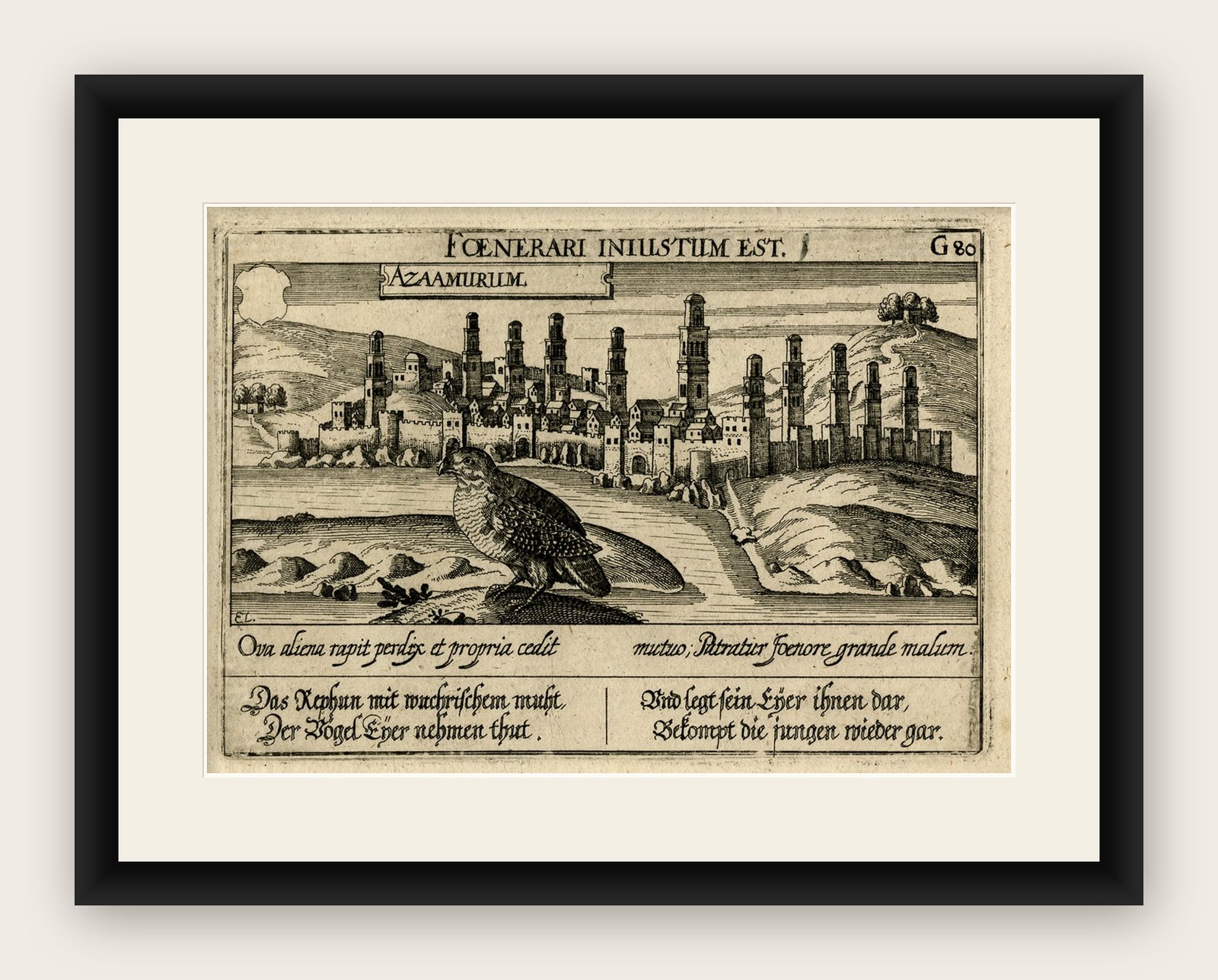
Old Print of a Partridge in Front of The Walled City of Azemmour, Morocco, c1630
€ 320
Original antique · The actual sheet photographed · Certificate of authenticity on request · Sold unframed · Worldwide shipping from € 15 (rates)
Sheet size
15.2 × 19 cm (6.0 × 7.5 in)
Reference
PCT-56699
What the condition grades mean
Excellent
Bright and clean, with no faults worth mentioning.
Very good
Only light signs of age, such as faint toning.
Good
Normal signs of age for a sheet of this period: toning, some foxing, small marks or neat old repairs.
Fair
Clear faults such as staining, tears or repairs, priced to match.
Every fault we see is written in the condition note, and the whole sheet is shown uncropped in the photos.
Condition
Very good, given age. Ample margins. Some faint soiling in the lower right margin. Left margin uneven. General age-related toning and/or occasional minor defects from handling. Please study scan carefully.
About this sheet
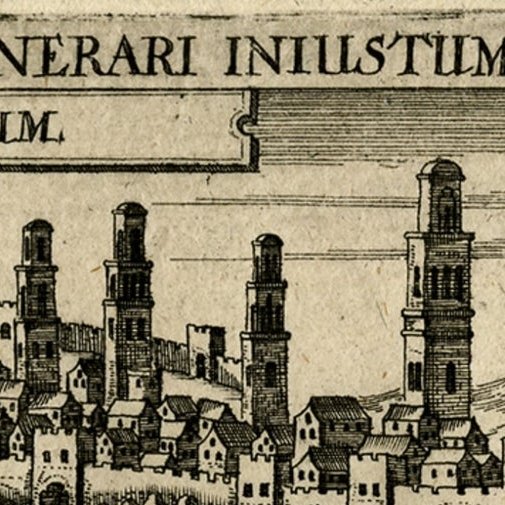
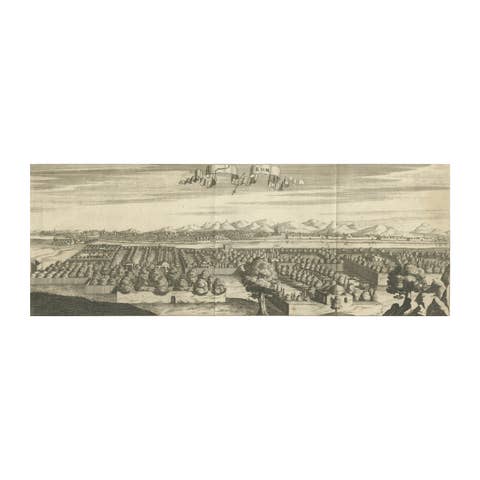
Antique print, titled: 'Azaamurum.' - Caption in the top reads: 'Foenerari iniustum est'.
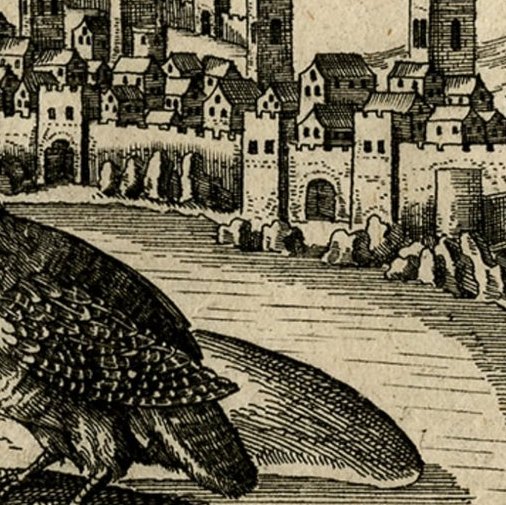
A partridge in the foreground, with the walled city (Azemmour in Morocco) behind.
From: 'Thesauri Philo-Politici' / 'Thesaurus Philopoliticus' / 'Politisches Schatzkastleins'. This work was originally created in the period 1623-1632 and consisted of 16 parts, first published separately and then together in 2 books of 8 parts ea. Altogether it had 830 prints. Later editions were published in 1637-1638 by Paul Furst (titled 'Sciographia Cormica') and in 1678 by his widow (titled:'Sciagraphia Cosmica'). Complete editions are scarse. The primary objective was the poetry and accompanying emblems with a moralising symbolism. The city views were secondary and mainly served for decoration. There is no particular tie between the poetry and the city. The city views were mostly engraved after popular engravings at the time from the works of Guicciardini, Braun/Hogenberg, Munster and others. The Poetry consists of a aphorism or theme in German or Latin at the top, a 2 line relating poem in Latin below the image and a 4 line relating poem in German below. In the engravings there is always a foreground which illustrates the theme and a city view in the background.
Artists and engravers: Authors: Daniel Meisner and Eberhart Kieser. The authors of this work are Daniel Meisner (1585-1625) and Eberhart Kieser (1583-1631). Meisner was a Bohemian / German poet. Kieser a German publisher and engraver. Kieser probably engraved some of the plates himself, but he also used other well known engravers: Sebastian Furck, Georg Keller, Johann Eckard Loffler and Matthias Merian the elder.