About this sheet
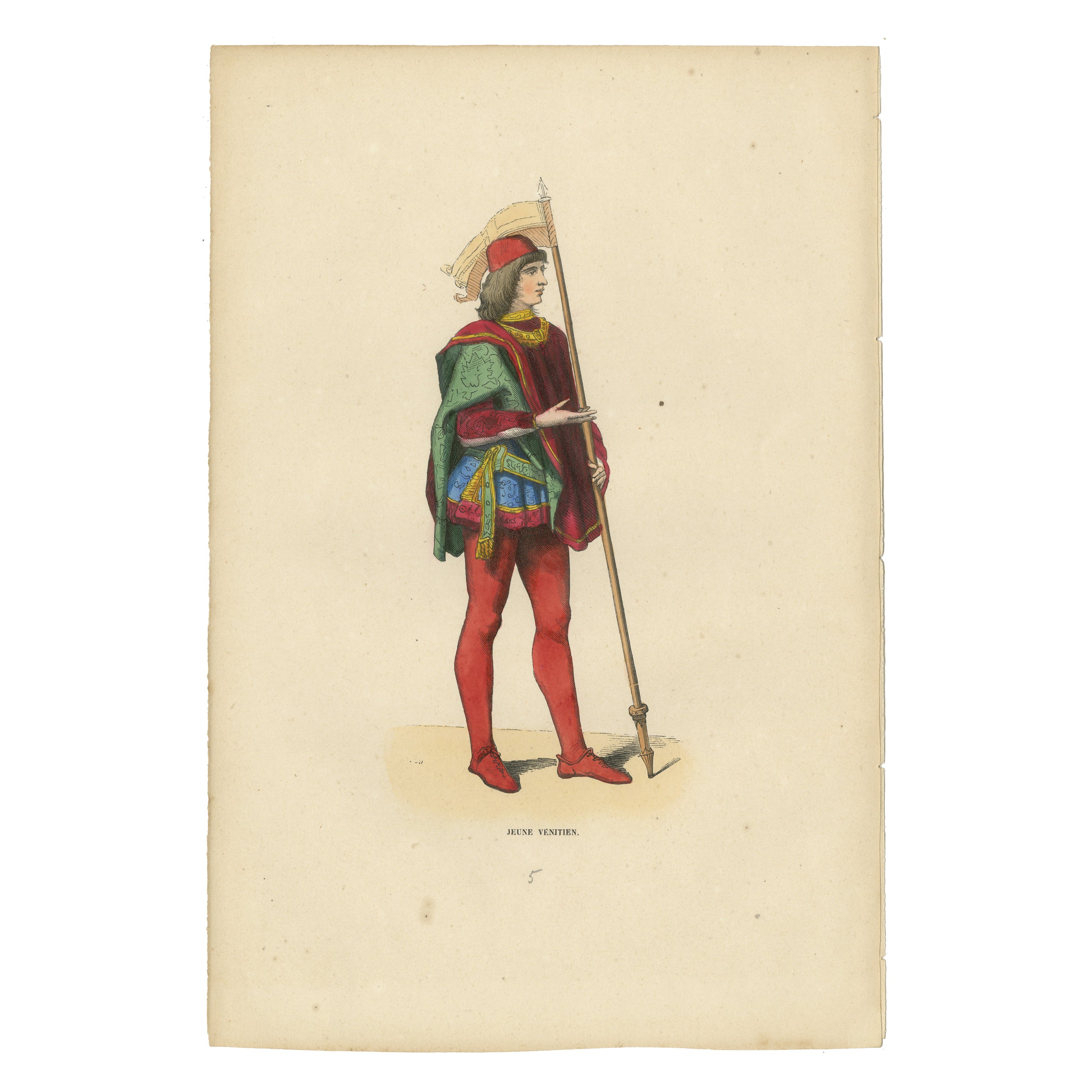
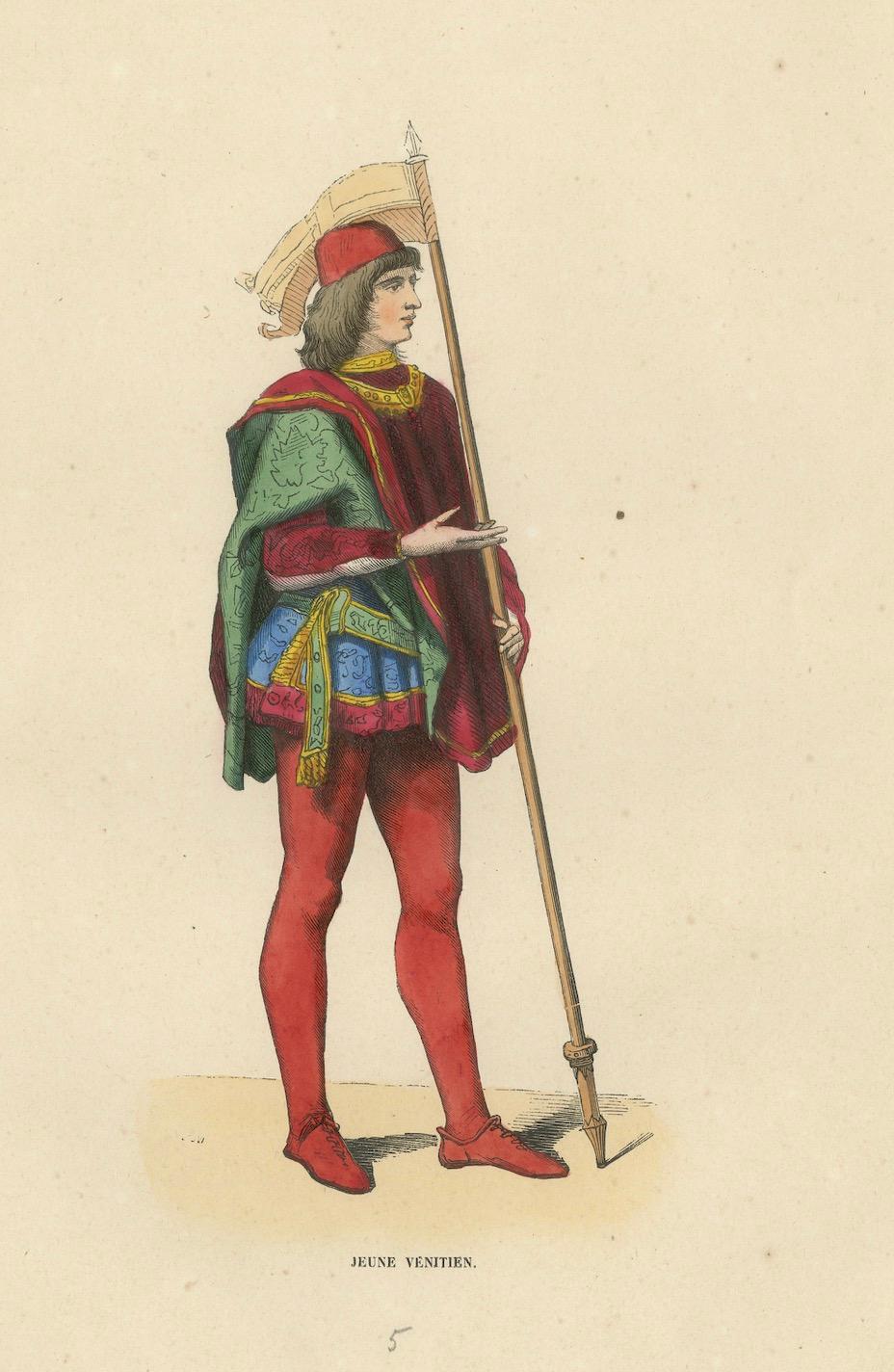
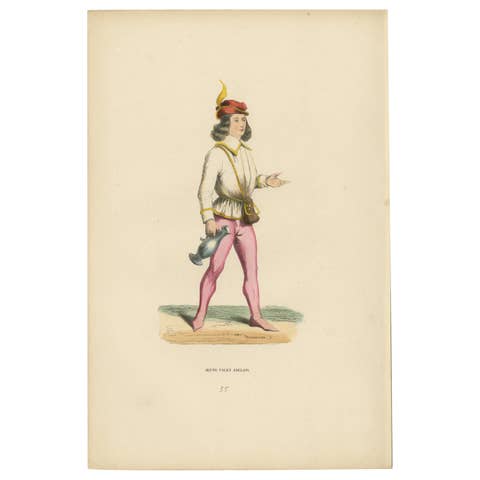
This original antique print depicts a young Venetian man, as indicated by the caption "Jeune Vénitien," which translates to "Young Venetian" from French.
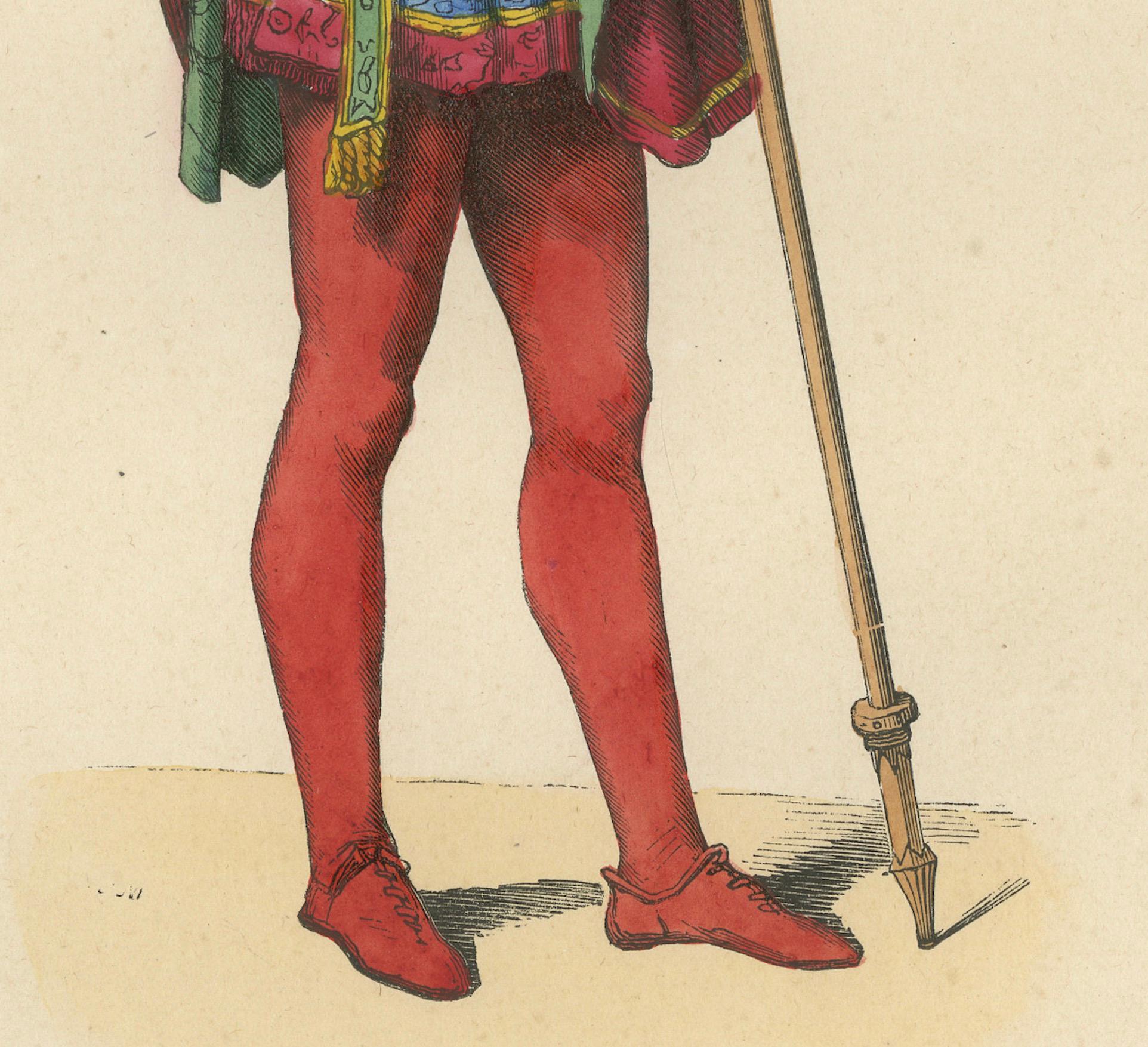
The young man is dressed in clothing that suggests a high status, possibly a noble or a wealthy merchant's attire from the Venetian Republic during the Middle Ages. He is wearing tight red hose, a common garment in medieval European fashion for men, which shows the shape of the legs clearly. Over this, he wears a decorative doublet or tunic with elaborate patterns and what appears to be embroidery or brocade, common in upper-class fashion of the time. The doublet has a green base with a heraldic design prominently displayed.
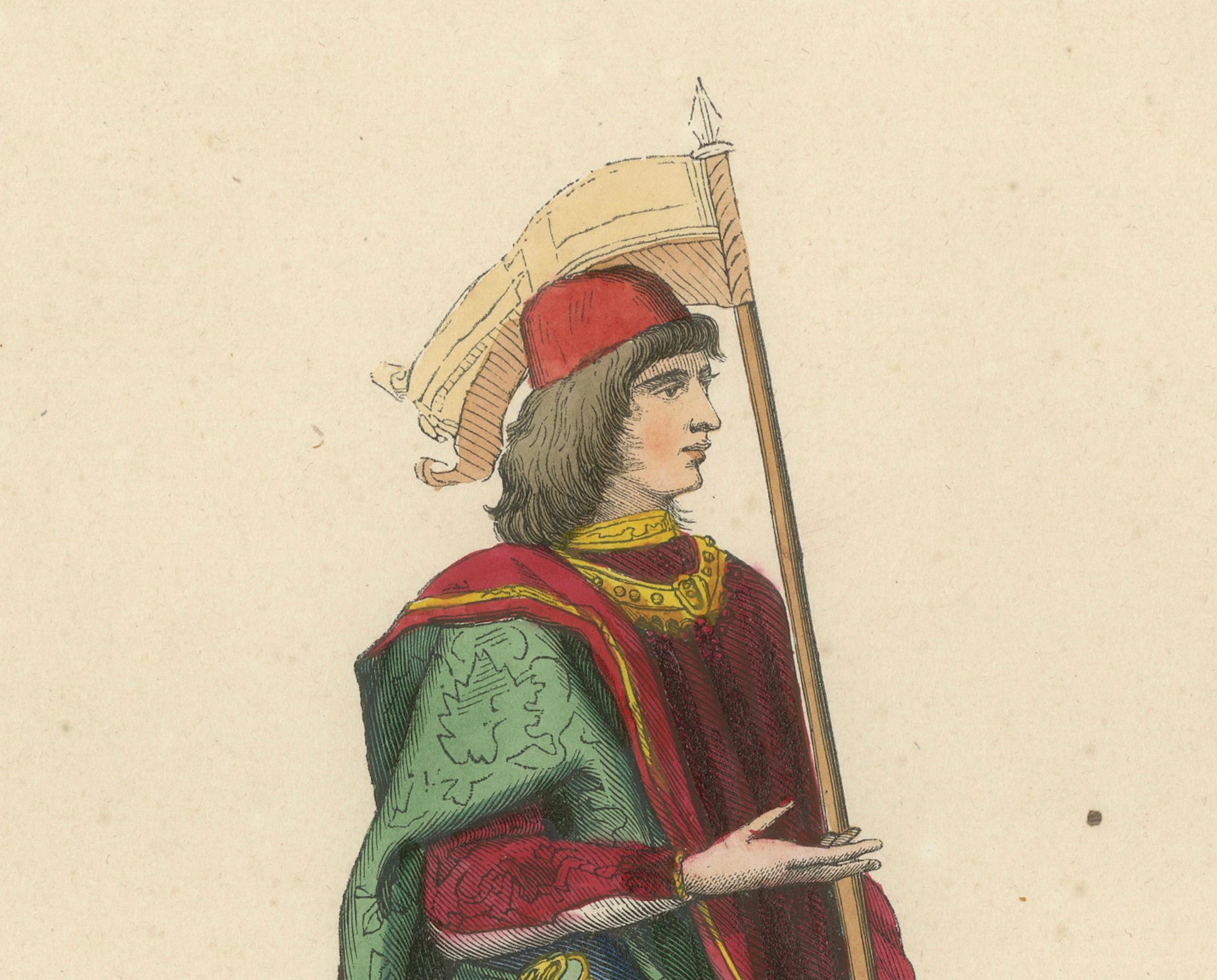
His shoulders are draped with a cape or cloak that is green on the outside and lined with a patterned fabric, and he has a gold chain around his neck, which was a symbol of wealth and status. His hat is distinctive and elaborate, with a conical shape and what looks like a structured brim, which reflects the unique and often extravagant fashion of the Venetian nobility.
In his hand, he holds a long spear or staff, which could be a ceremonial item or a signifier of his role or office within Venetian society. His posture is upright and poised, suggesting confidence and nobility.
The quality of the print is with bright colors and fine detail that have been well-preserved. The paper shows slight signs of aging but overall, the print is in good condition, indicating it has been well cared for over the years.
The colors have a nice glow over them. Historically, egg whites, known as glair, and sometimes egg yolk were indeed used in illumination and painting, particularly in manuscripts, to give colors a brighter appearance and to add a sheen or gloss to the work. This technique was quite common during the Middle Ages and into the Renaissance.
Egg whites can be applied as a varnish over pigments to enhance their brightness and to protect the colors. This application could make the colors appear more vivid and also add a slight glossy sheen to the surface of the image.
Egg yolk, on the other hand, was commonly used as a binding agent in paint. It forms the basis of tempera paint, a medium that was widely used before the advent of oil painting. Egg yolk helps to create a durable and long-lasting color that adheres well to various surfaces.
In the context of the print from 1847, it's less likely that egg whites or yolks were used directly on the print, as by that time, commercial printing processes would have been more advanced and less reliant on such manual methods. However, if this print is a representation of an earlier style or is meant to mimic the appearance of hand-painted manuscripts, the original artists might have employed techniques or materials that gave a similar effect to those achieved with egg-based binders and varnishes.