About this sheet
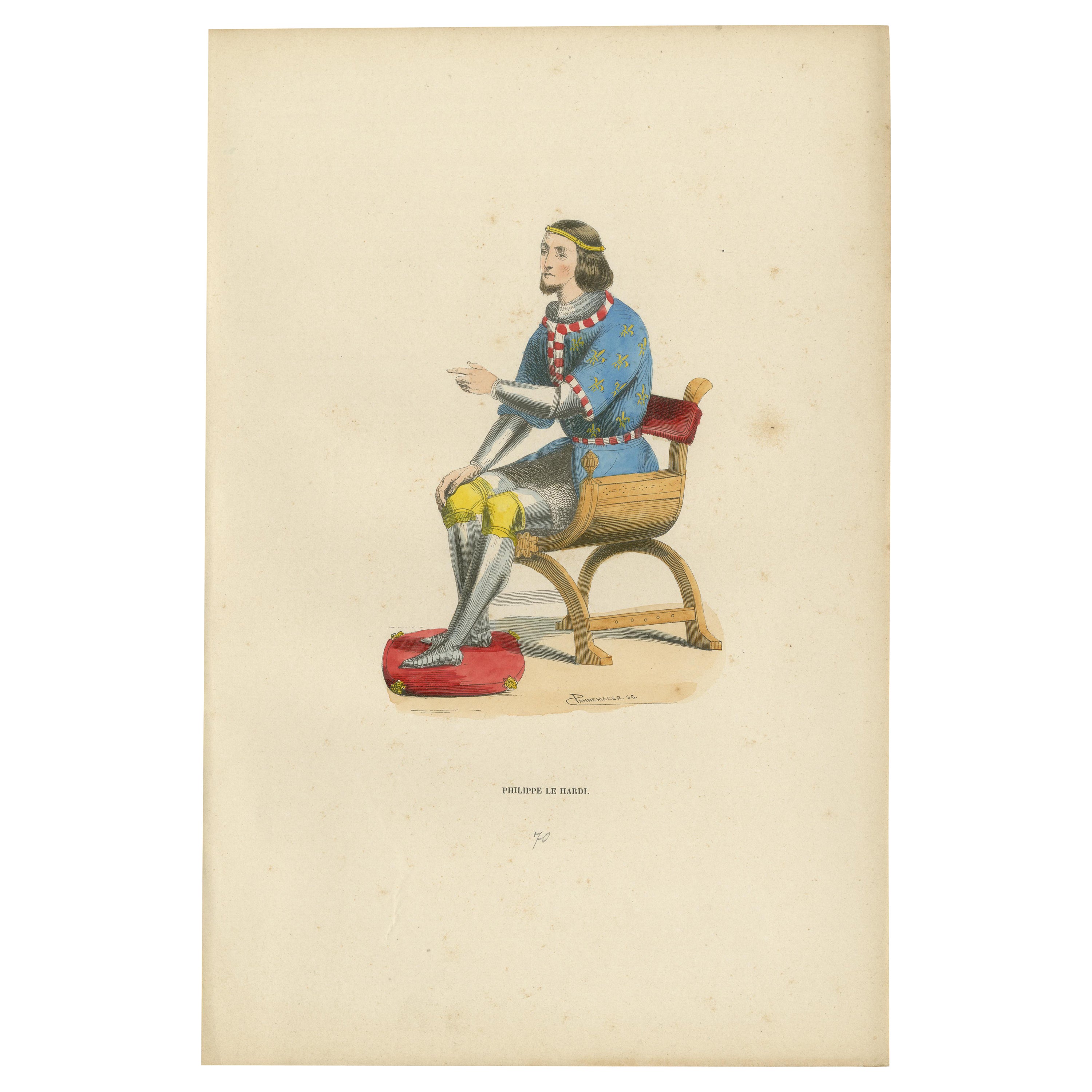
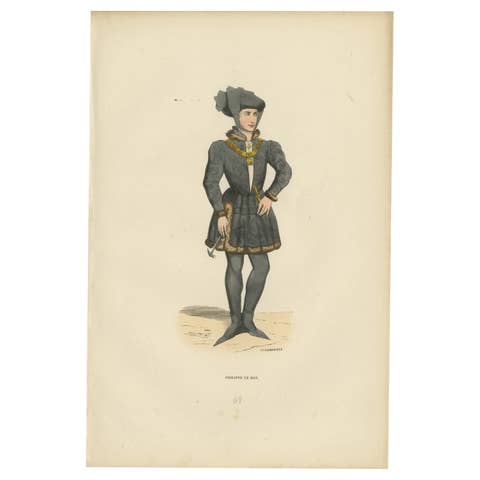
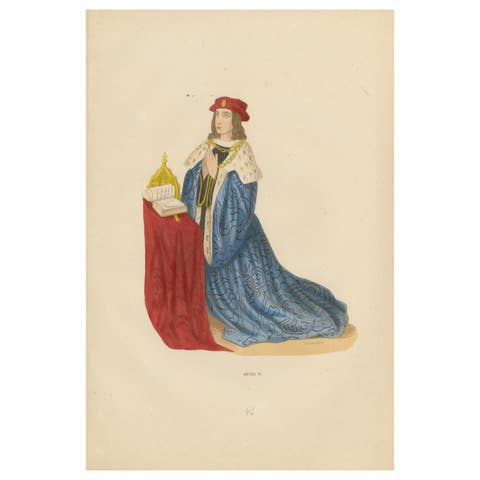
This print captures Philippe le Hardi, also known as Philip the Bold, Duke of Burgundy, seated in a posture of consultation or leadership. He is depicted in the midst of governance or decision-making, a role befitting his historical reputation as a founder of the Burgundian state.
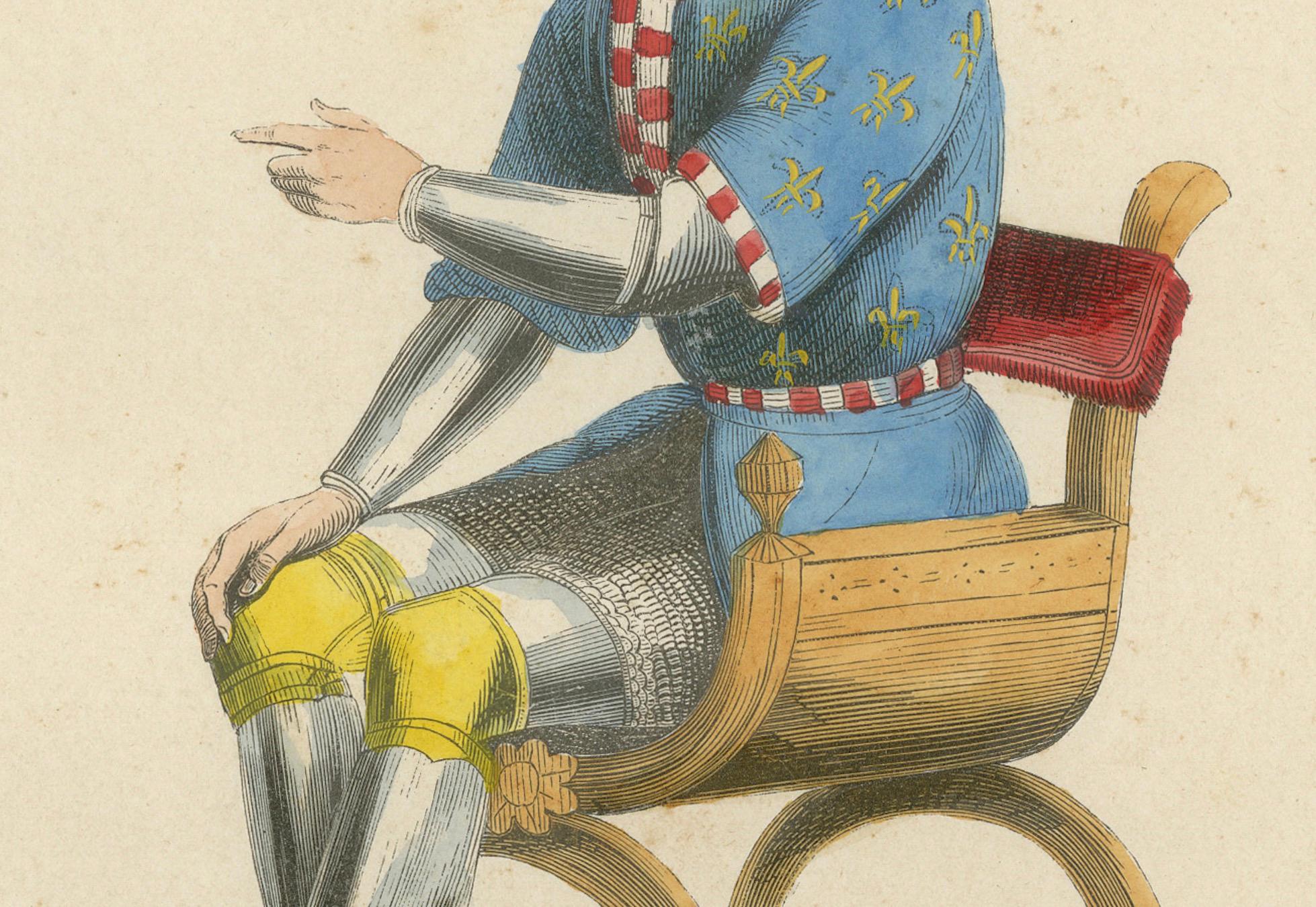
The Duke is attired in a blue doublet emblazoned with golden fleur-de-lis, a symbol of his connection to the French royal lineage. The doublet is tailored to his form, suggesting the refined tastes of Burgundian court fashion. The edges of the doublet feature a decorative border, adding to the noble appearance.
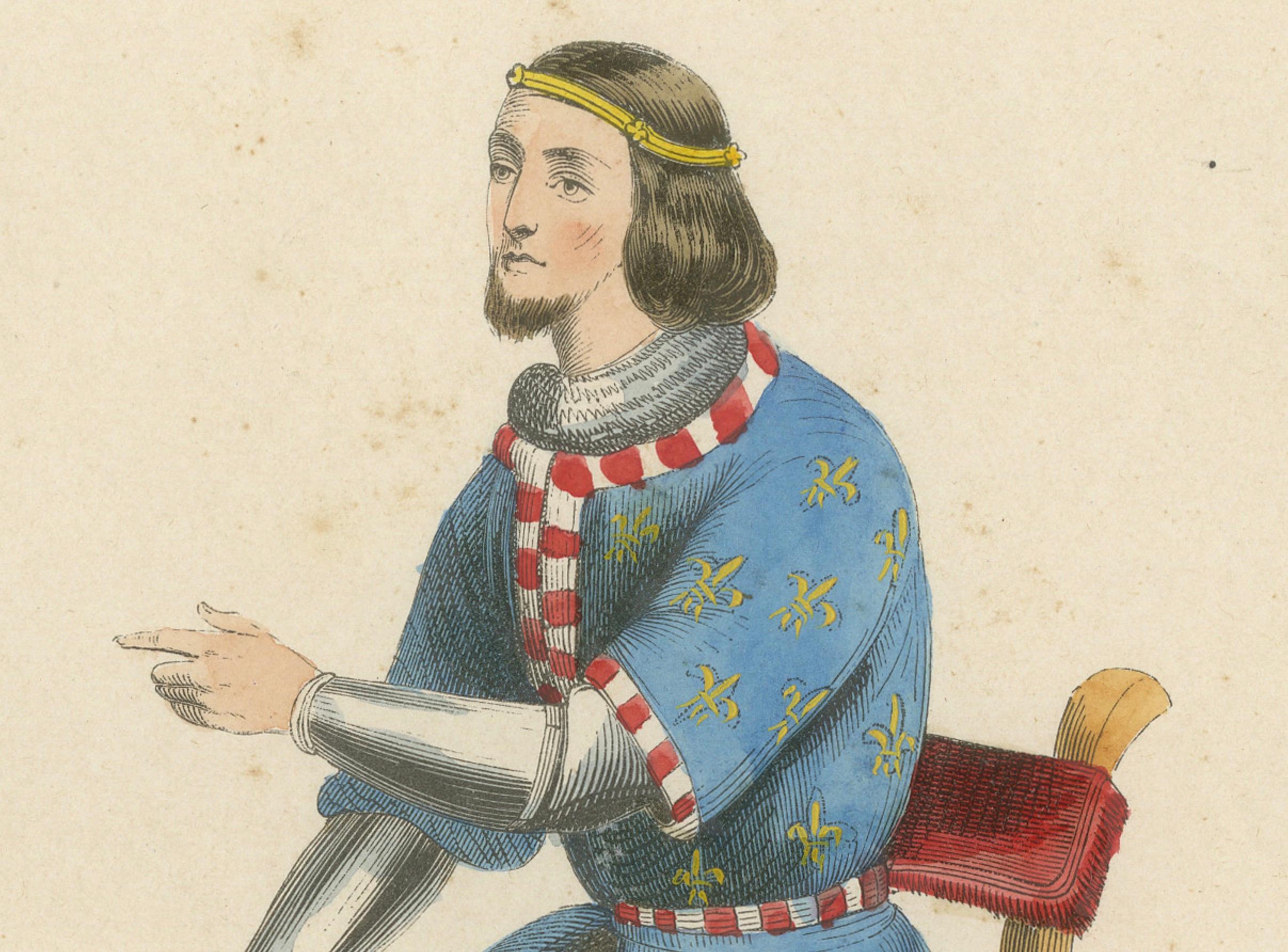
He wears a red and white striped chaperon, a stylish head covering for men of the period, which features a twisted scarf around the crown, indicative of his high social status. The chaperon complements his doublet with its own hint of golden embellishment.
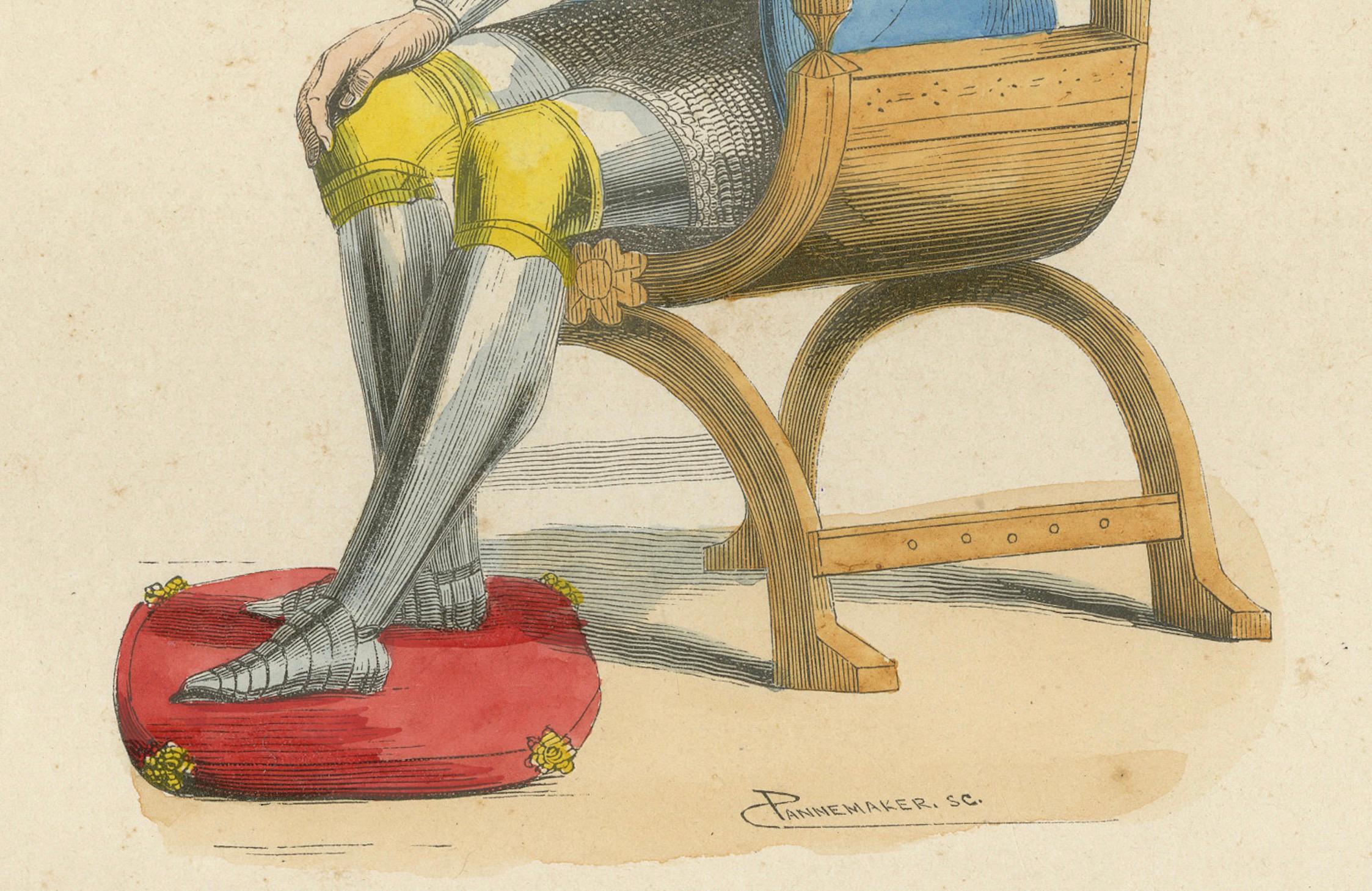
His hose are striped in yellow and black, providing a striking contrast to the blue of his doublet. This choice of colors may reflect the heraldic colors of his house. The red footrest under his feet is a rich detail that adds a note of luxury and comfort.
Philippe's right hand is slightly extended as if in mid-gesture, perhaps making a point or issuing an order, while his left hand rests on his knee, grounding him in his authoritative position. His expression is one of contemplative leadership, and his eyes appear to be focused on an unseen interlocutor or thought.
This portrayal of Philippe le Hardi encapsulates the image of a duke actively involved in the arts of rulership and diplomacy that characterized the governance style of the powerful Burgundian dukes during the late Middle Ages.
The colors have a nice glow over them. Historically, egg whites, known as glair, and sometimes egg yolk were indeed used in illumination and painting, particularly in manuscripts, to give colors a brighter appearance and to add a sheen or gloss to the work. This technique was quite common during the Middle Ages and into the Renaissance.
Egg whites can be applied as a varnish over pigments to enhance their brightness and to protect the colors. This application could make the colors appear more vivid and also add a slight glossy sheen to the surface of the image.
Egg yolk, on the other hand, was commonly used as a binding agent in paint. It forms the basis of tempera paint, a medium that was widely used before the advent of oil painting. Egg yolk helps to create a durable and long-lasting color that adheres well to various surfaces.
In the context of the print from 1847, it's less likely that egg whites or yolks were used directly on the print, as by that time, commercial printing processes would have been more advanced and less reliant on such manual methods. However, if this print is a representation of an earlier style or is meant to mimic the appearance of hand-painted manuscripts, the original artists might have employed techniques or materials that gave a similar effect to those achieved with egg-based binders and varnishes.