1930s AM Radio Map of US, Canada, Cuba, Mexico – Stations & Frequencies
€ 990
Original antique · The actual sheet photographed · Certificate of authenticity on request · Sold unframed · Worldwide shipping from € 15 (rates)
Sheet size
69.6 × 85.1 cm (27.4 × 33.5 in)
Condition
Fair
What the condition grades mean
Excellent
Bright and clean, with no faults worth mentioning.
Very good
Only light signs of age, such as faint toning.
Good
Normal signs of age for a sheet of this period: toning, some foxing, small marks or neat old repairs.
Fair
Clear faults such as staining, tears or repairs, priced to match.
Every fault we see is written in the condition note, and the whole sheet is shown uncropped in the photos.
Condition
Repaired: archival repairs to a few small edge tears and numerous short fold separations with some minor loss at the fold junctions. Fair condtion. Issued folding with archival repairs to a few small edge tears and numerous short fold separations with some minor loss at the fold junctions. There.
About this sheet
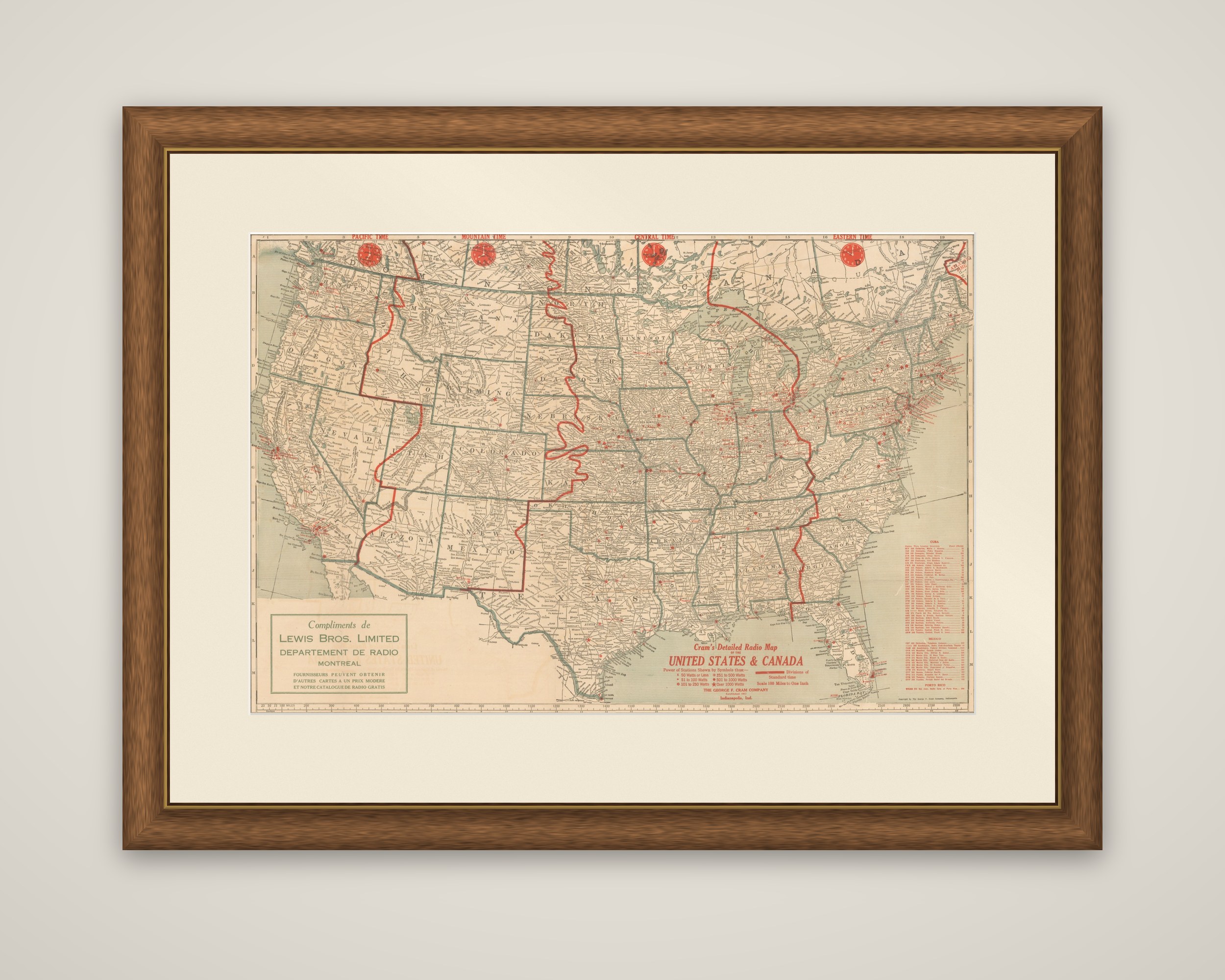
Radio stations of the United States and southern Canada on a large printed map titled "Cram's Detailed Radio Map of the United States & Canada", issued by The George F. Cram Company of Indianapolis, with a corner panel reading "Compliments de Lewis Bros. Limited, Département de Radio, Montréal". The date is given as the 1930s. The sheet is a color-printed map with red overprint.
The map shows the states and provinces with their borders, rivers and principal cities in pale tones, and the red overprint marks the broadcasting stations as small dots and the boundaries of the time zones as heavy lines, with a clock face at the head of each zone labeled Pacific, Mountain, Central and Eastern Time. A key in the lower margin groups the stations by power. Station listings with call letters, frequencies and locations run in tight columns down the right margin, and the lower left carries the Montreal firm's panel, which in French offers other maps at modest cost and a free radio catalog.
As a document of early broadcasting, the sheet records where commercial radio stood in the days of the AM dial, when stations were found by their call letters and location.