About this sheet
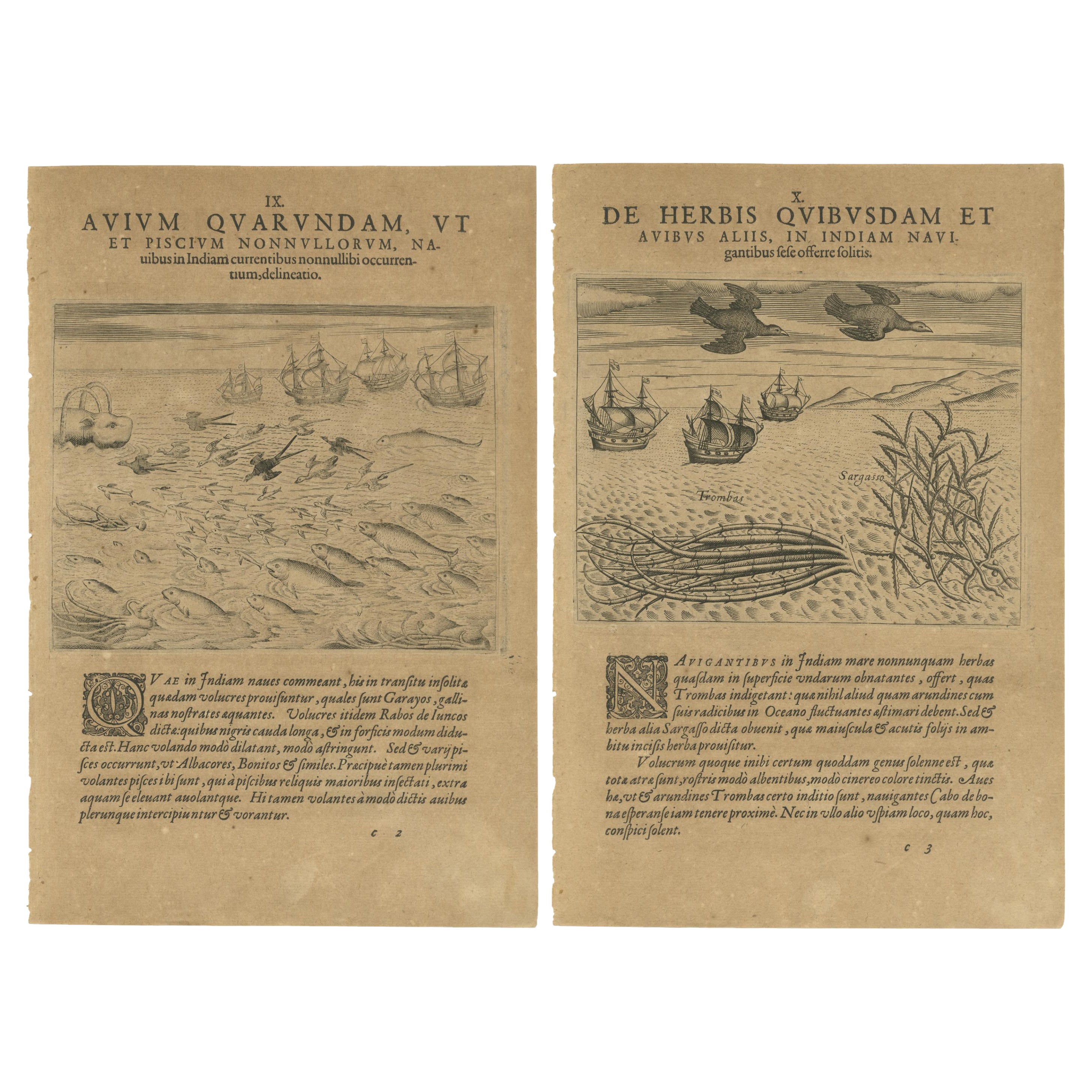
This pair of original antique engravings, published in 1601 by the famed engraver Theodore de Bry, showcases the rich tapestry of marine life and flora encountered by explorers in the Indian Ocean during the Age of Discovery.
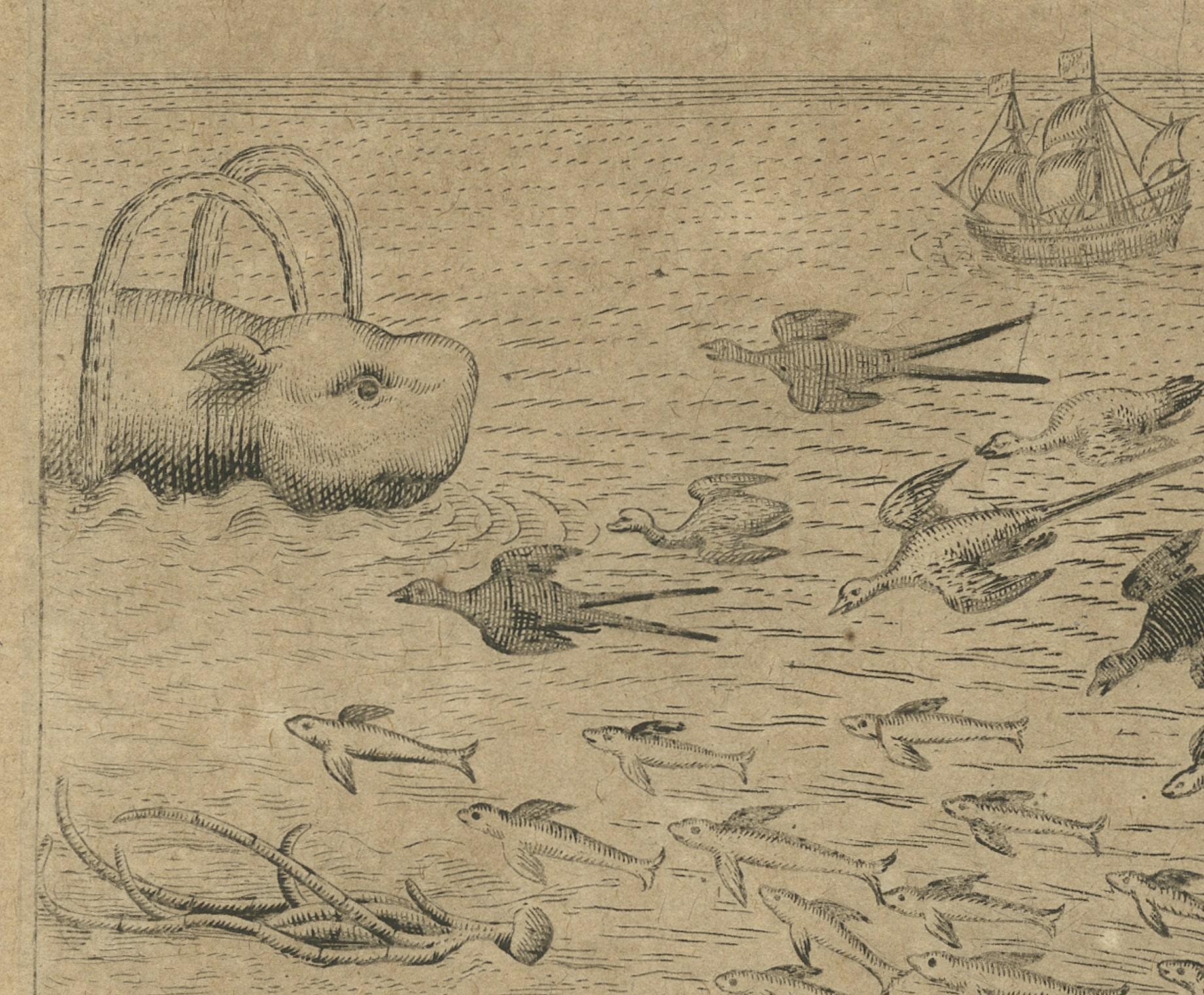
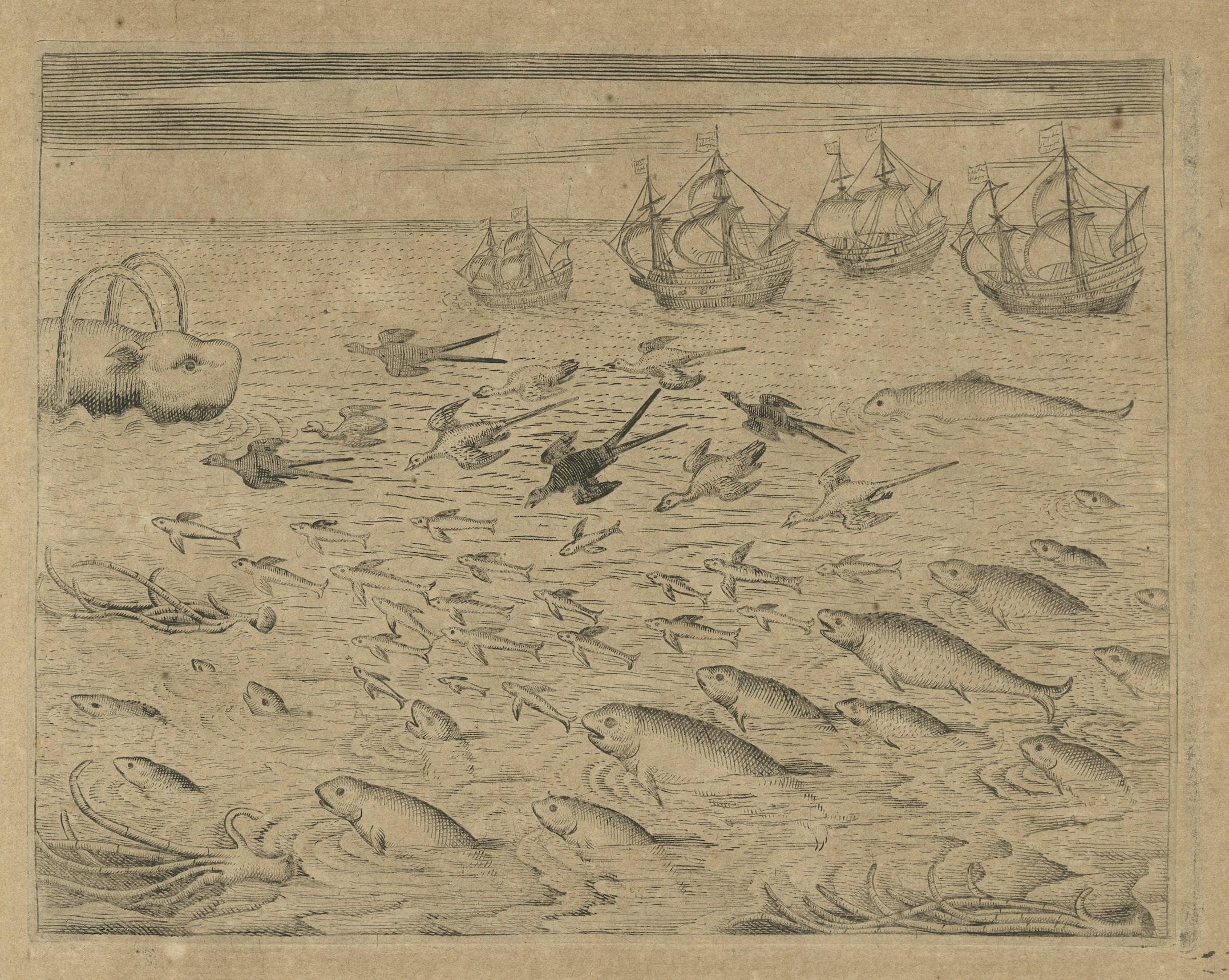
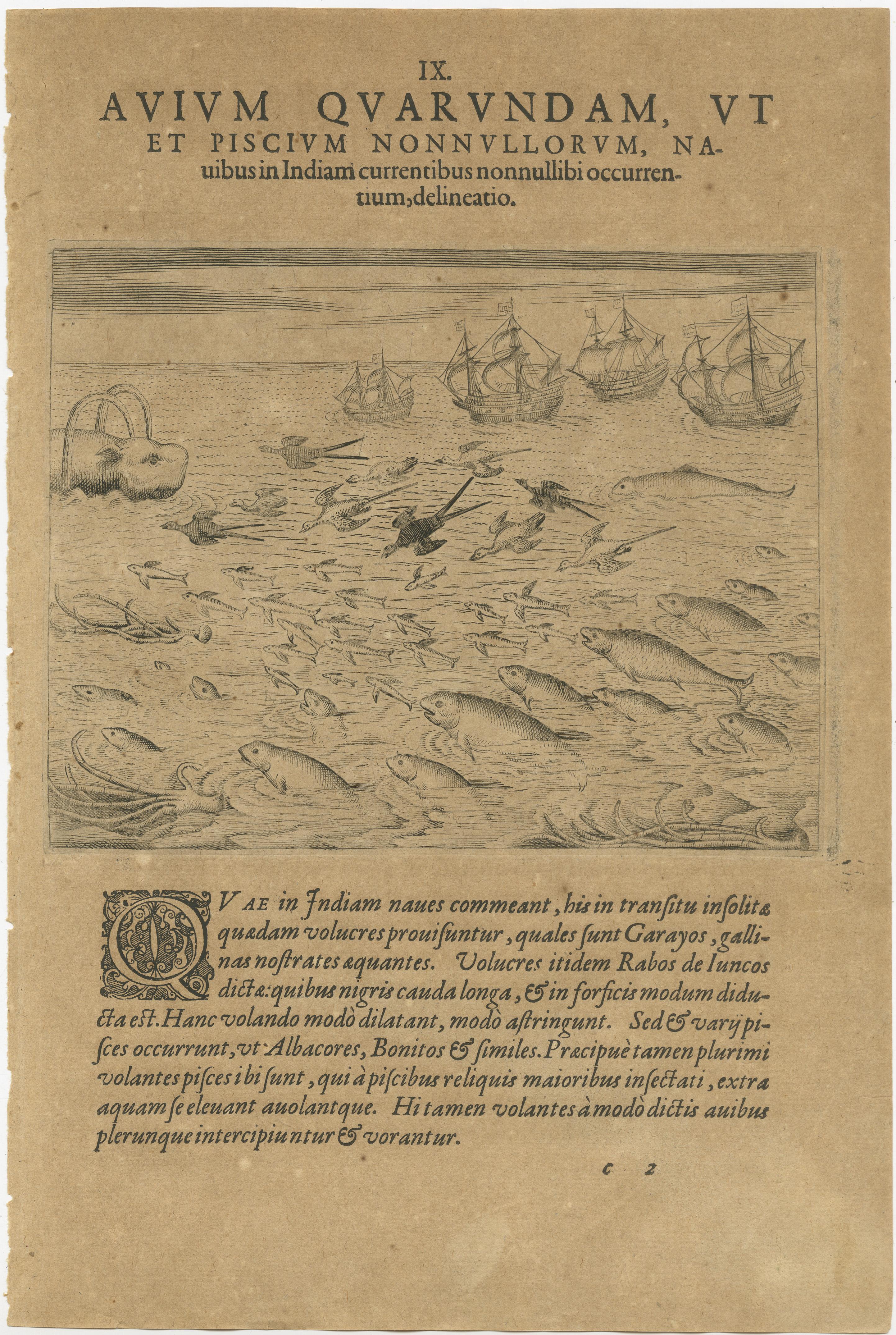
The first engraving vividly depicts a variety of fish and birds, some of which were likely seen for the first time by European eyes, capturing their forms with a blend of artistic interpretation and naturalistic detail.
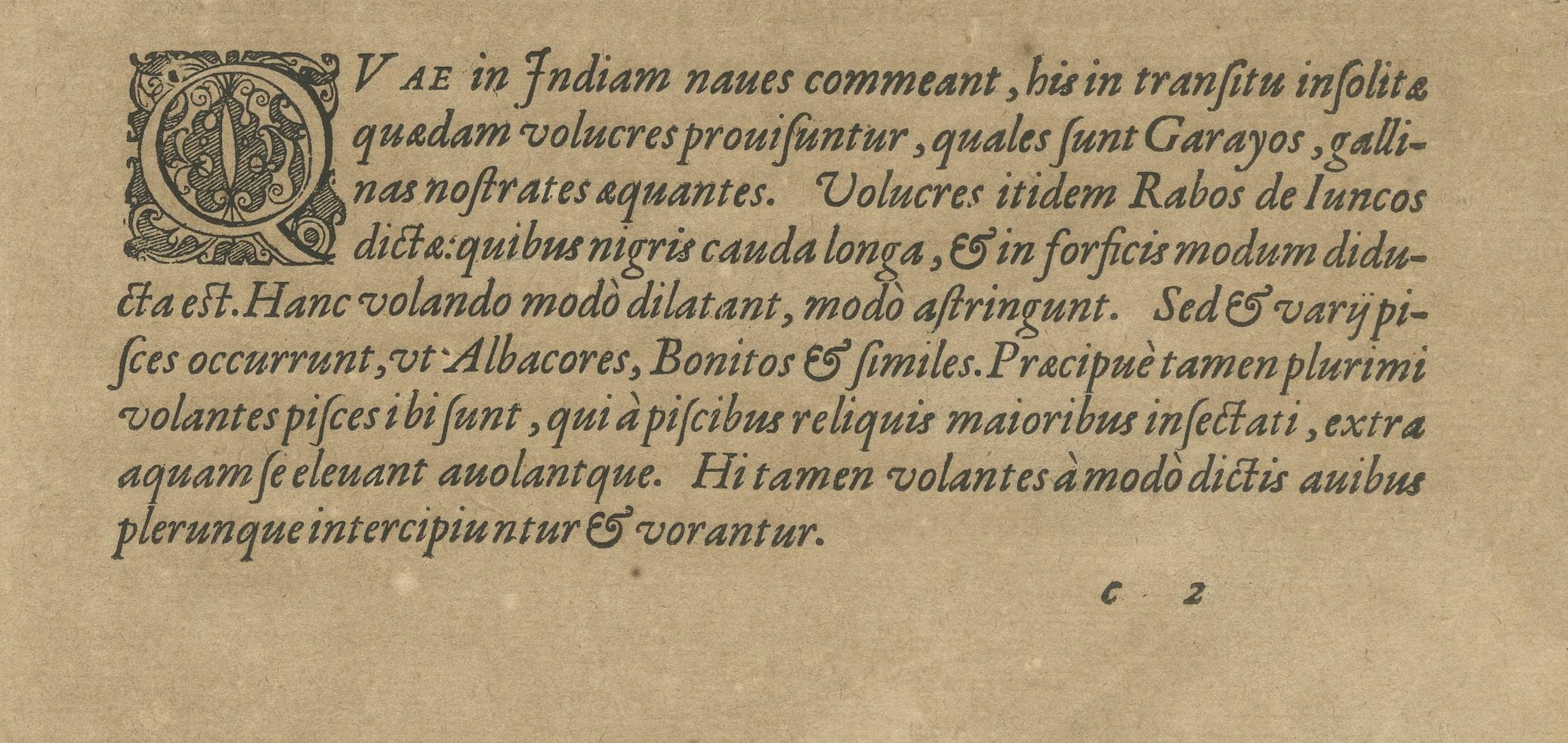
The text provided is in Latin. Here is the English translation:
"When sailing to India, some birds are observed, which are called Garayos, following our ships. These birds, called Rabos de junco, have a long black tail, and their body is quite extended. They fly now dilating, now contracting themselves. But there are various fishes, like Albacores, Bonitos, and the like. However, most of them are flying fish, which, being larger than the rest, when they set themselves out of the water, they fly away. Yet often while flying they are caught by the aforementioned birds and eaten."
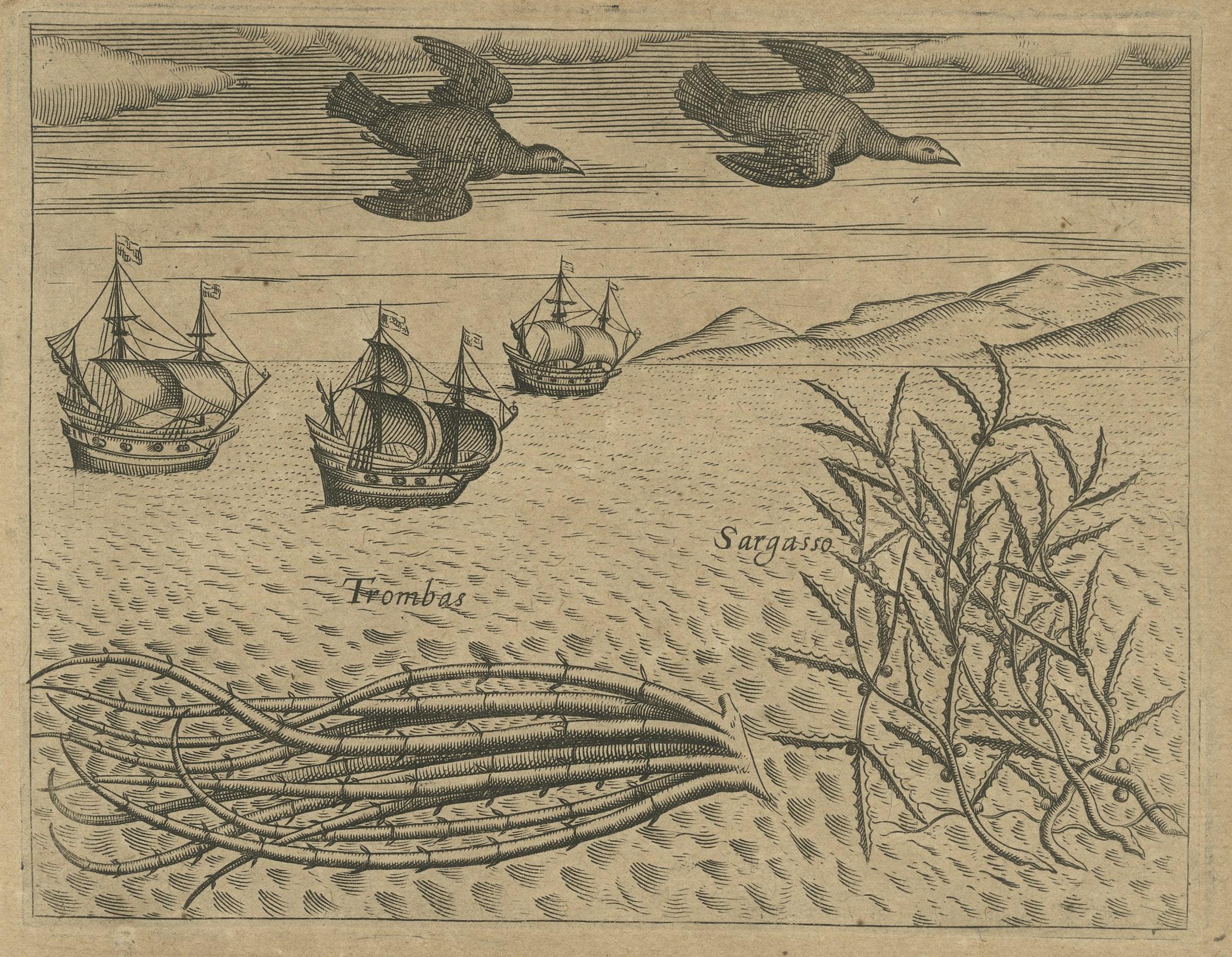
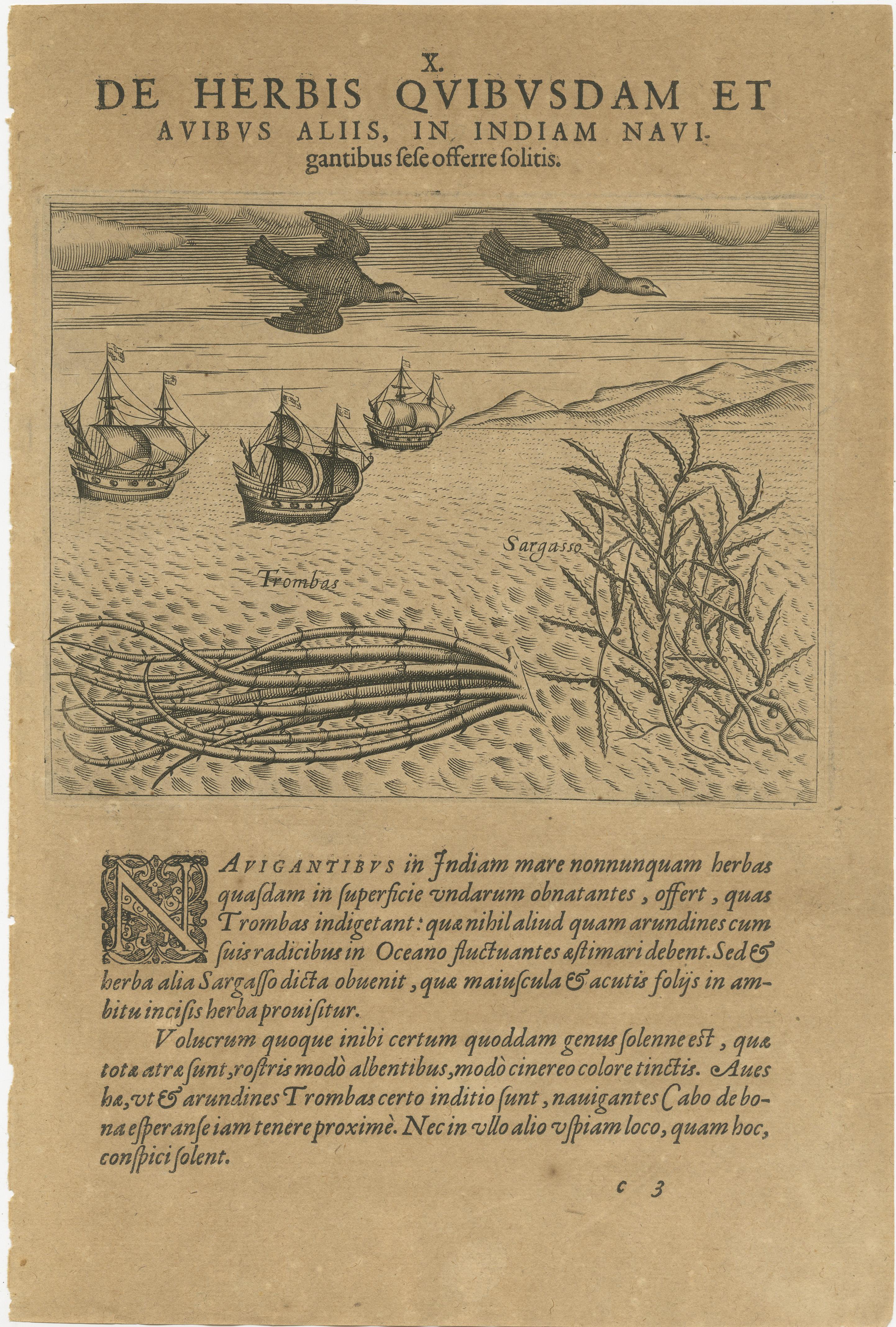
The second engraving offers a detailed look at the aquatic plants and birds in flight, highlighting the Sargasso seaweed that was noted for floating en masse on the ocean's surface.
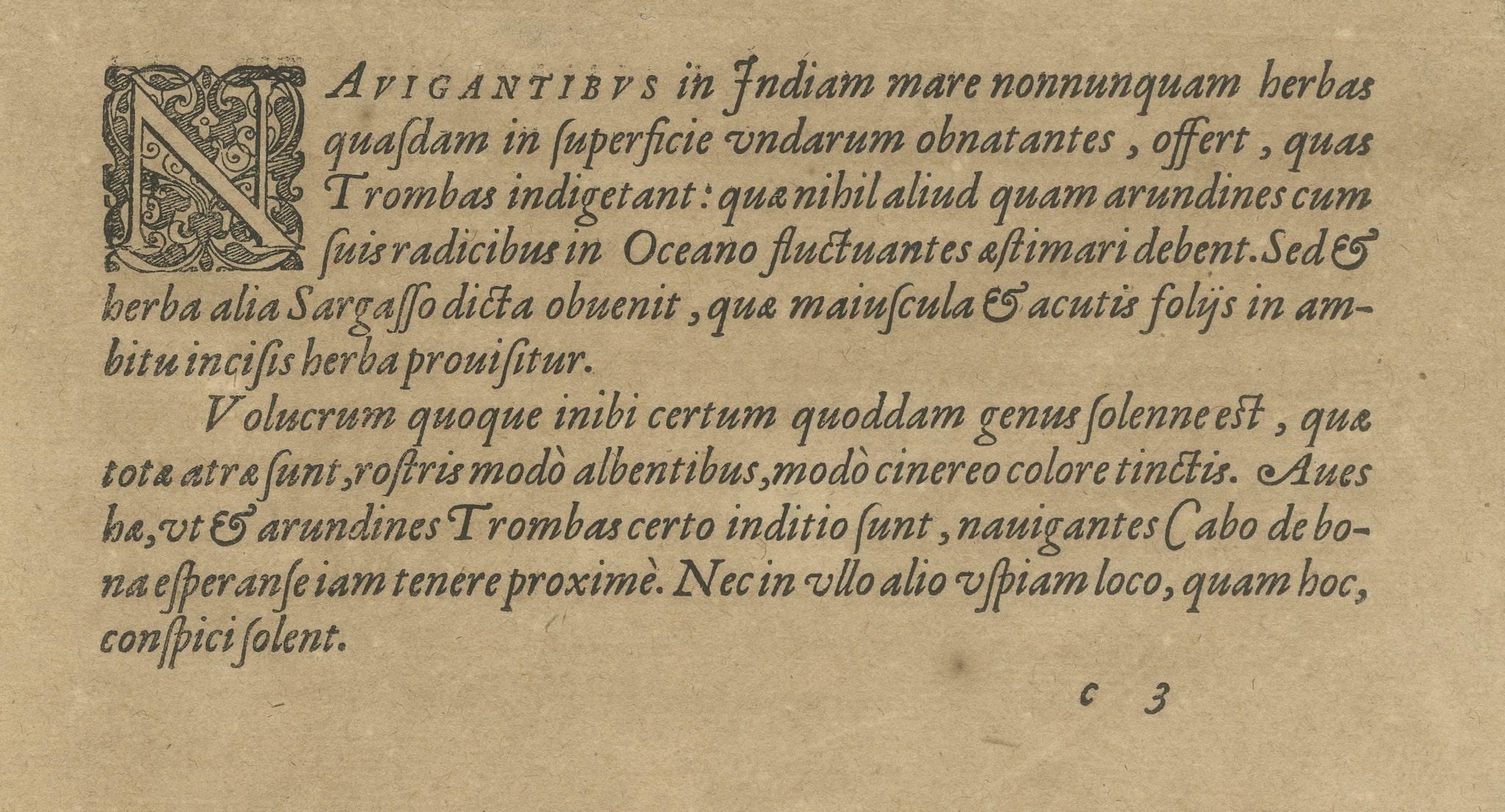
The provided image contains a text in Latin. Here is the English translation:
"Sailors navigating to the Indian Sea occasionally encounter certain herbs floating on the surface of the waves, which they call 'Trombas' suggesting nothing other than reeds with their roots, which must be assumed to float in the Ocean. But another herb called 'Sargasso' is obtained, which has a dense clump and sharp leaves cut into bits.
There is also a certain kind of solemn bird that inhabits there, which are entirely black, sometimes with a whitish color, sometimes with a gray hue. Birds like these reeds Trombas are known to dwell near the Cape of Good Hope and are said to hold proximity. And in no other place, as far as we know, are they usually seen to be completed."
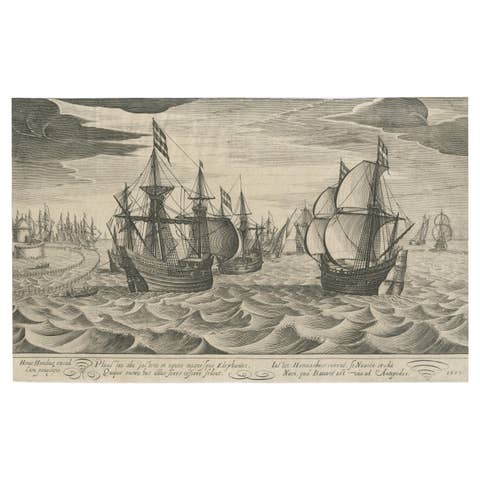
Both works are from De Bry's renowned collection documenting the new and exotic discoveries of the East Indies, as reported by travelers and explorers of the era. These engravings not only served as a visual record of these voyages but also as a means to satisfy and ignite the European imagination with depictions of the distant and wondrous natural world. The precise linework and careful composition of these engravings reflect De Bry's skill in bringing to life the wonders of uncharted territories.
These pieces represent a confluence of art, exploration, and science at a time when every new discovery had the potential to challenge and expand the known boundaries of the world. They are a testament to the enduring human spirit of curiosity and the desire to document and share knowledge across continents and cultures. As such, these engravings are not only valuable for their historical and artistic merit but also as cultural artifacts that narrate the story of our collective quest for understanding and connection.
This piece forms part of a larger corpus of works produced under the supervision of the de Bry family, a lineage of renowned engravers and publishers based in Frankfurt. Initiated by Theodore de Bry in 1590, this series aimed to visually document the epoch of European global exploration and the encounters with the natural world that ensued.
The engraving is a page from Part IV of de Bry's "Petits Voyages," which narrates significant expeditions to the East Indies, including those led by Jan Juygen van Linschoten and Cornelis de Houtman between 1595-97, as well as the journey by Jacob van Neck and Wybrandt van Warwijck in 1598-99. These works were not merely artistic endeavors but also ethnographic records, showcasing indigenous peoples, fauna, flora, and the diverse riches of lands like India, Madagascar, and the East Indies.
Though Theodore de Bry began this ambitious project, it was continued posthumously by his family and later completed by his son-in-law, Matthaus Merian, in 1644. This particular engraving, rich in detail and drama, offers a window into the perilous and wondrous experiences of early explorers, and the ways in which these moments were captured and communicated to a European audience hungry for knowledge of the wider world.