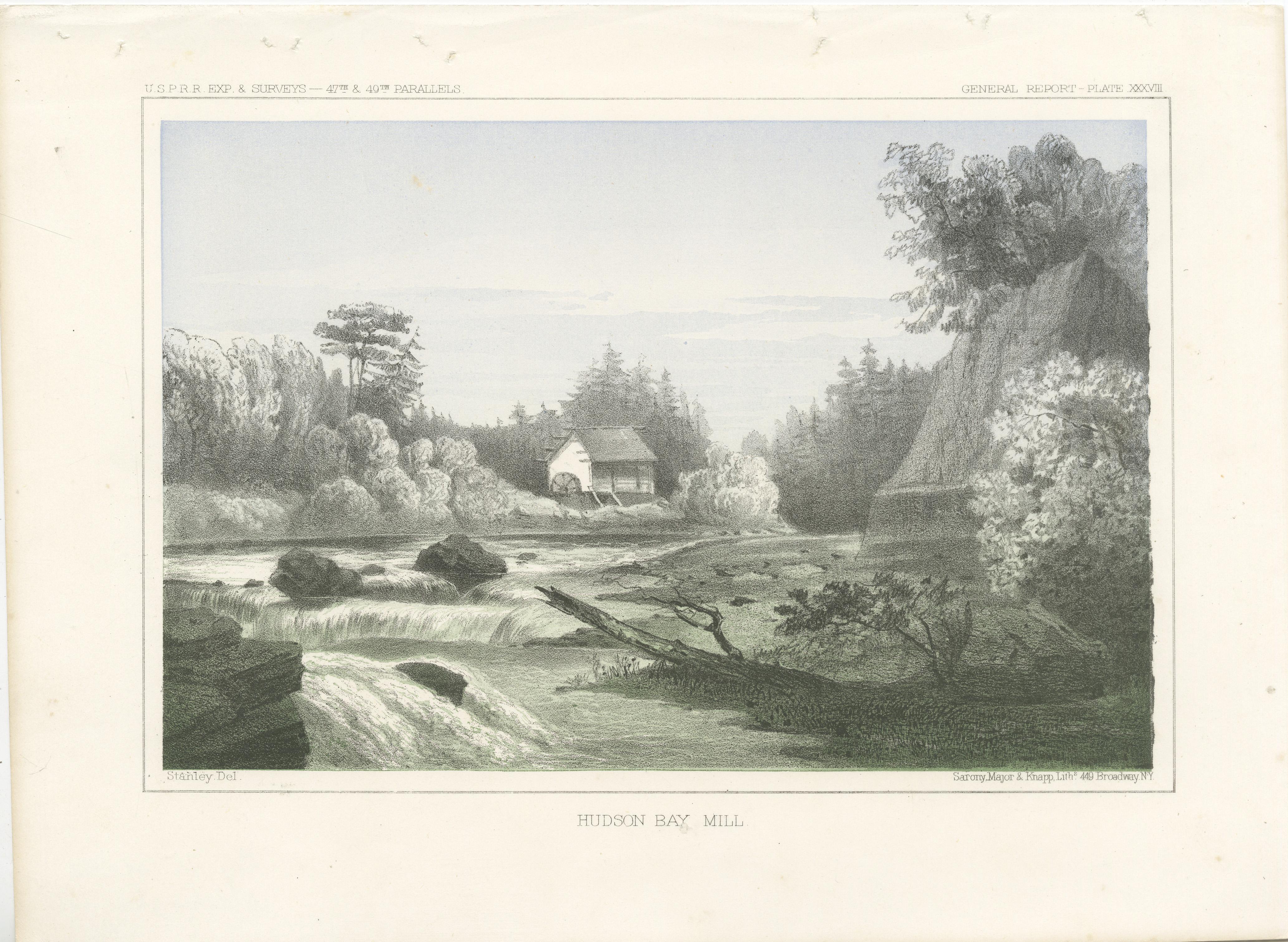
Tinted Lithograph of Hudson Bay Mill, Washington State, 1856
€ 220
One of a kind: this is the sheet in the photographs. Ships from Langweer, the Netherlands.
Date
1856
Sheet size
20.7 × 28.3 cm (8.1 × 11.1 in)
Reference
BG-14038-9
Condition
Very good, with minor foxing at the edges that does not affect the clarity of the image. Some small holes in the top, outside the image. The tones remain vibrant and well-preserved.
About this sheet
This exquisite lithograph, "Hudson Bay Mill," captures a tranquil and picturesque scene of a water mill nestled amidst lush foliage and a serene stream. Published as General Report – Plate XXXVIII in the Pacific Railroad Exploration Survey reports of 1856, this work embodies the harmony of nature and early industrial enterprise. The idyllic setting showcases a waterwheel-powered mill, a hallmark of frontier ingenuity, framed by dense trees and flowing waters.
Created by the renowned Sarony, Major & Knapp, this lithograph reflects the artistic and technical skill of the mid-19th century. The tinted lithography technique emphasizes the natural textures of the scene, from the rippling water and rugged rocks to the fine details of the surrounding forest. This combination of precision and artistry makes the piece both historically significant and visually appealing.
As part of the monumental Pacific Railroad Survey, this print not only documents the landscapes encountered during the exploration but also offers insight into the lives of settlers and their relationship with the natural environment. It serves as a window into an era of expansion and innovation.
Additional info: The HBC gristmill and sawmill were built to support the operations of Fort Colville, which was established in 1825 by the Hudson’s Bay Company. The mill was located on Mill Creek, a tributary of the Columbia River, near the fort. These mills were essential for processing grain and timber, helping sustain both the fort and surrounding settlements.
The fort and mills were situated in what is now northeastern Washington State, near Kettle Falls and the Columbia River. However, much of the original fort site is now submerged under Lake Roosevelt, which was created by the construction of the Grand Coulee Dam in the 1940s.
Condition: Very good, with minor foxing at the edges that does not affect the clarity of the image. Some small holes in the top, outside the image. The tones remain vibrant and well-preserved.
Framing Tip: Use a soft beige or cream matte to highlight the subtle hues of the lithograph. Pair it with a dark wooden or antique-style metallic frame for a timeless display. This piece is perfect for a study, library, or any setting that appreciates the beauty of historical landscapes and frontier life.