Flying Squirrel & Blue-Tail Lizard – Catesby Natural History c.1771
€ 1 500
Original antique · The actual sheet photographed · Certificate of authenticity on request · Sold unframed · Worldwide shipping from € 15 (rates)
Date
1771
Technique
Engraved
Sheet size
50 × 34.5 cm (19.7 × 13.6 in)
Condition
Good
Reference
BG-12512-64 & BG-12512-65
What the condition grades mean
Excellent
Bright and clean, with no faults worth mentioning.
Very good
Only light signs of age, such as faint toning.
Good
Normal signs of age for a sheet of this period: toning, some foxing, small marks or neat old repairs.
Fair
Clear faults such as staining, tears or repairs, priced to match.
Every fault we see is written in the condition note, and the whole sheet is shown uncropped in the photos.
Condition
Condition summary: Very good condition with clean impressions and rich hand coloring. Slight age-toning and faint foxing near the edges, but no tears or repairs. The paper is strong and stable.
About this sheet
Flying Squirrel & Blue-Tail Lizard – Catesby’s Natural History Prints c.1777
This set of two antique prints features the work of renowned English naturalist Mark Catesby, known for his groundbreaking documentation of the plants and animals of North America. These illustrations are from his monumental work Piscium, serpentum, insectorum, aliorumque nonnullorum animalium nec non plantarum quarundam imagines, published in the early 18th century.
The first print, titled Sciurus volans, Guajacana, shows a flying squirrel perched among the branches of a native tree. The animal’s stretched limbs and delicate wing-like membrane are illustrated with characteristic grace and anatomical precision. It is accompanied by a botanical specimen bearing small fruit and glossy green leaves.
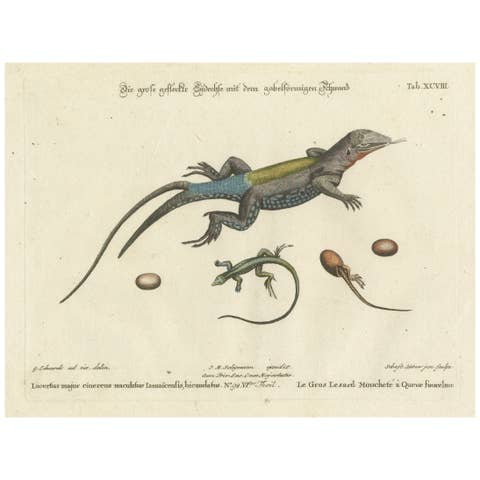
The second print, Lacertus cauda coerulea, Anona fructa viridi loevi Pyri inversi forma, features a blue-tailed lizard shown resting on the branch of a tropical plant bearing fruit resembling inverted pears (Anona species). The bold coloring and clean composition reflect Catesby’s desire to depict animals in their natural environments alongside the plants they inhabit.
Mark Catesby (1683–1749) was one of the first naturalists to combine both flora and fauna in single compositions, an innovative practice that influenced future scientific illustrators including Linnaeus. His fieldwork across the American colonies and the Bahamas resulted in some of the earliest and most accurate records of species never before seen by European audiences. His work is highly regarded for its scientific value and its charm as decorative art.
These engravings were produced using copperplate engraving with original hand-coloring – a technique that ensured fine detail and vibrant naturalistic hues.
Condition summary: Very good condition with clean impressions and rich hand coloring. Slight age-toning and faint foxing near the edges, but no tears or repairs. The paper is strong and stable.
Framing tips: These two prints work beautifully as a pair. Use matching cream mounts and classic gold or dark wooden frames. UV-protective glass is recommended to preserve the colors and fine engraving detail.