Exotic Jamaican Lizards: The Large Spotted Fork-Tailed Lizard Engraved, c.1773
€ 690
Original antique · The actual sheet photographed · Certificate of authenticity on request · Sold unframed · Worldwide shipping from € 15 (rates)
Date
1773
Sheet size
37 × 25 cm (14.6 × 9.8 in)
Reference
BG-13961
What the condition grades mean
Excellent
Bright and clean, with no faults worth mentioning.
Very good
Only light signs of age, such as faint toning.
Good
Normal signs of age for a sheet of this period: toning, some foxing, small marks or neat old repairs.
Fair
Clear faults such as staining, tears or repairs, priced to match.
Every fault we see is written in the condition note, and the whole sheet is shown uncropped in the photos.
Condition
Very good. Vibrant colors, minimal fading. Paper shows light toning and minor foxing in margins. Edges sharp; one small tear in bottom, no folds. Slight handling marks, not affecting image quality.
About this sheet
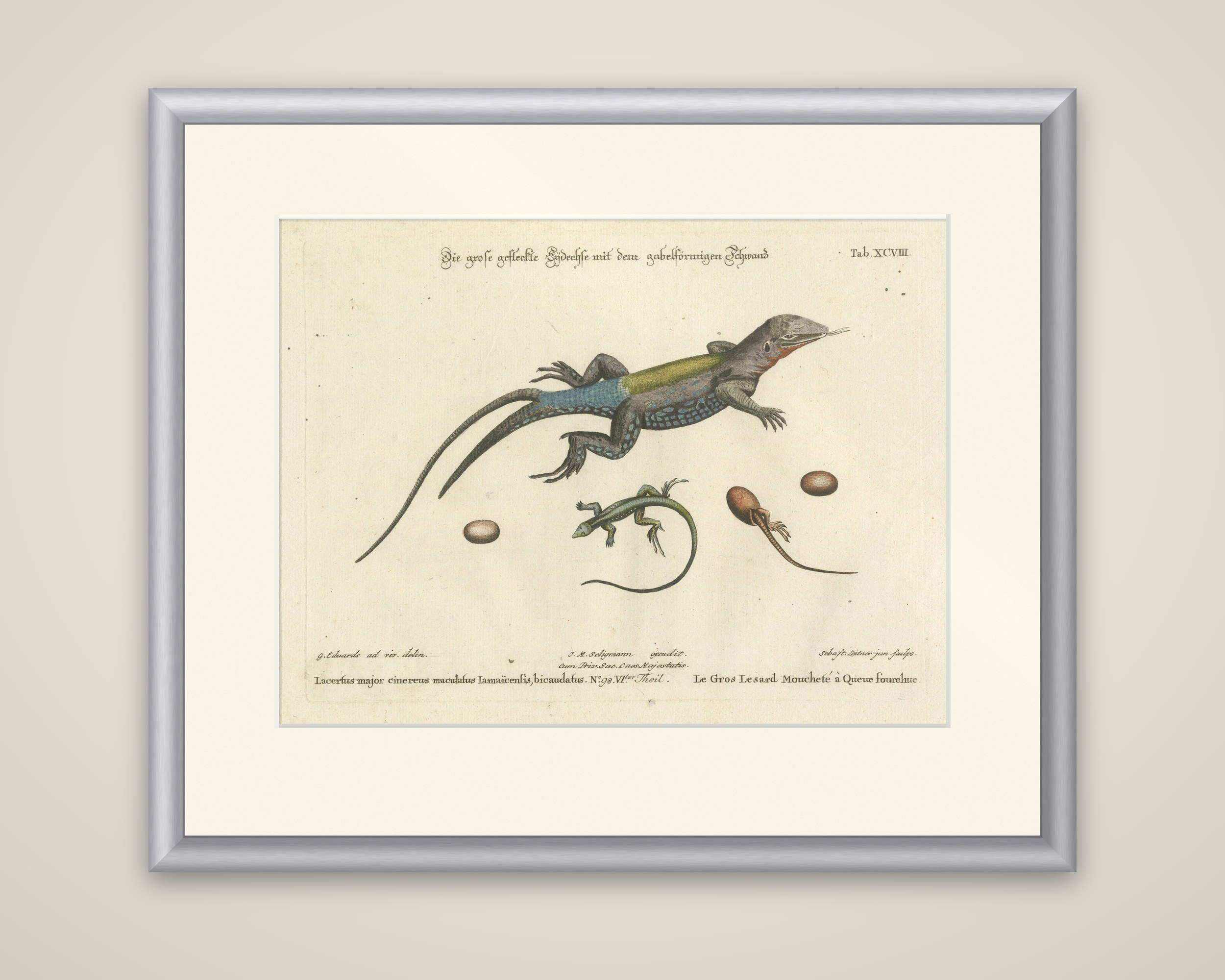
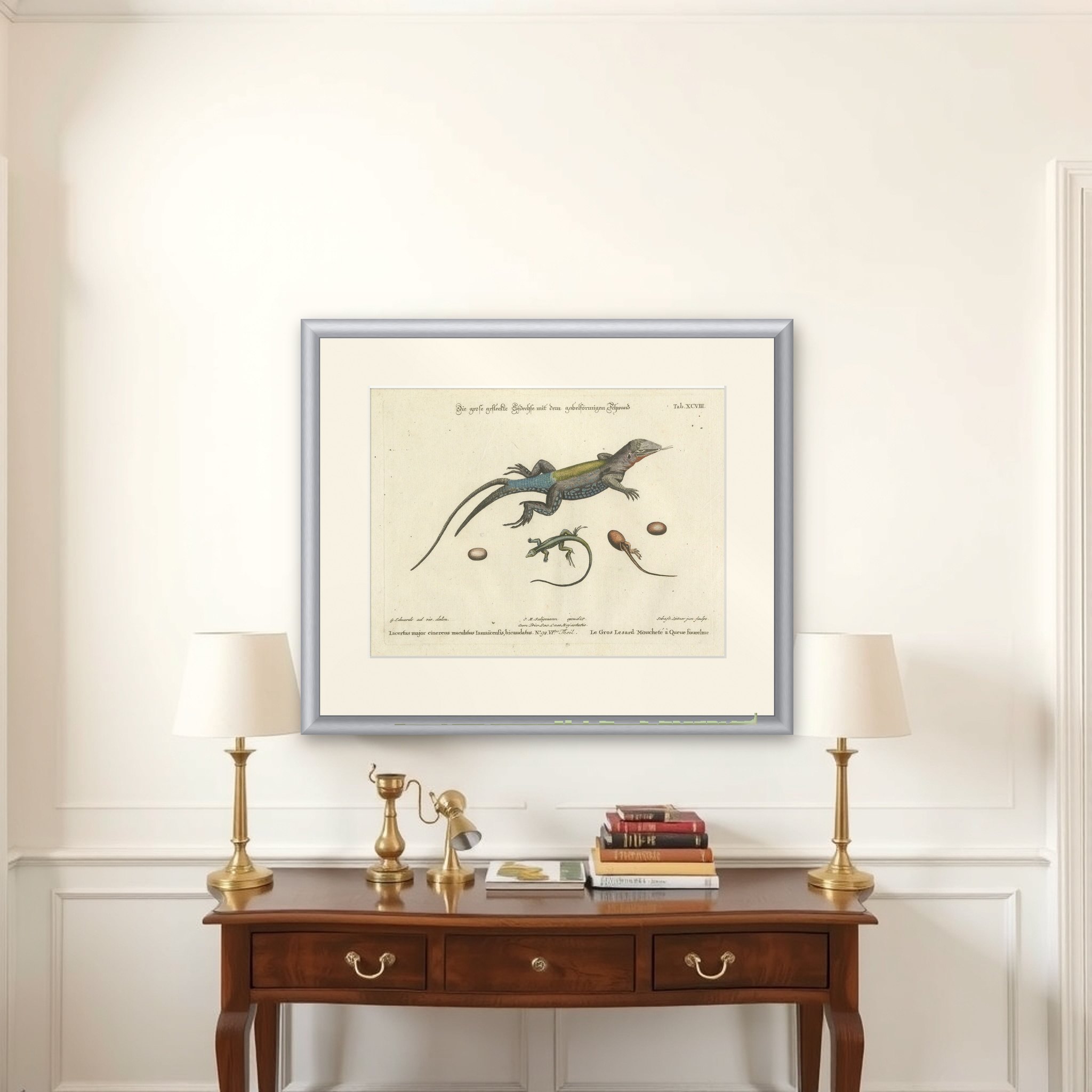
A large Jamaican lizard with a forked tail, an original hand-colored copperplate engraving from Johann Michael Seligmann's Sammlung verschiedener ausländischer und seltener Vögel, published in Nuremberg, circa 1773. The plate is numbered "Tab. XCVIII" at the upper right and titled "Die grose gefleckte Eydechse mit dem gabelförmigen Schwanz". Below the image are the Latin name "Lacertus major cinereus maculatus Iamaicensis, bicaudatus" and the French "Le Gros Lesard Mouché à Queue fourchue", with the credits "G. Edwards ad viv. delin.", "J. M. Seligmann excudit" and "Sebast. Leitner jun. sculps."
The main figure is a gray lizard with a pale mouth and a touch of red at the throat, seen from above and moving to the right. Its back is washed with yellow-green behind the shoulders and bright blue toward the hips, and the flanks are dotted with a pattern of small blue spots. The tail splits in two long curved branches that sweep to the lower left, the feature the Latin name calls "bicaudatus". Below the big animal, a smaller green lizard curls with a slender tail, and three rounded eggs are scattered around the plate, one with a young lizard half emerging from it.
The plate follows a drawing by George Edwards, the London naturalist, and Seligmann issued such plates with German, Latin and French captions for readers on the Continent.