WWI Satirical Cartoon Map: 'Kill That Eagle' by J.H. Amschewitz, 1914
€ 2 250
Original antique · The actual sheet photographed · Certificate of authenticity on request · Sold unframed · Worldwide shipping from € 15 (rates)
Date
1914
Sheet size
49.3 × 71.9 cm (19.4 × 28.3 in)
Condition
Good
Reference
BHZ11707
What the condition grades mean
Excellent
Bright and clean, with no faults worth mentioning.
Very good
Only light signs of age, such as faint toning.
Good
Normal signs of age for a sheet of this period: toning, some foxing, small marks or neat old repairs.
Fair
Clear faults such as staining, tears or repairs, priced to match.
Every fault we see is written in the condition note, and the whole sheet is shown uncropped in the photos.
Condition
Bold color with moderate scattered foxing. The covers are toned and soiled. Having visible age-toning and some edge wear, which is typical for an item of its vintage. Despite these signs of aging, it is overall well-preserved and suitable for framing.
About this sheet
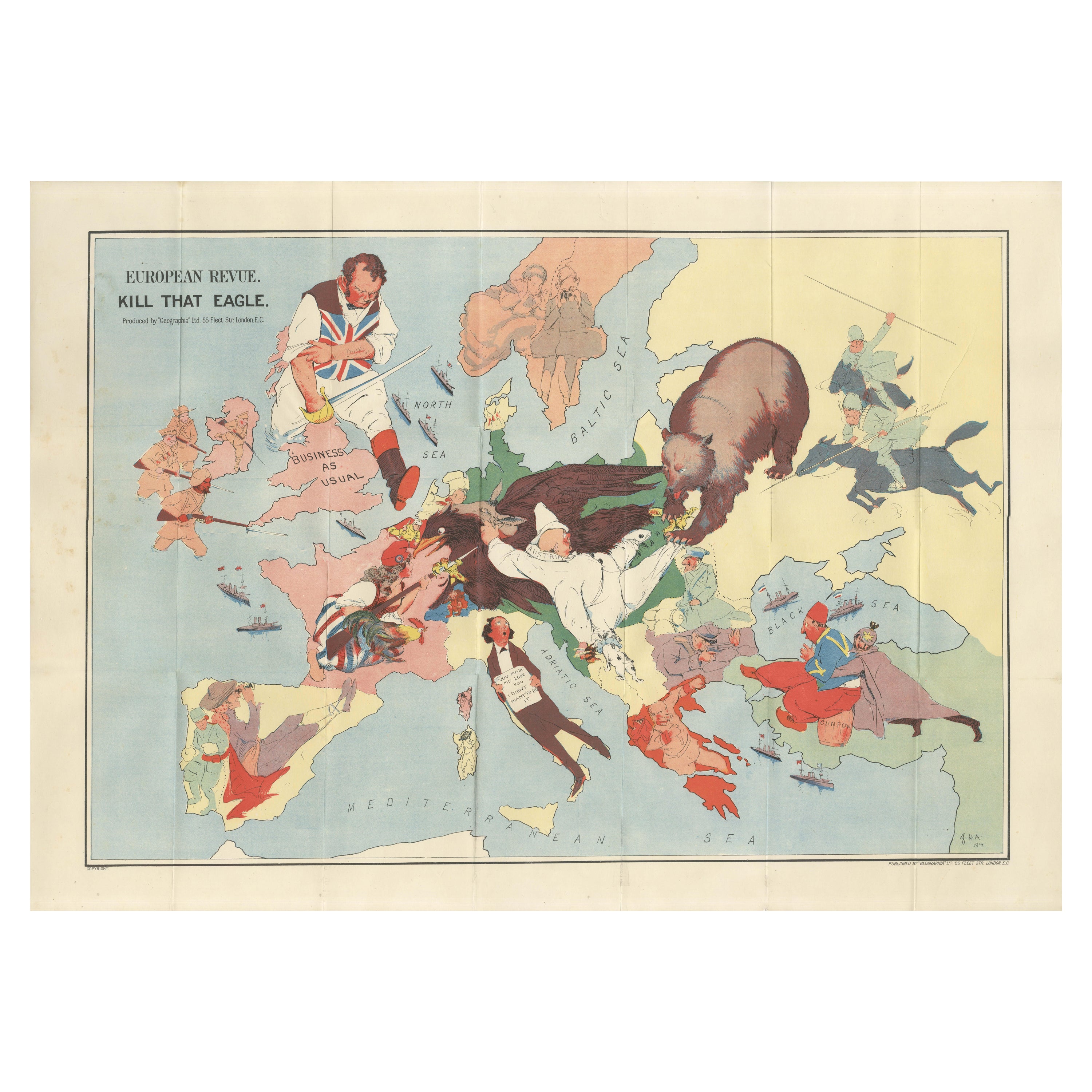
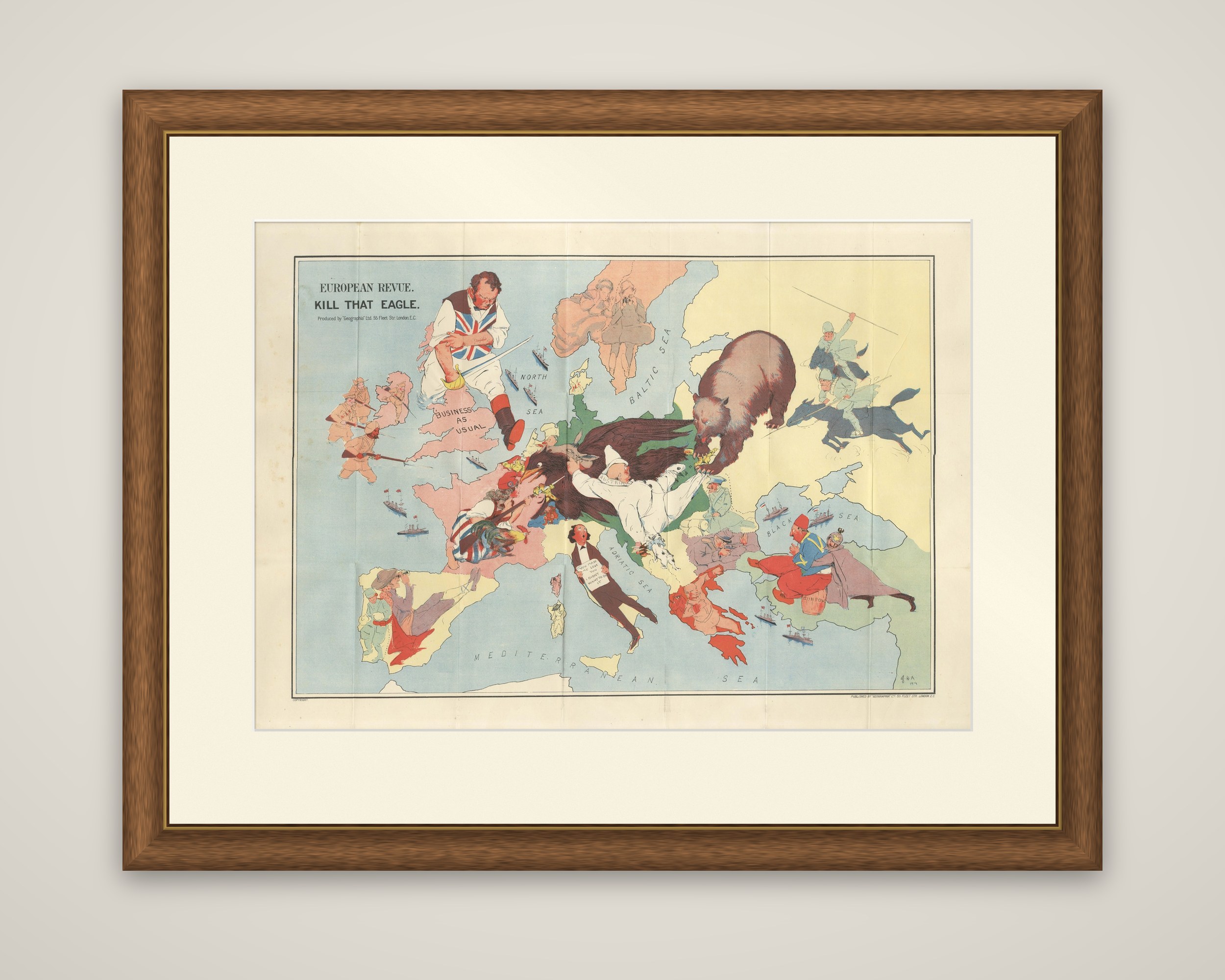
European Revue: Kill That Eagle, an original color lithographed serio-comic map of Europe published in London in December 1914 by Geographia Ltd and drawn by John Henry Amschewitz, in the first months of the First World War. The title is set at the upper left, with the publisher's line and a monogram at the lower right. The sheet was issued folding in the original printed paper wrappers.
The countries are drawn as figures. A large John Bull in a Union Jack waistcoat sits over Britain, with the words "Business as usual" lettered across the island. A black eagle, Germany, has one claw on the bayonet of France in her tricolor and the other in the grip of the Russian bear, who tears at it from the east. Austria is a clown in white holding an ass's head, Italy sings the music-hall refrain "You made me love you, I didn't want to do it," and Cossacks ride across Russia. The Balkans and Turkey are drawn at the lower right, and Spain is a sleepy figure at the lower left.
The map was later copied by German propagandists, who read "Business as usual" as proof of British war-mongering. Cartoon maps of this kind, with nations as caricatures, were a staple of European printmaking between 1845 and 1945.