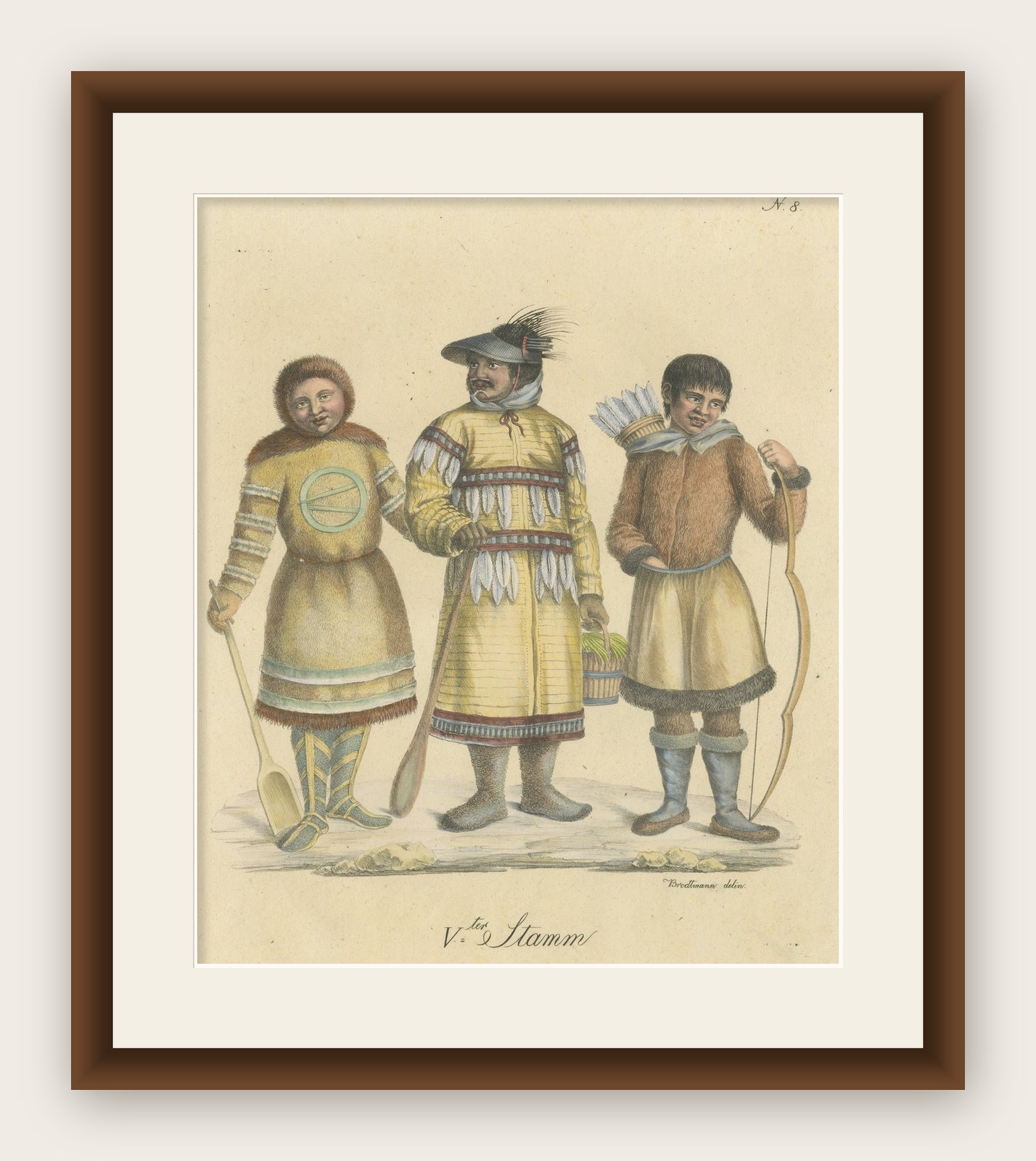
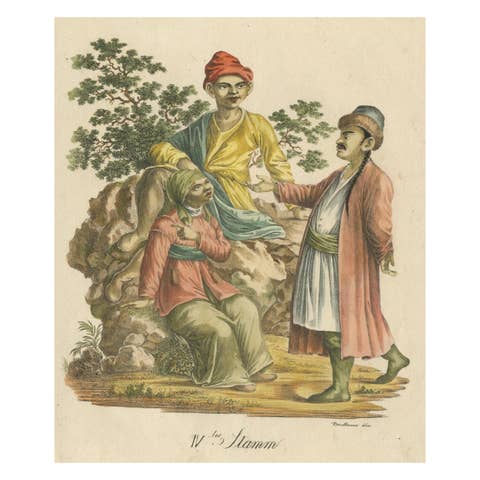
Vter Stamm – Unalaska Man, Nenet Woman, and Eskimo c.1816
€ 690
Original antique · The actual sheet photographed · Certificate of authenticity on request · Sold unframed · Worldwide shipping from € 15 (rates)
Date
1816
Sheet size
44.5 × 35.7 cm (17.5 × 14.1 in)
Condition
Good
Reference
BG-13581-4
What the condition grades mean
Excellent
Bright and clean, with no faults worth mentioning.
Very good
Only light signs of age, such as faint toning.
Good
Normal signs of age for a sheet of this period: toning, some foxing, small marks or neat old repairs.
Fair
Clear faults such as staining, tears or repairs, priced to match.
Every fault we see is written in the condition note, and the whole sheet is shown uncropped in the photos.
Condition
Condition summary: Excellent condition with strong paper, vibrant and clear hand coloring, minimal toning, and no tears or repairs observed. Only very slight foxing near the edges. Paper remains firm and crisp.
About this sheet
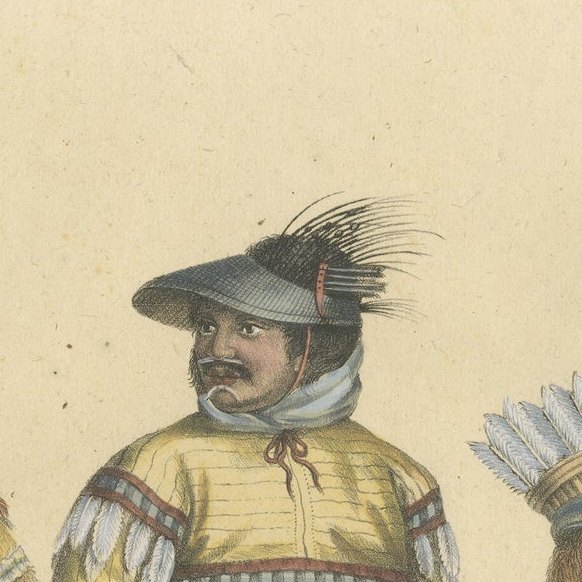
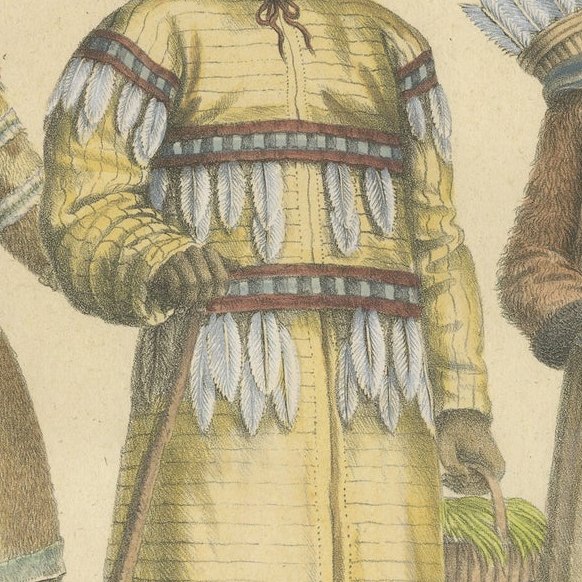
This antique lithograph shows three figures representing indigenous peoples of the Arctic and Siberian regions. On the left stands a Nenet (historically referred to as Samoyed) woman, wearing a fur-lined hooded coat decorated with patterned bands and high protective boots, typical of the reindeer-herding Nenets of northern Siberia. In the center is a man from Unalaska, one of the Aleutian Islands, dressed in a long decorated parka with a distinctive hat adorned with feathers, reflecting Aleut hunting and ceremonial attire. On the right stands an Eskimo (Inuit) youth with a bow and arrow, wearing a practical hooded tunic and trousers suited for Arctic hunting.
This print was published circa 1816 by Karl Joseph Brodtmann in his ‘Naturhistorische Bilder-Galerie.’ Brodtmann was an early master of lithography, and his ethnographic series was among the first to combine accurate costume depiction with detailed hand-coloring, enhancing their educational and aesthetic value. His work coincided with European interest in Arctic exploration, Russian expansion into Siberia, and North Pacific voyages, which introduced Europeans to these cultures’ resilient adaptations to harsh environments.
Lithography, a relatively new technique at the time, allowed Brodtmann to produce fine linear detail and nuanced shading efficiently, making his prints both affordable and visually sophisticated. The costumes depicted highlight the functional beauty of Arctic and sub-Arctic clothing, designed for extreme weather while carrying symbolic patterns indicating cultural identity.
Condition summary: Excellent condition with strong paper, vibrant and clear hand coloring, minimal toning, and no tears or repairs observed. Only very slight foxing near the edges. Paper remains firm and crisp.
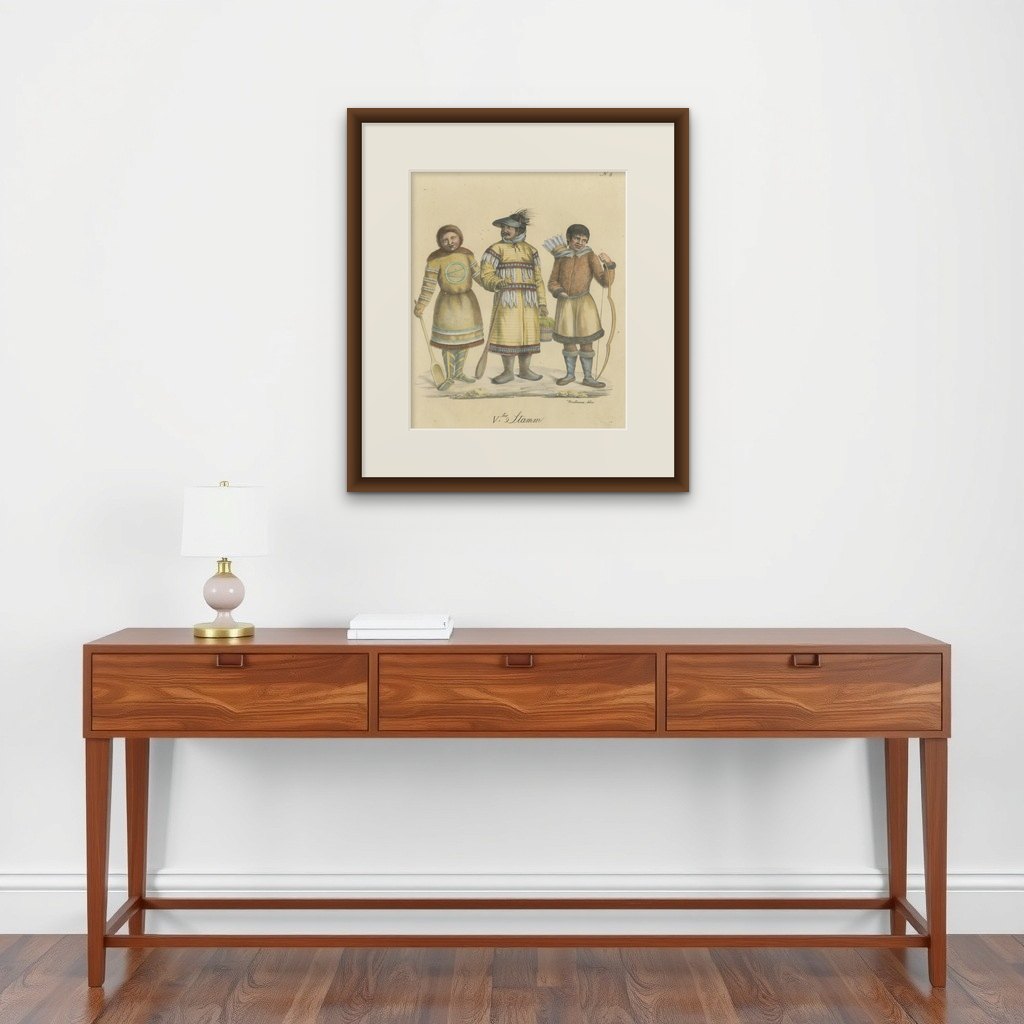
Framing tips: A pale gray or cream mount will harmonize with the muted earth and fur tones. Framing in light oak or mid-tone walnut wood complements the naturalistic subject, while a thin black frame with an inner silver line offers a more contemporary gallery presentation. UV-protective glass is advised to maintain the delicate pigments over time.