About this sheet
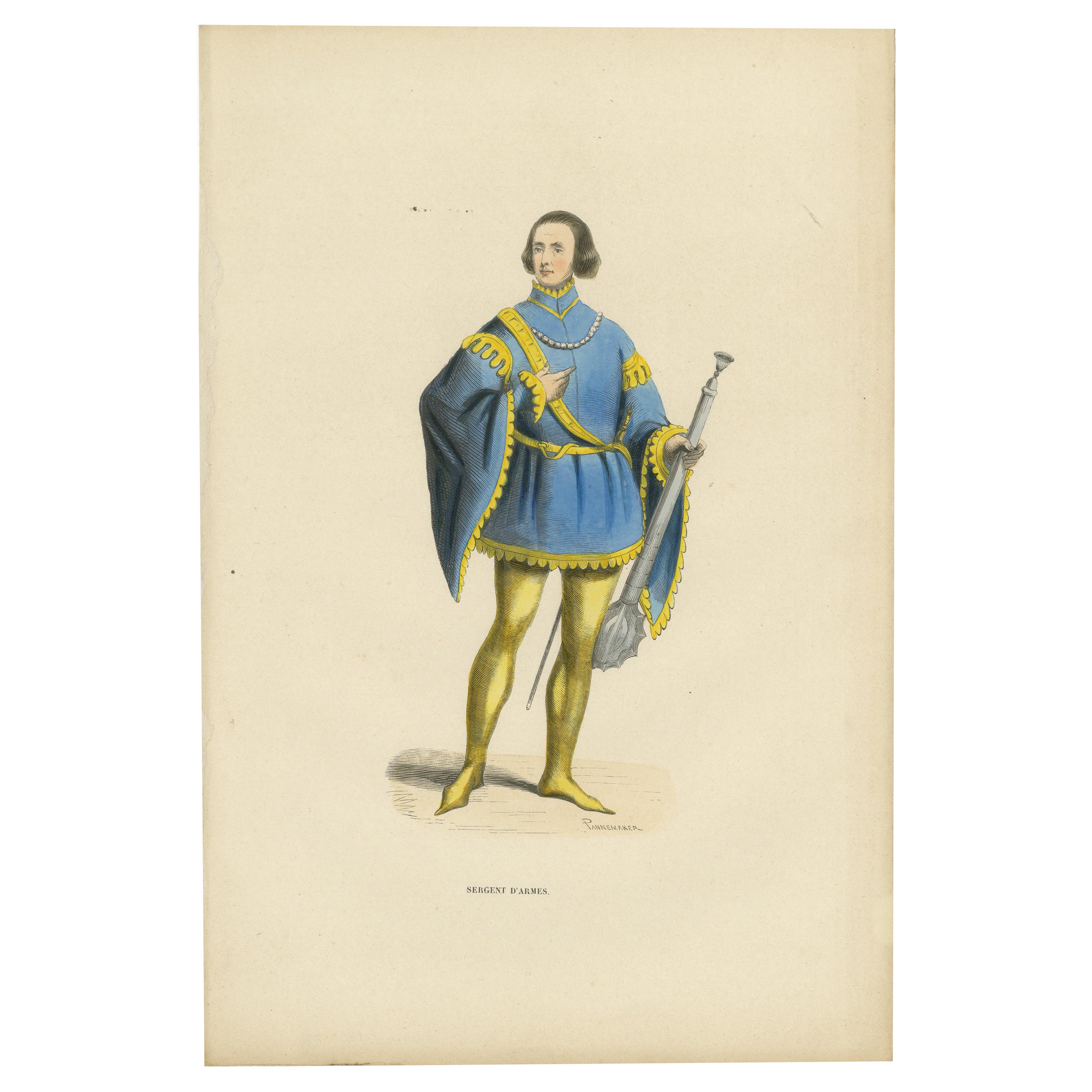
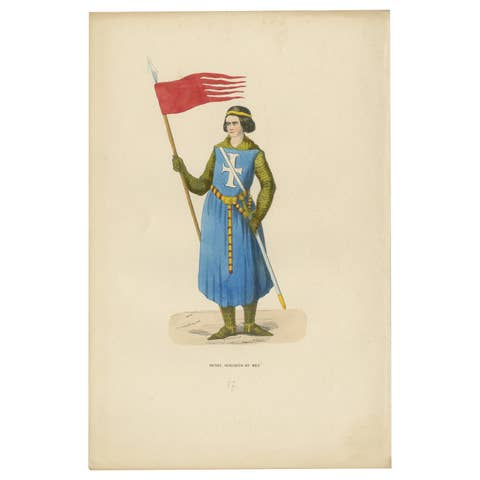
This hand-colored engraving, titled "Sergent d'Armes," depicts a Sergeant at Arms from the Middle Ages, a role that historically combined duties of law enforcement, security, and ceremonial functions within the royal court.
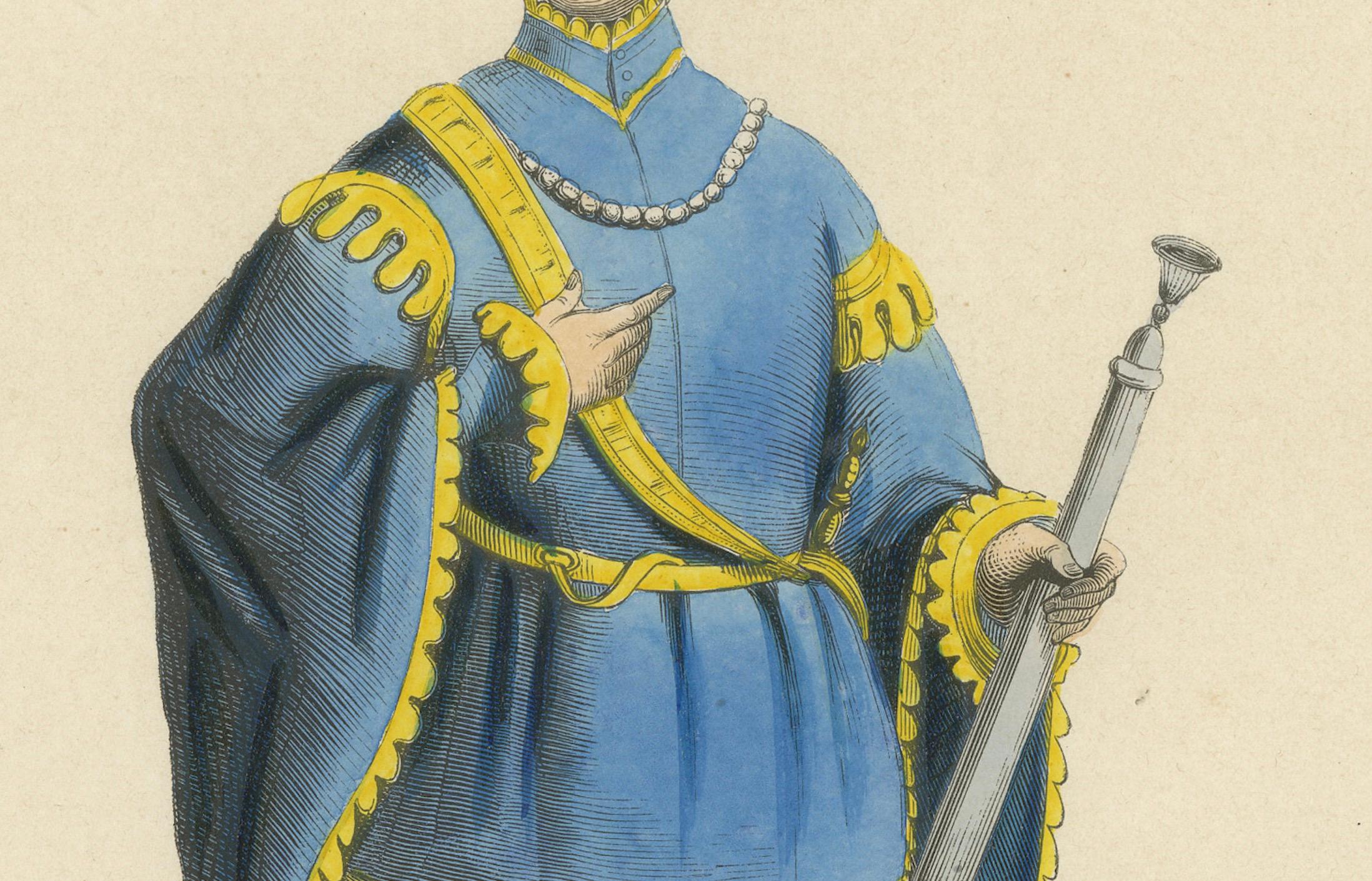
The figure stands in a poised and authoritative stance, dressed in a rich blue doublet with full sleeves, edged with a yellow patterned trim that denotes his official capacity. The doublet is belted at the waist, accentuating the length of the garment which falls to the mid-thigh, a typical fashion of the period for men of status.
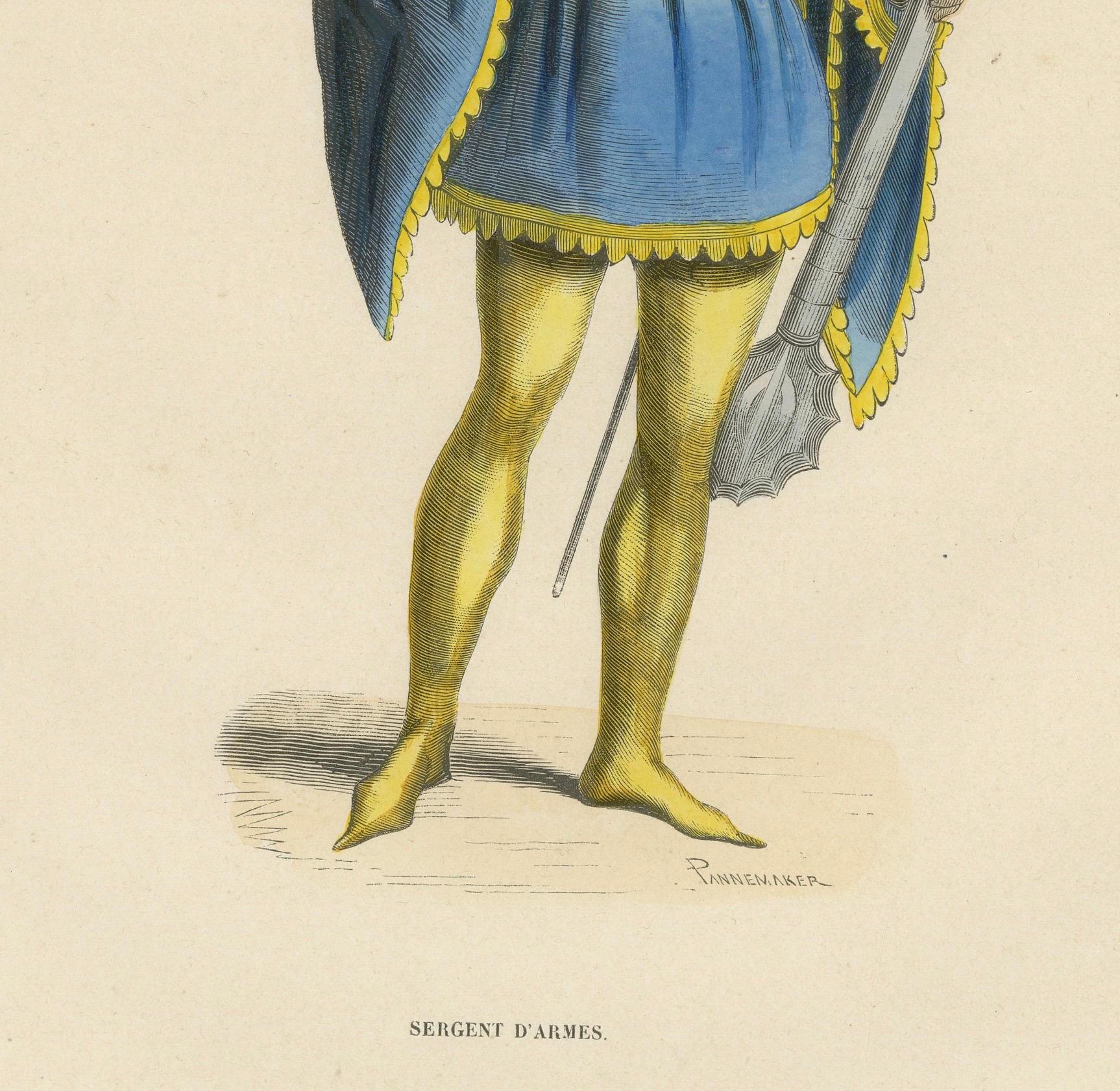
Over the doublet, he wears a cape that drapes over one shoulder, suggesting readiness for action. The cape, matching the doublet in color and trim, reinforces his dignified position. His hose are golden, fitting snugly and shimmering in contrast to the matte finish of the doublet, indicative of the esteem of his office.
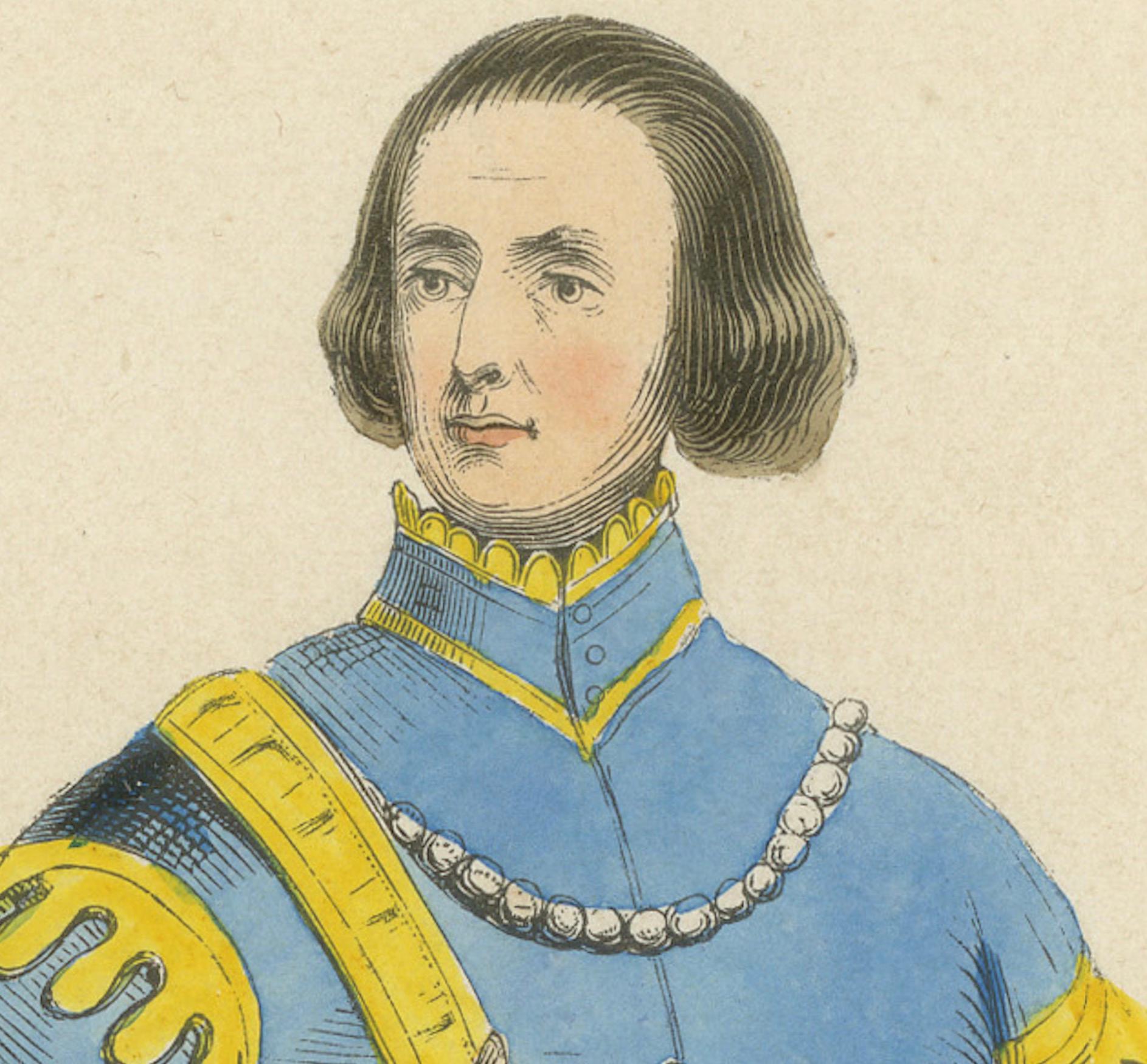
The sergeant's head is adorned with a red chaperon, a style of hat that was fashionable and practical, with the tail of the hat often used to display the wearer's allegiance through color or emblem.
In one hand, he holds a halberd, a type of weapon that was part polearm and part axe, signaling his role in maintaining order and providing protection. His other hand appears to gesture, perhaps in the act of giving orders or directing individuals.
The print, numbered "112," is part of the "Costume du Moyen Age" series and captures the presence and attire of a key figure within the medieval hierarchy, combining the dual aspects of military readiness and courtly service. The subtle detailing of the costume, from the patterned trim to the texture of the hose, contributes to a vivid portrayal of the sergeant at arms.
The colors have a nice glow over them. Historically, egg whites, known as glair, and sometimes egg yolk were indeed used in illumination and painting, particularly in manuscripts, to give colors a brighter appearance and to add a sheen or gloss to the work. This technique was quite common during the Middle Ages and into the Renaissance.
Egg whites can be applied as a varnish over pigments to enhance their brightness and to protect the colors. This application could make the colors appear more vivid and also add a slight glossy sheen to the surface of the image.
Egg yolk, on the other hand, was commonly used as a binding agent in paint. It forms the basis of tempera paint, a medium that was widely used before the advent of oil painting. Egg yolk helps to create a durable and long-lasting color that adheres well to various surfaces.
In the context of the print from 1847, it's less likely that egg whites or yolks were used directly on the print, as by that time, commercial printing processes would have been more advanced and less reliant on such manual methods. However, if this print is a representation of an earlier style or is meant to mimic the appearance of hand-painted manuscripts, the original artists might have employed techniques or materials that gave a similar effect to those achieved with egg-based binders and varnishes.