About this sheet
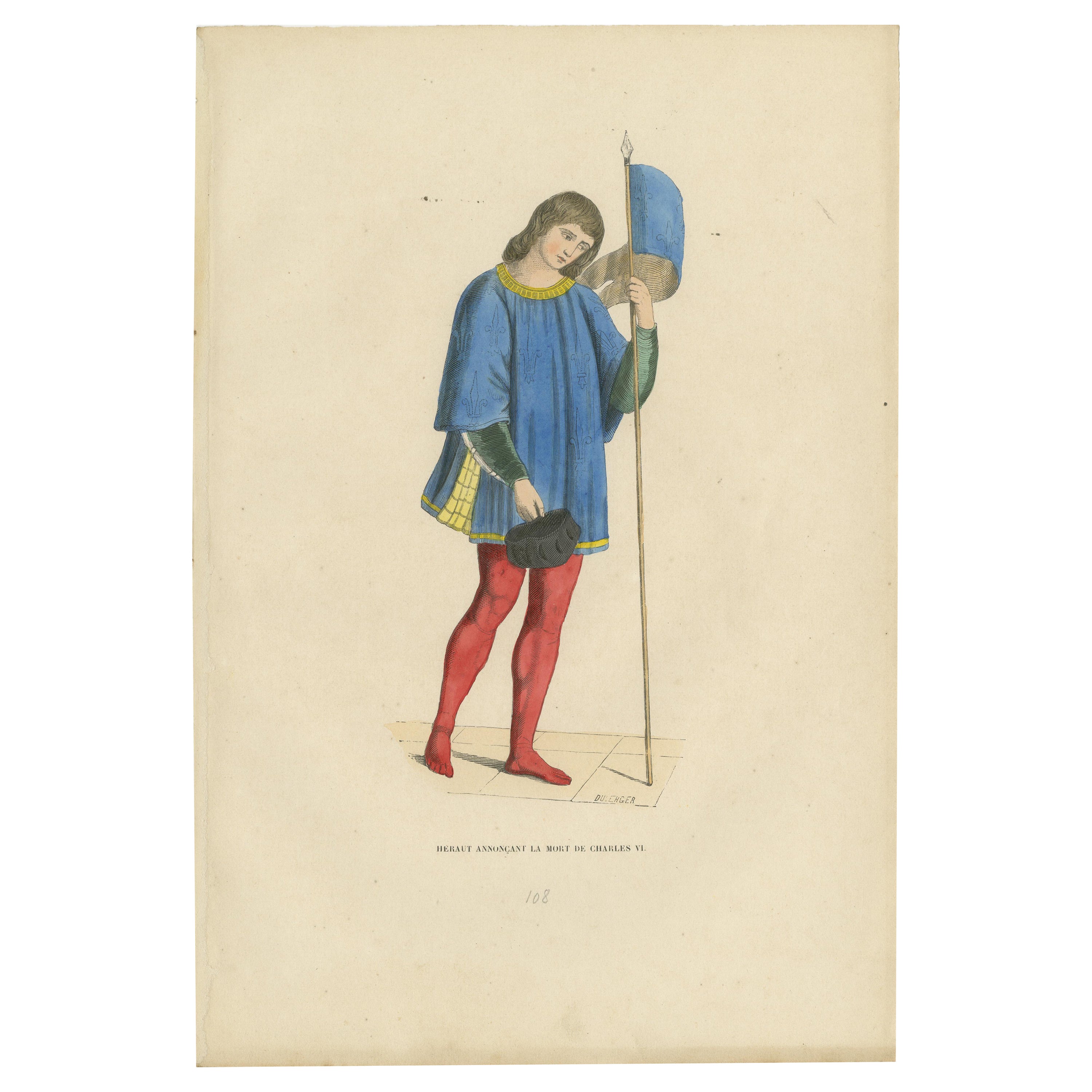
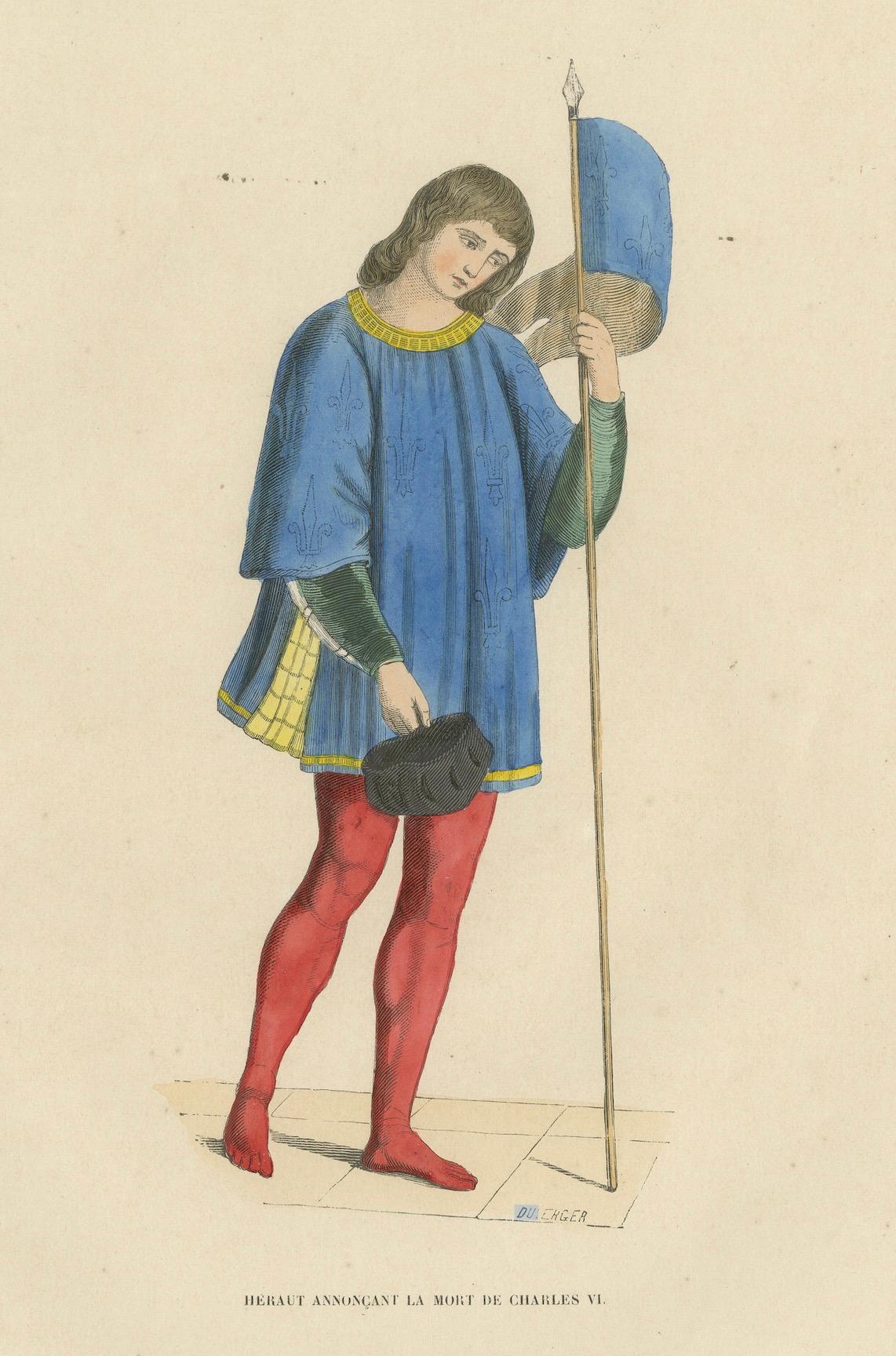
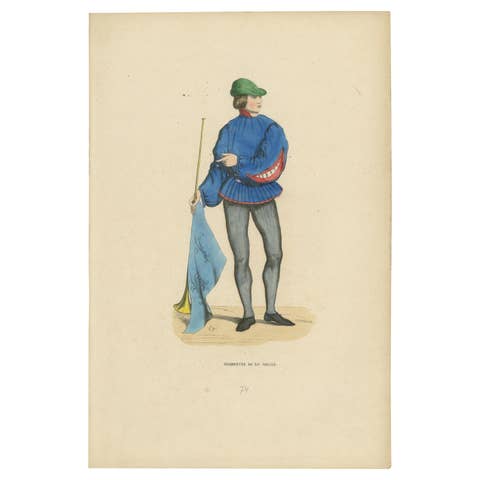
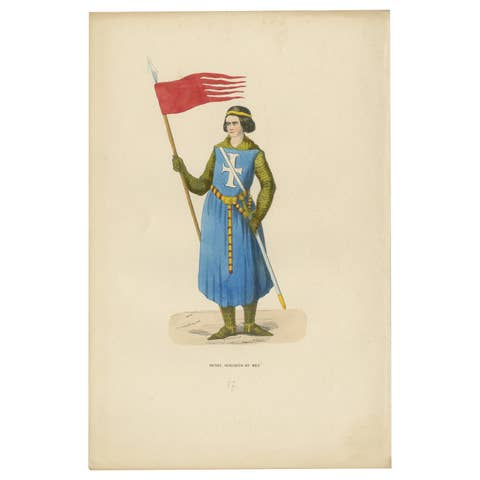
This 1847 hand-colored engraving is titled "Héraut Annonçant la Mort de Charles VI," translating to "Herald Announcing the Death of Charles VI." It depicts a herald, a messenger and officer of arms in medieval times, tasked with conveying important news, in this case, the passing of King Charles VI of France.
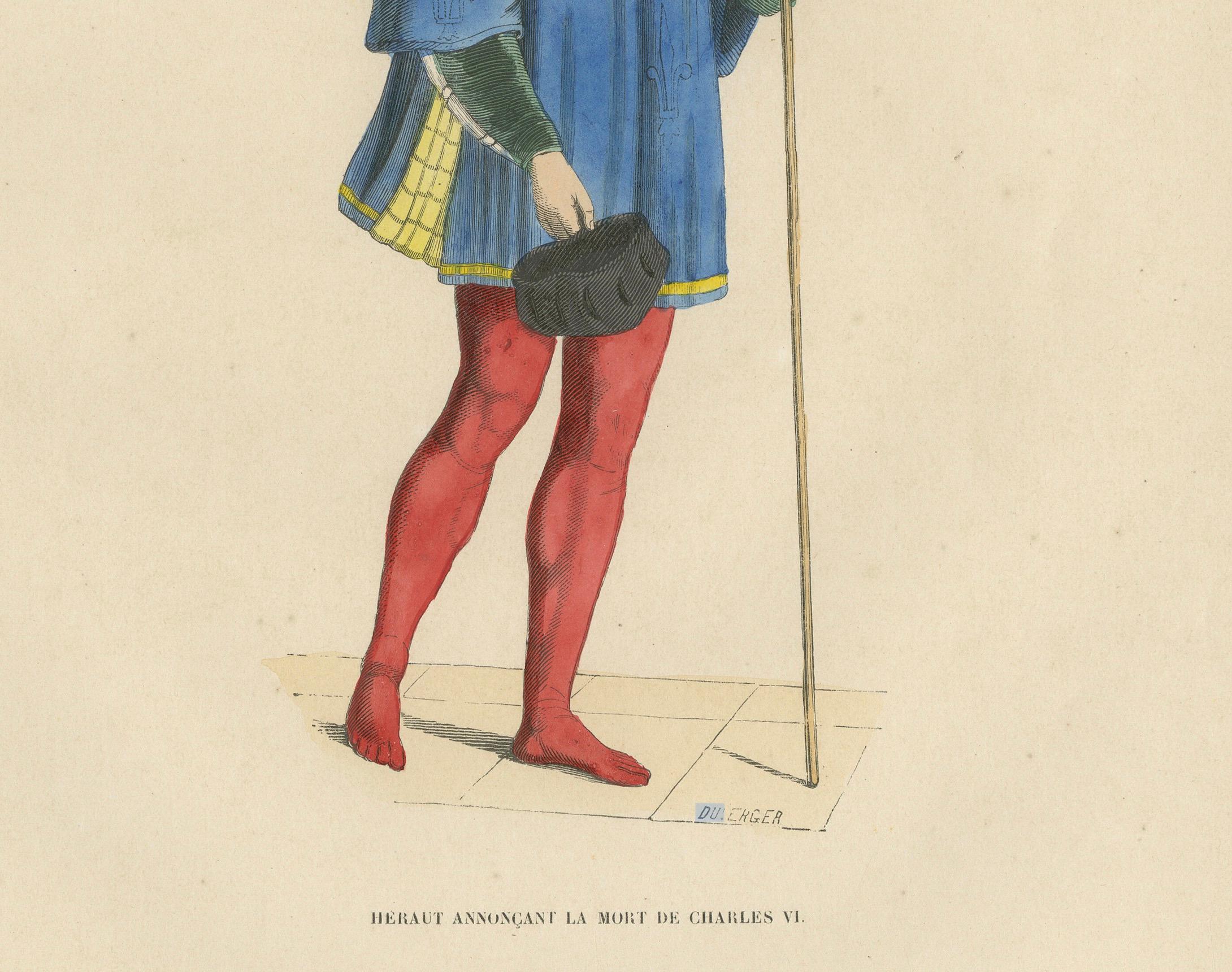
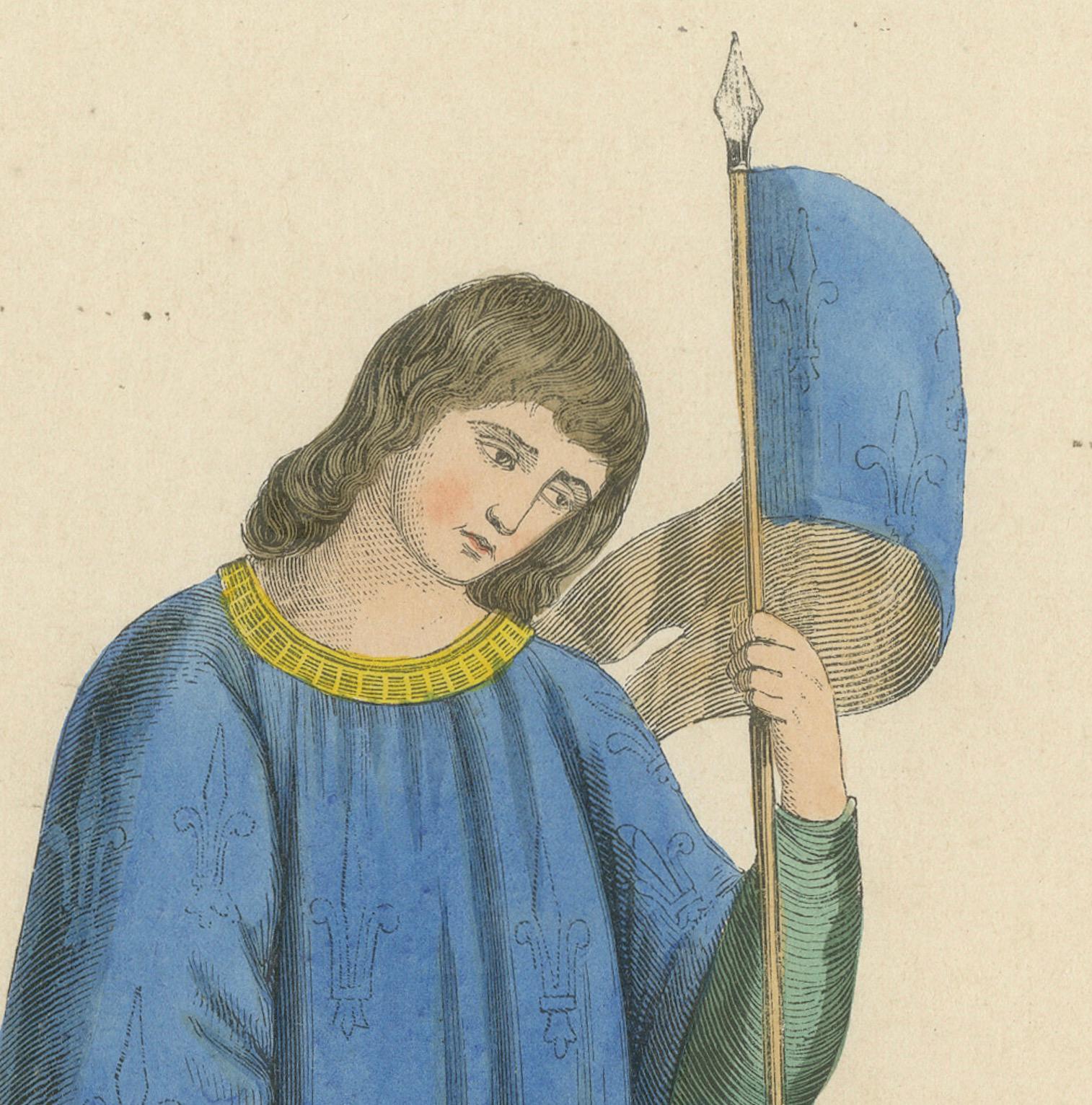
The herald is clothed in a short, blue tunic emblazoned with fleur-de-lis, the symbol of the French monarchy, indicating his official capacity in service to the king. The tunic has wide sleeves and is edged with gold trim, suggesting the importance of his role. Underneath, he wears a yellow garment with a checkered hem, which provides a striking contrast to the blue of the tunic.
He wears red hose, a common element of men's fashion during the period, and his shoes are hidden from view, suggesting the focus is on the upper part of his attire, which bears the symbols of his office. The herald's hat is red with a rolled brim, distinctive and easily noticeable, which would help in identifying him amidst a crowd.
In his right hand, he carries a long staff, possibly a symbol of his authority to speak on behalf of the crown. His left hand holds his hat, as if he has just removed it in a gesture of respect or to attract attention before making his announcement. The herald's gaze is downcast, befitting the somber news he bears.
This image provides insight into the historical role of heralds as bearers of news and the regalia associated with their duties in the medieval period.
The colors have a nice glow over them. Historically, egg whites, known as glair, and sometimes egg yolk were indeed used in illumination and painting, particularly in manuscripts, to give colors a brighter appearance and to add a sheen or gloss to the work. This technique was quite common during the Middle Ages and into the Renaissance.
Egg whites can be applied as a varnish over pigments to enhance their brightness and to protect the colors. This application could make the colors appear more vivid and also add a slight glossy sheen to the surface of the image.
Egg yolk, on the other hand, was commonly used as a binding agent in paint. It forms the basis of tempera paint, a medium that was widely used before the advent of oil painting. Egg yolk helps to create a durable and long-lasting color that adheres well to various surfaces.
In the context of the print from 1847, it's less likely that egg whites or yolks were used directly on the print, as by that time, commercial printing processes would have been more advanced and less reliant on such manual methods. However, if this print is a representation of an earlier style or is meant to mimic the appearance of hand-painted manuscripts, the original artists might have employed techniques or materials that gave a similar effect to those achieved with egg-based binders and varnishes.