About this sheet
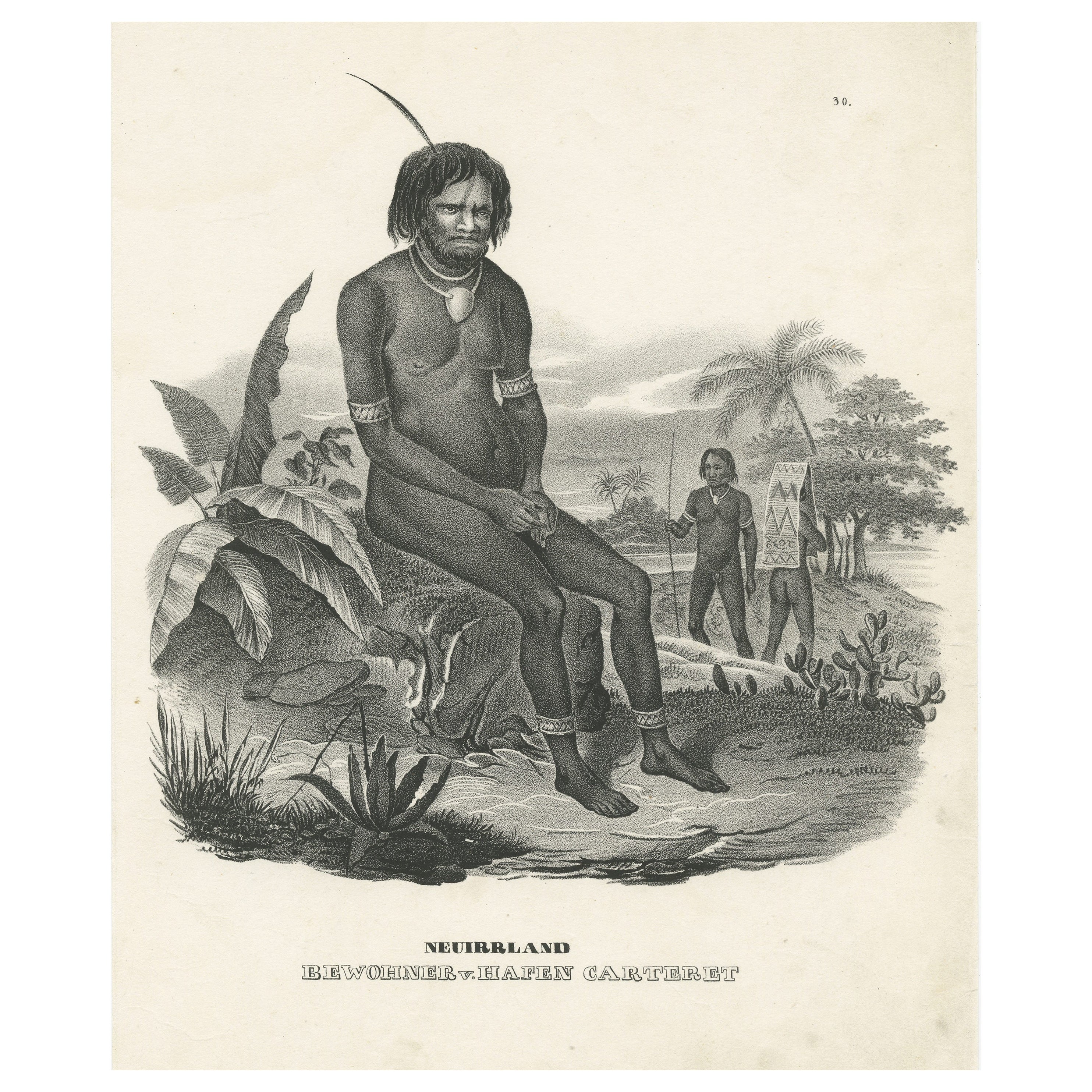
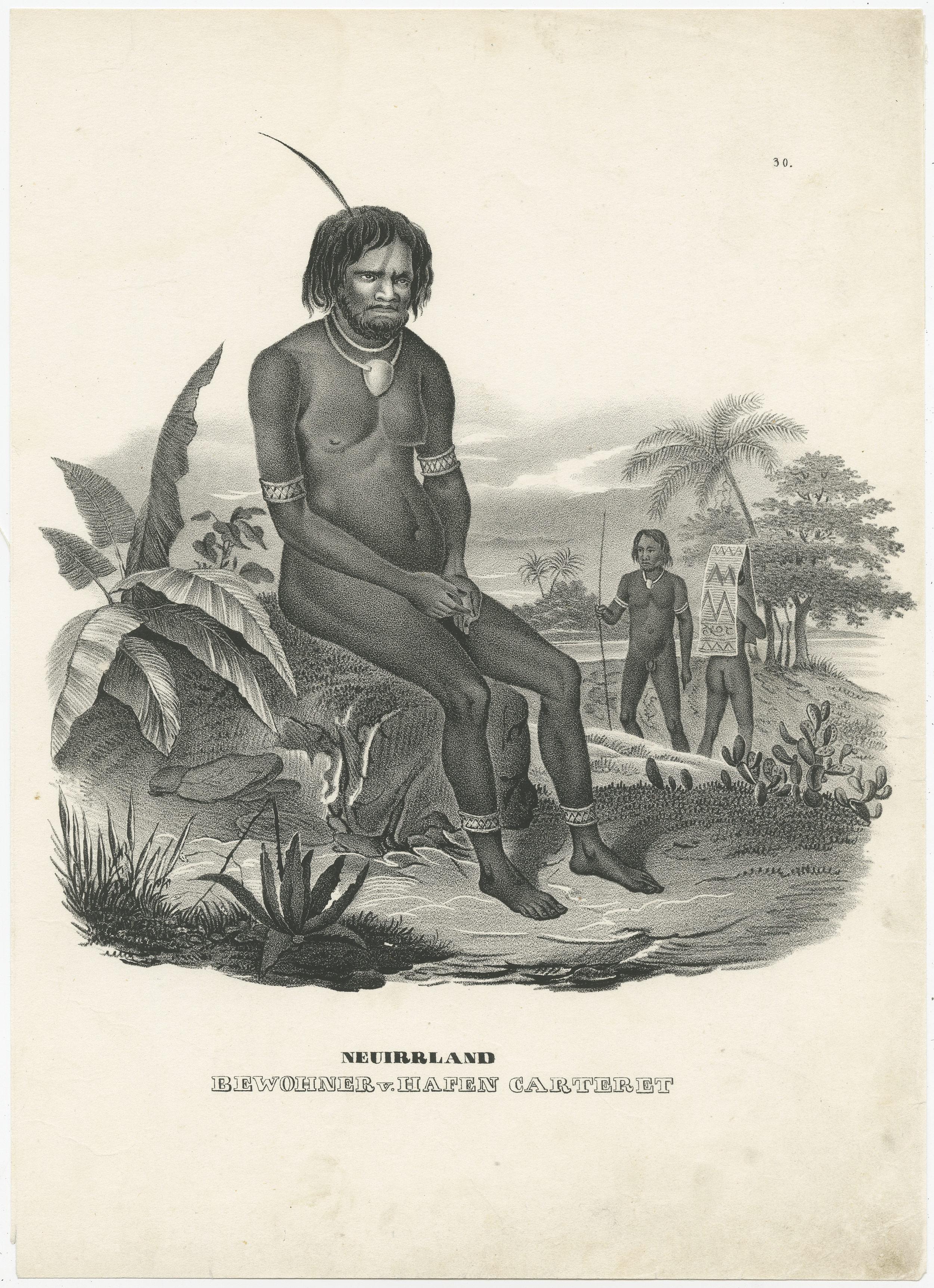
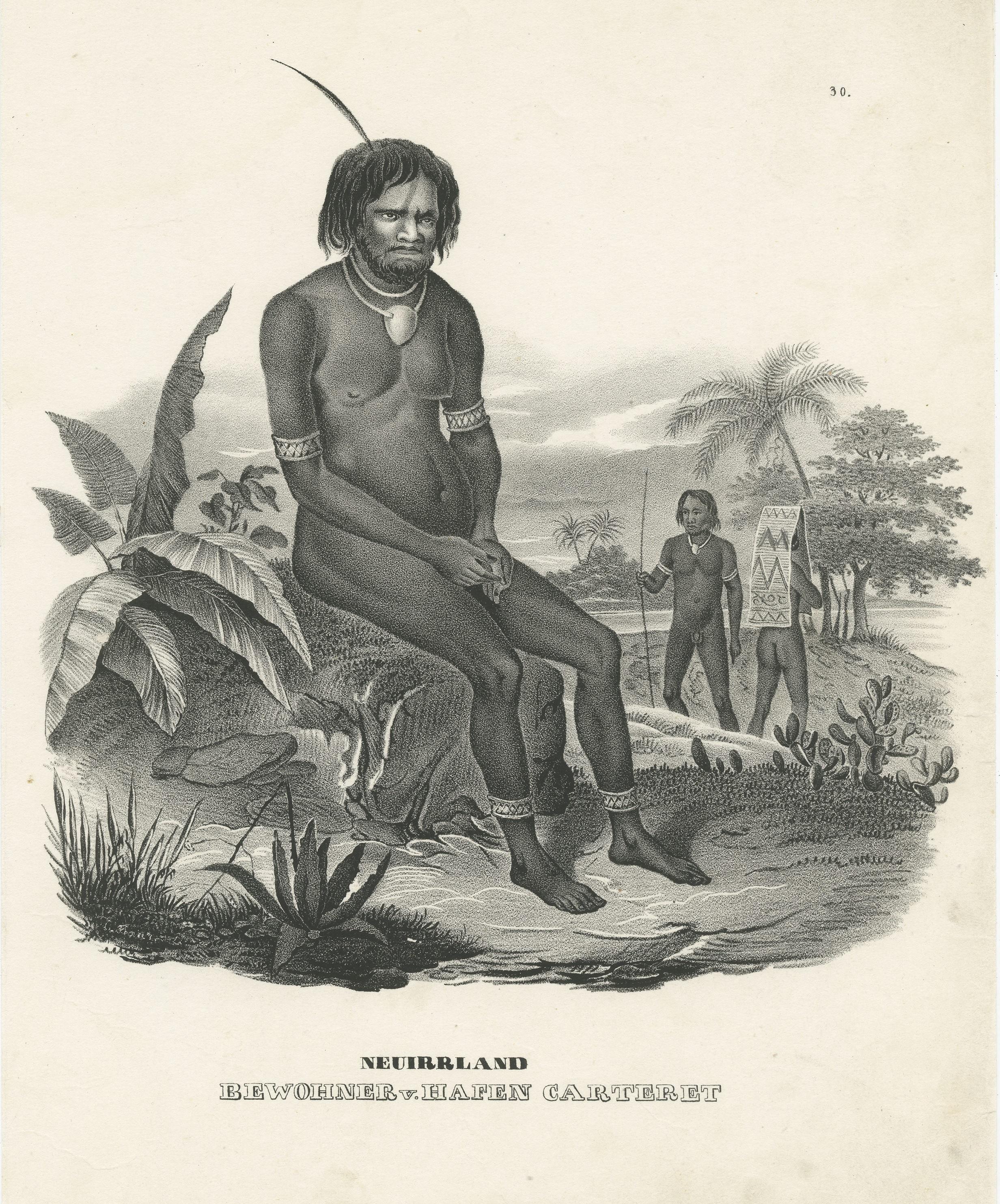
Antique Ethnographic Print of New Ireland Native, Carteret Harbour – Pacific, 1824
Antique lithographic ethnographic print titled “Neuirrland, Bewohner v. Hafen Carteret,” depicting a male inhabitant of New Ireland in the Bismarck Archipelago, seated on a rock within a tropical landscape. Two additional figures appear in the background, one carrying a plaited mat or woven covering above his head, adding contextual detail to the scene and suggesting everyday activity and material culture.
The image represents the region historically known as New Ireland, located in the Bismarck Archipelago of the western Pacific. Carteret Harbour, referenced in the title, was situated at the southern tip of the island and was named after **Philip Carteret**, who in 1767 navigated the channel separating New Britain from New Ireland, establishing the latter as a distinct island. During the early nineteenth century, this region attracted growing European ethnographic interest following exploration and contact voyages.
The composition reflects the period’s approach to ethnographic illustration, combining a posed central figure with a carefully constructed landscape setting intended to convey both physical appearance and cultural environment. Details such as body adornment, hairstyle, and carried objects were considered essential visual information for European audiences seeking to understand distant societies.
This print was lithographed by **Honegger** and is generally attributed to the circle of publications associated with **Heinrich Rudolf Schinz**, most likely originating from *Naturgeschichte und Abbildungen der Menschen und der Säugethiere*. Works from this publication are among the early systematic attempts to document human diversity through text and image, reflecting the scientific and ethnographic frameworks of the early nineteenth century.
An evocative and historically significant Pacific ethnographic print, of interest to collectors of exploration imagery, Oceania, and nineteenth-century anthropology, as well as to interior designers seeking a striking and contemplative historical image.
Condition
Good original condition with light age-related toning and minor surface wear consistent with early nineteenth-century lithographs. Plate mark visible. No later coloring or restoration observed.
Framing tips
This print presents well in a dark walnut or ebonized frame with a wide ivory or warm off-white mat, allowing the figure and surrounding landscape to stand out clearly. Museum glass is recommended to protect the lithographic surface and preserve tonal detail.
Technique: Lithograph
Maker: Lithographed by Honegger, after R. Schinz, Switzerland, circa 1824