About this sheet
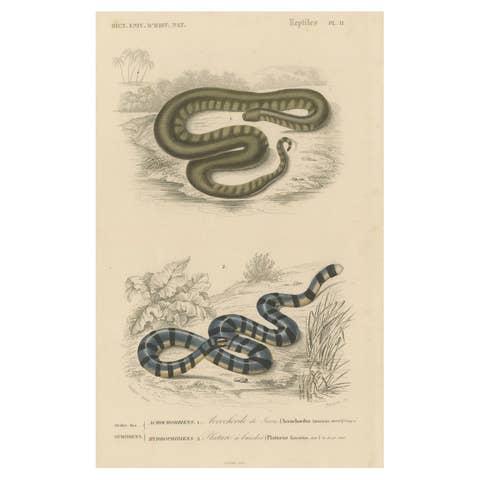
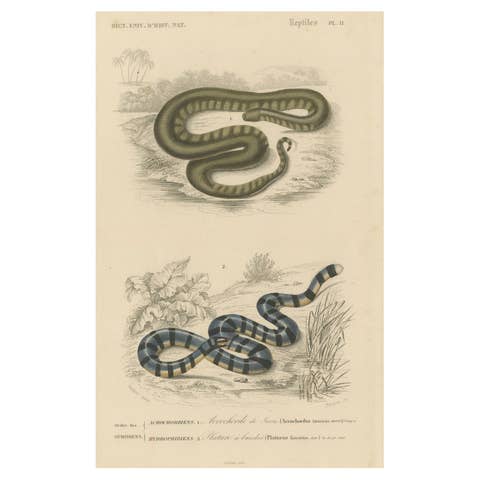
Snake Print of Rattlesnake and Horned Viper, c.1850, by Orbigny
This highly detailed 19th-century hand-colored engraving, Reptiles Pl. 13, features two of the world’s most iconic venomous snakes: the Rattlesnake (Crotalus durissus) and the Horned Viper (Cerastes cornutus). Published around 1850 as part of the Dictionnaire Universel d’Histoire Naturelle by Charles Dessalines d'Orbigny, this plate combines zoological accuracy with striking visual presentation.
Figure 1, at the top, depicts the 'Crotalus durissus', commonly known as the South American Rattlesnake. It is easily identified by the rattle at the tip of its tail, which it uses as a defensive warning signal. The snake is shown in an alert, defensive posture, with its head raised and tongue extended. The scales are finely detailed in shades of green, brown, and black, and the distinctive rattle is clearly illustrated. Native to Central and South America, this pit viper is known for its potent venom and its important role in local ecosystems.
Figure 2 presents Cerastes cornutus, the Horned Viper, known for the two small horns above its eyes. This desert-dwelling species is native to North Africa and the Middle East, and it is shown here with its body coiled on a sandy terrain. The viper’s coloring, in golden ochre and gray, is rendered with precision to suggest camouflage in its natural habitat. The plate captures the horned head and flattened body that allow the viper to burrow into the sand.
The artwork was drawn by Oudart and engraved by Mme Fournier, both respected figures in 19th-century natural science illustration. This print exemplifies the French scientific tradition of combining beauty and knowledge, with hand coloring applied to emphasize each snake’s distinctive markings.
Perfect for collectors of zoological illustrations, antique natural history prints, or as a dramatic accent in a study or library.
Condition Summary:
Light foxing along outer margins, one faint spot at top right corner. Some dirt due to handling below the image but central image clean and colors well preserved. No tears or repairs. Strong impression with fine detail.
Framing Tips (240 characters):
A dark wood or black frame works well to enhance the intense tones of both snakes. Use a sand or ivory mat to complement the earthy palette. UV-protective glass is advised to preserve the hand coloring and paper quality.