Bright and clean, with no faults worth mentioning.
Very good
Only light signs of age, such as faint toning.
Good
Normal signs of age for a sheet of this period: toning, some foxing, small marks or neat old repairs.
Fair
Clear faults such as staining, tears or repairs, priced to match.
Every fault we see is written in the condition note, and the whole sheet is shown uncropped in the photos.
Condition
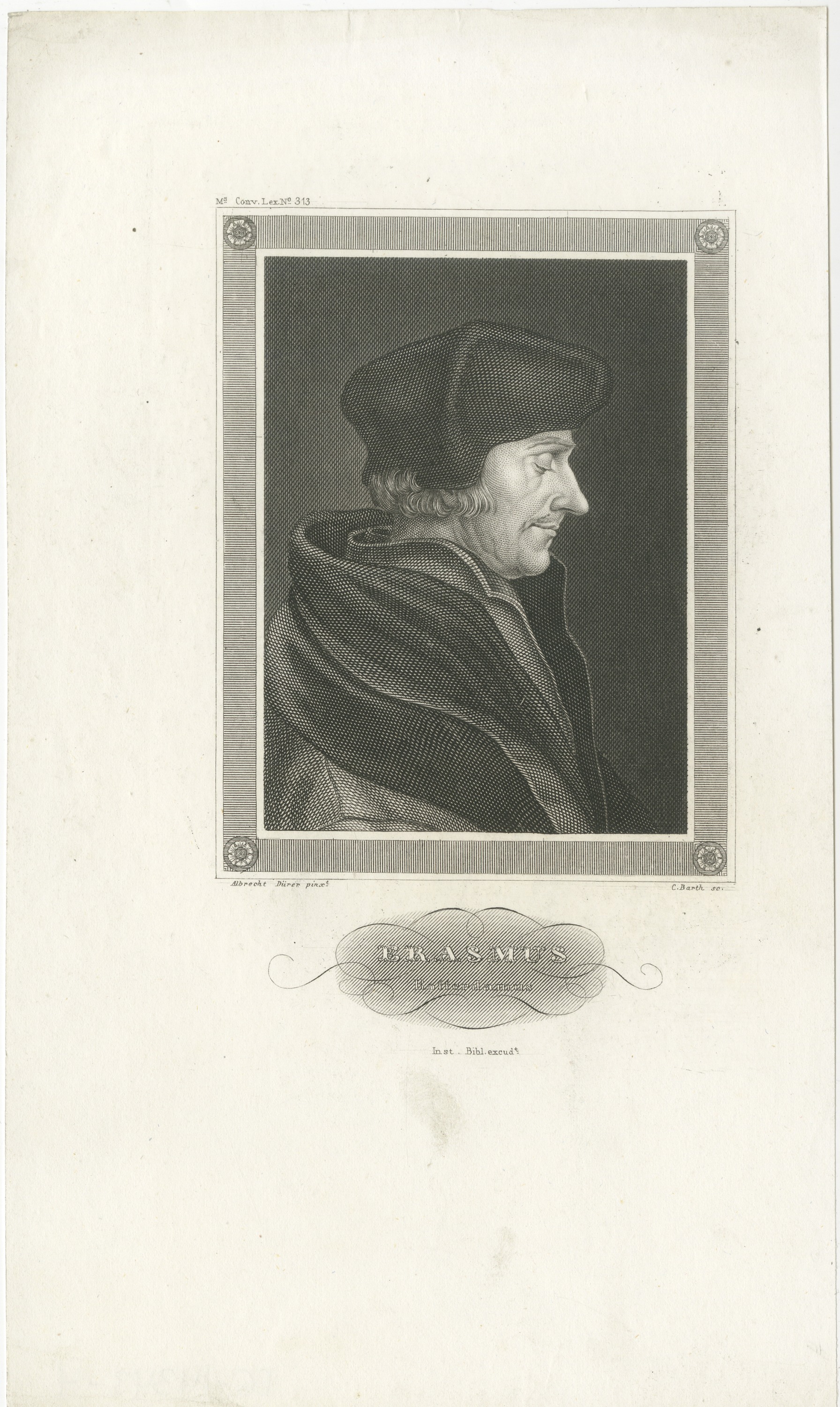
Good condition for its age. Light toning with a few small spots to the margins; a faint smudge below the title. The image is clean. Please review the images for further condition details.
About this sheet
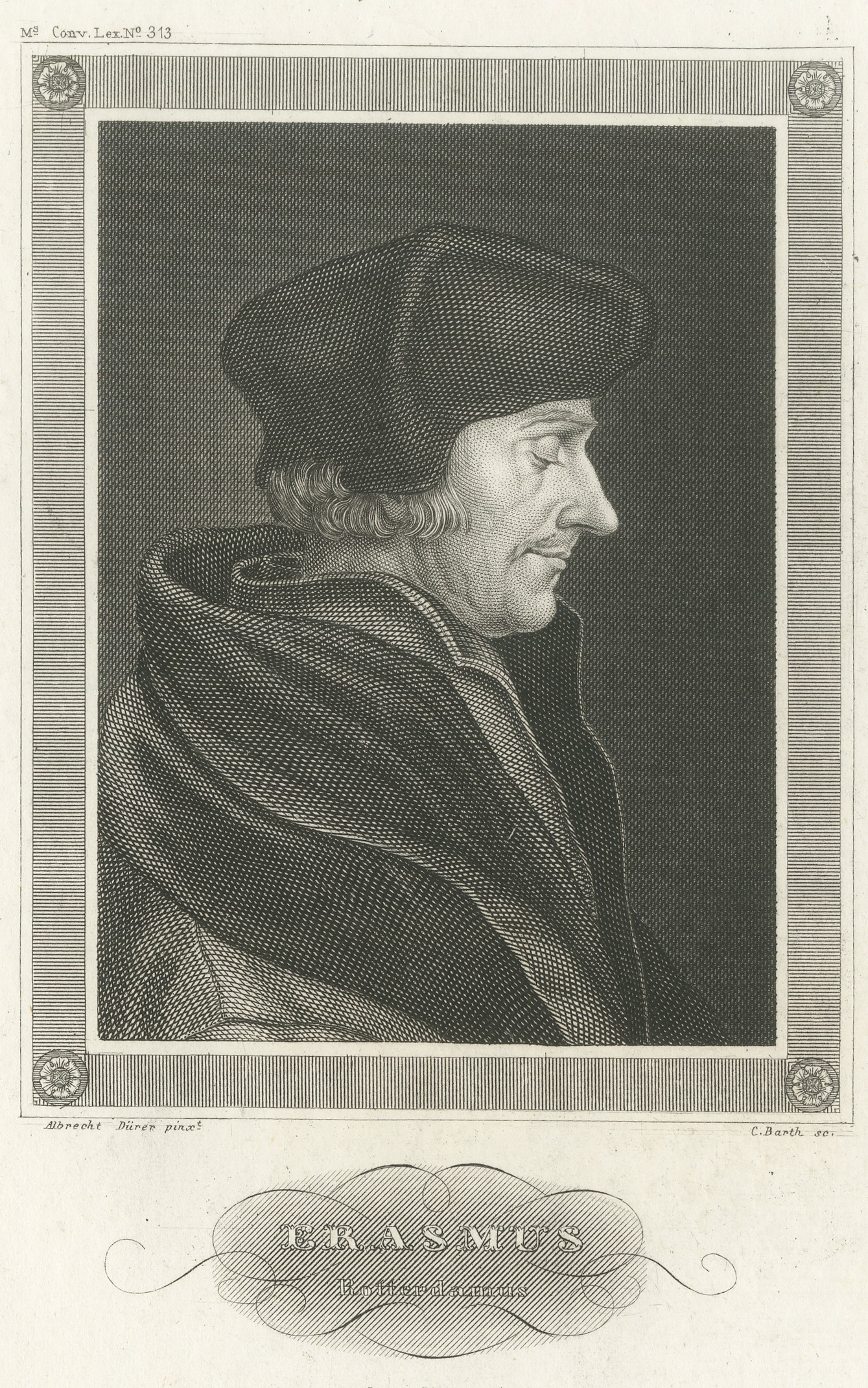
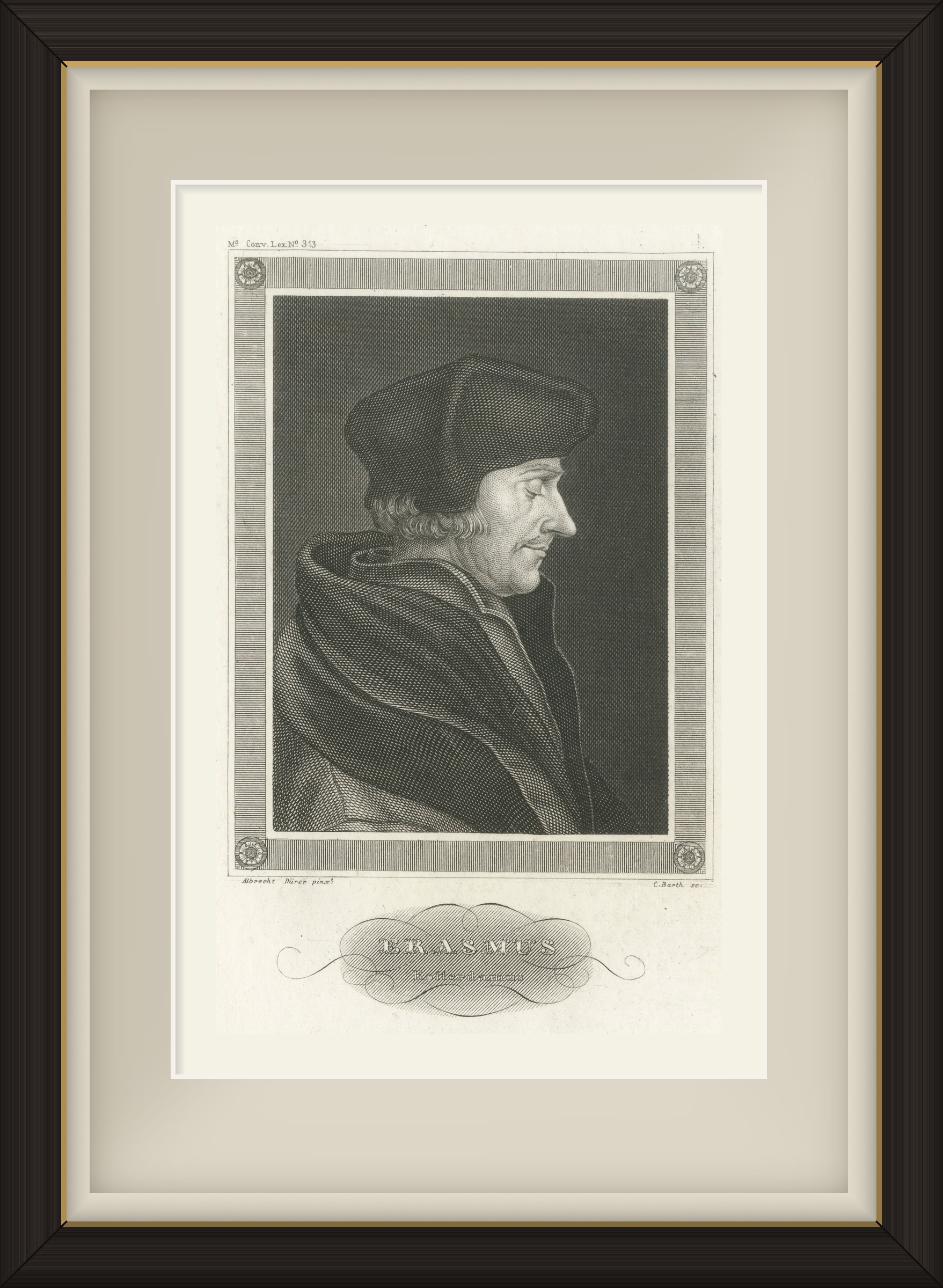
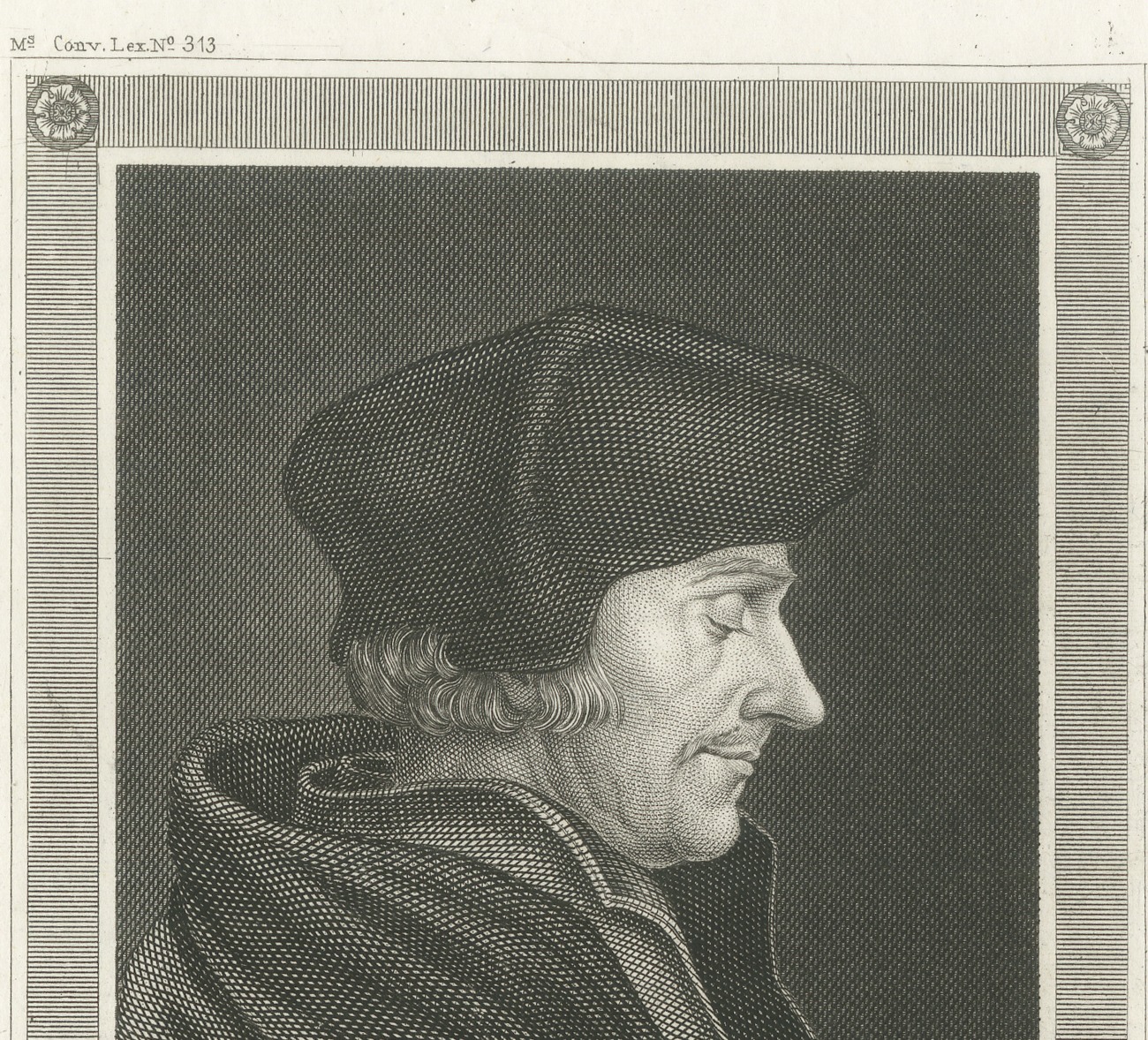
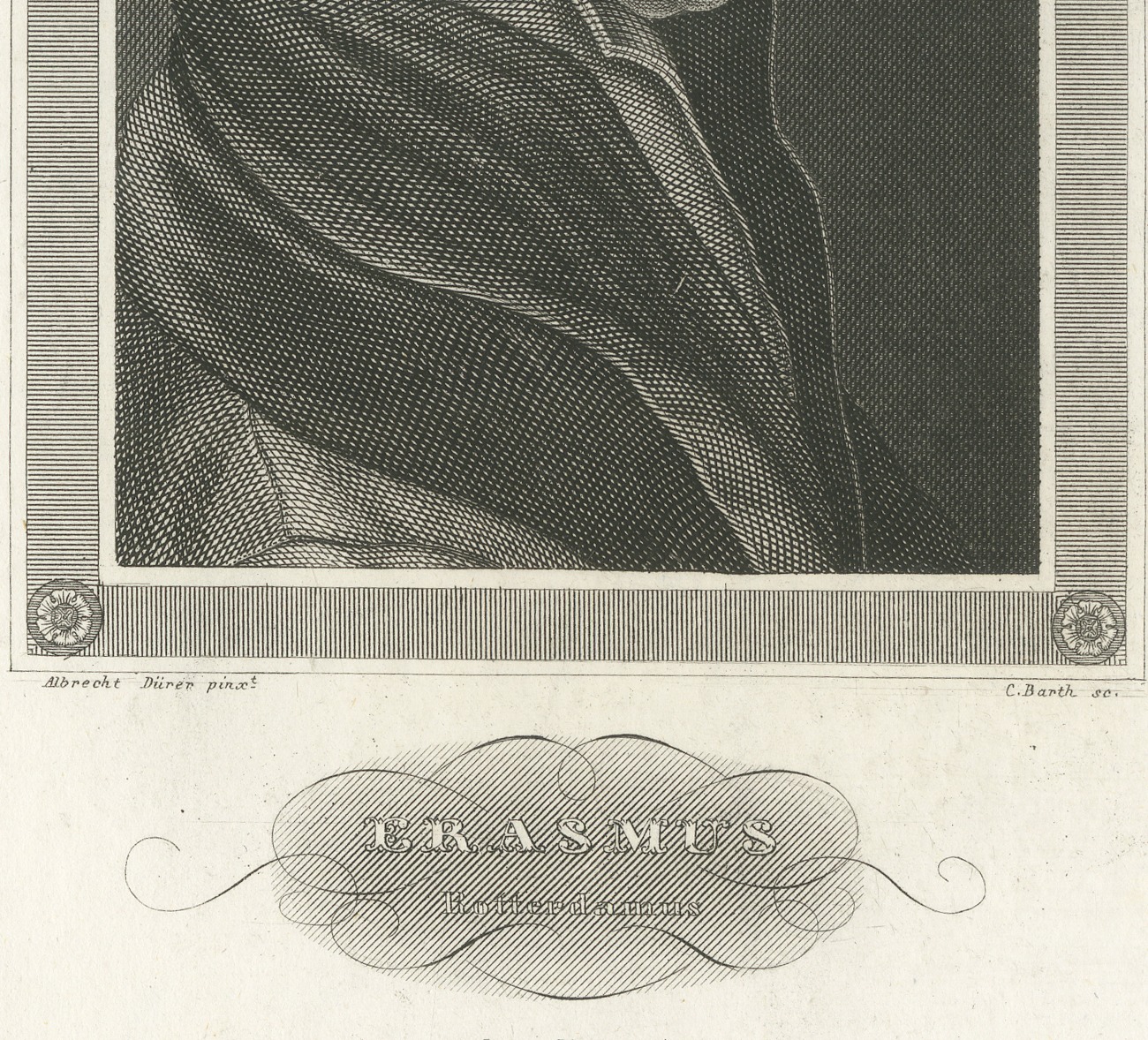
An original steel engraved portrait of Desiderius Erasmus of Rotterdam, issued as a plate of Meyer's Conversations-Lexicon by the Bibliographisches Institut in the 1840s. The sitter is shown in strict profile to the right, eyes lowered, wearing a soft scholar's cap and a heavy gown with a deep folded collar, set against a dark ground.
The image sits within a ruled frame of fine vertical and horizontal lines with a rosette at each corner. Beneath it an ornamental cartouche of flourished lines is lettered "ERASMUS" in shaded capitals, with "Rotterdamus" below. The credits read "Albrecht Dürer pinx." at lower left and "C. Barth sc." at lower right, the imprint "Inst. Bibl. excud." stands below the cartouche, and the upper left corner carries the plate reference "Ms. Conv. Lex. No. 313".
Desiderius Erasmus (circa 1466 to 1536) was the leading humanist scholar of the northern Renaissance, author of The Praise of Folly and editor of the Greek New Testament of 1516. His correspondence reached every learned center in Europe, and his likeness was drawn, painted and engraved by Dürer, Holbein and Quentin Matsys in his own lifetime.
The Bibliographisches Institut, founded by Joseph Meyer, published its great Conversations-Lexicon from 1840 onward in Hildburghausen, illustrating it with a long series of steel engraved portraits, views and plates. Carl Barth was one of the engravers who worked for the firm. The steel plate allowed very fine, even work, seen here in the woven texture of the gown and the soft modeling of the face.
A portrait of Erasmus is a natural choice for a scholar's study, a library or a collection of Renaissance and Reformation figures, and it frames well with a generous mat.
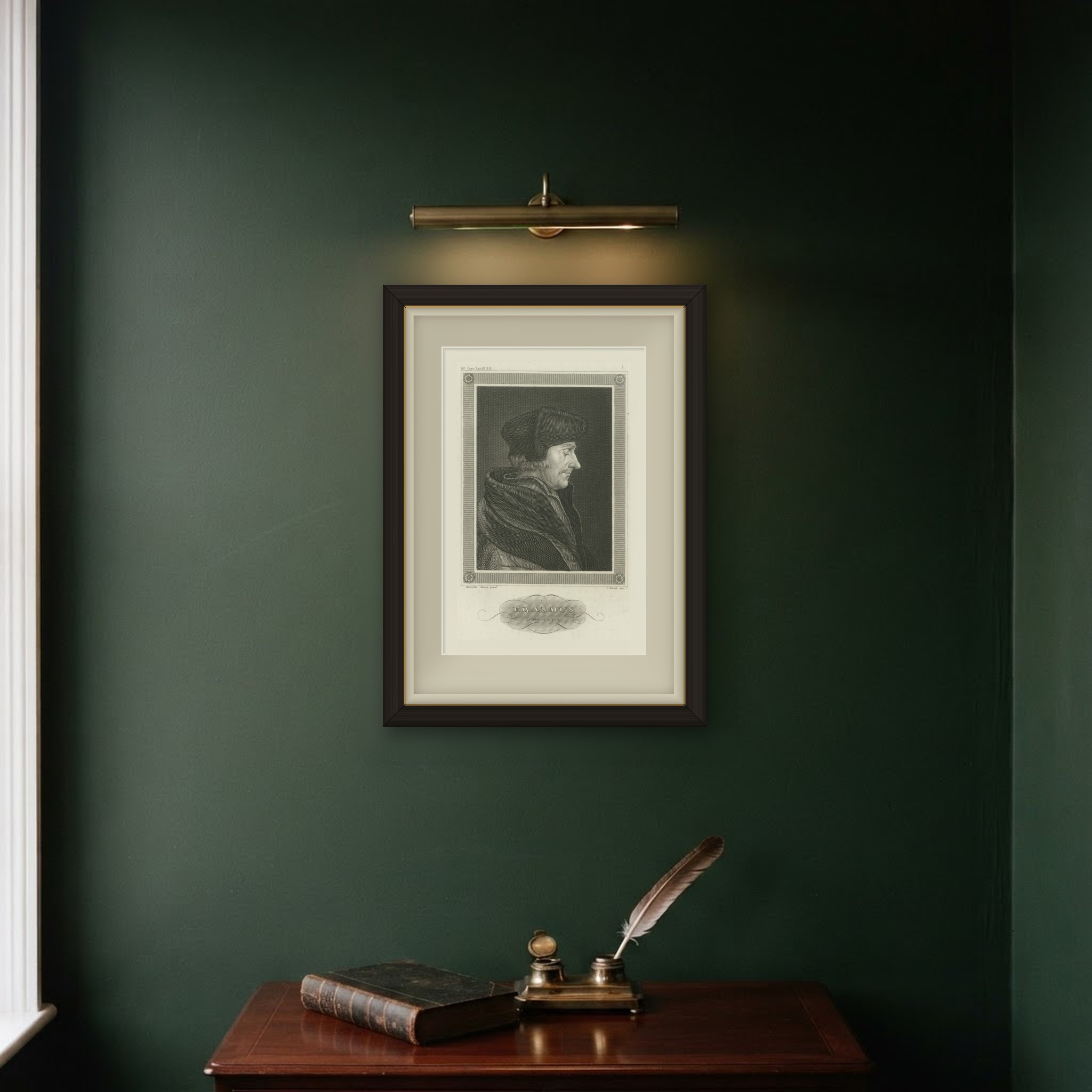
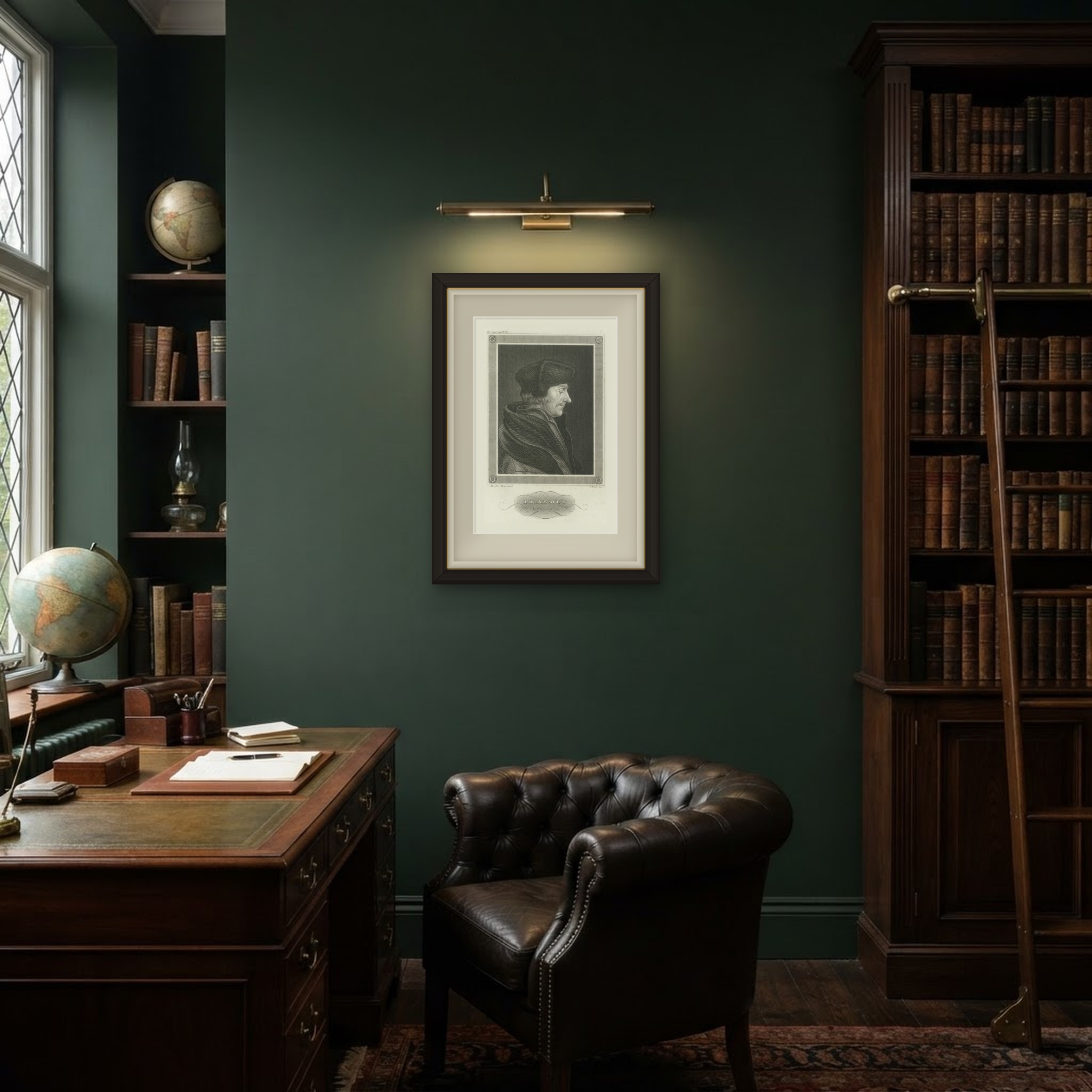
This is an original antique print, not a modern reproduction. This item is sold unframed. Any framed or interior images are shown for presentation and inspiration only, unless the listing explicitly states that the item is sold framed.