About this sheet
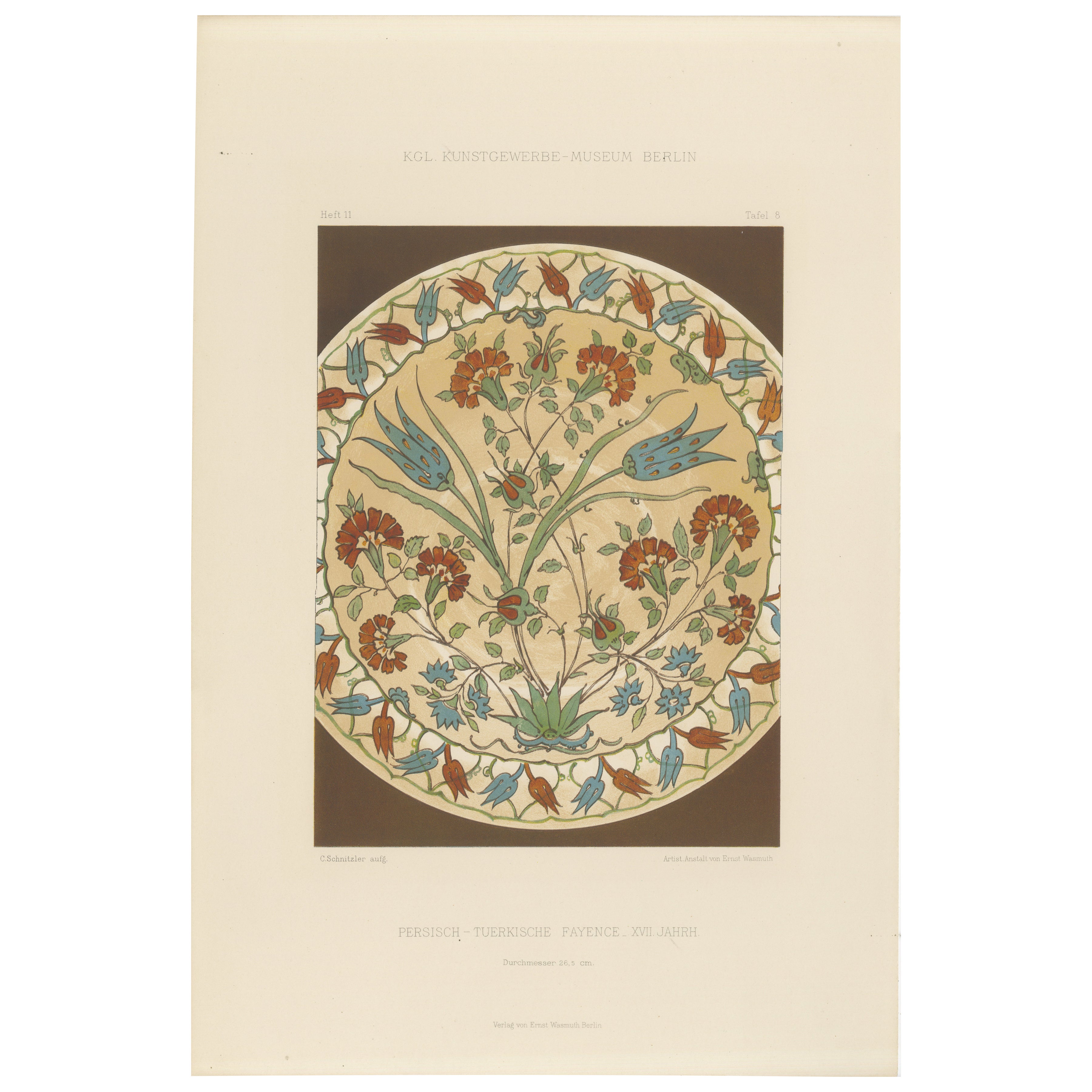
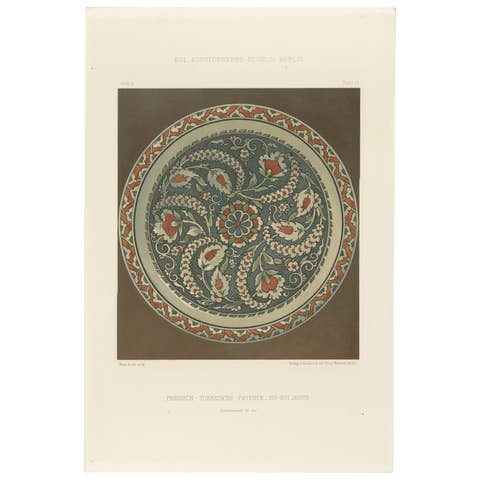
Persian-Turkish Faience Plate with Tulip and Carnation Design – Julius Lessing, Berlin 1890
An elegant chromolithograph from Persisch-Türkische Fayencen (Persian-Turkish Faience), published by Ernst Wasmuth, Berlin, in 1890 as part of Vorbilder-Hefte aus dem Königlichen Kunstgewerbe-Museum, Heft 11, under the direction of Julius Lessing. This plate (Tafel 8) reproduces a 17th-century Persian-Turkish faience dish from the renowned collection of the Royal Museum of Decorative Arts in Berlin.
The design displays a delicate balance of naturalism and symmetry characteristic of late 16th–17th-century Iznik pottery. The composition centers on an elegant spray of stylized tulips and carnations rising from a leafy base, surrounded by smaller floral vines and blossoms. The outer rim features alternating blue and red tulip motifs connected by a winding tendril, symbolizing vitality and renewal.
Set against a warm beige ground, the colors — turquoise blue, soft green, coral red, and ivory — evoke the subtle elegance of Ottoman ceramics. The stylized flowers are rendered with lyrical precision, blending Persian-inspired floral motifs with the Ottoman taste for geometric rhythm and vivid contrast. This form of faience, known for its underglaze-painted decoration, flourished in the city of Iznik and reflects the cosmopolitan artistry of the Ottoman Golden Age.
Drawn by C. Schnitzler and printed by Ernst Wasmuth in Berlin, this chromolithograph captures both the technical brilliance and the serene beauty of the original ceramic. Julius Lessing’s series aimed to preserve and share the decorative heritage of world art through high-quality color reproductions, serving as invaluable references for designers, artists, and collectors of the 19th century.
Condition report:
Excellent condition with vibrant color retention and full margins. Minor age toning to paper edges, otherwise clean and bright.
Framing tips:
Best presented in an ivory or pale cream mat with a gold or dark wood frame to complement the warm background tones and accentuate the rich blues and reds. This print pairs beautifully with other plates from the Persisch-Türkische Fayencen series.