About this sheet
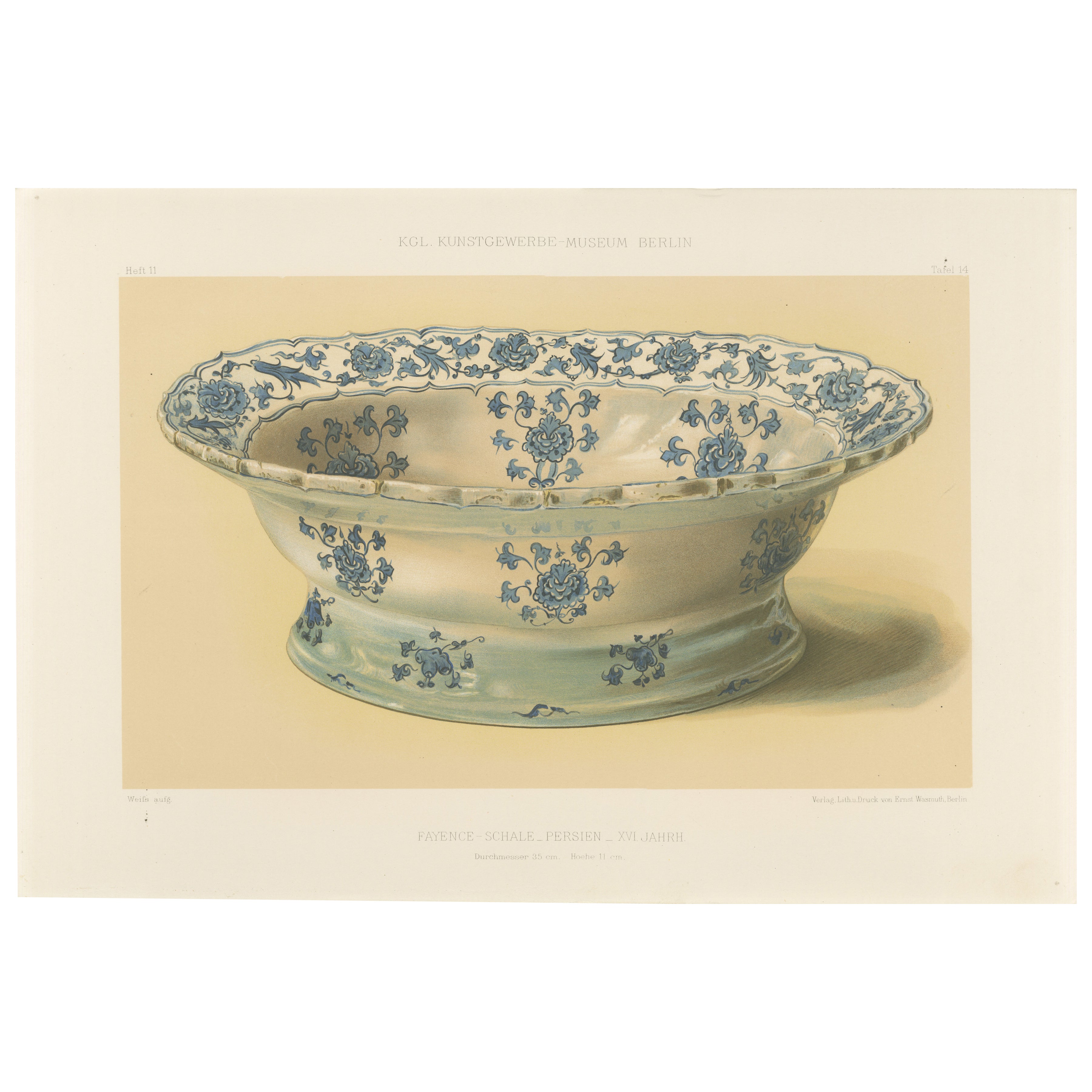
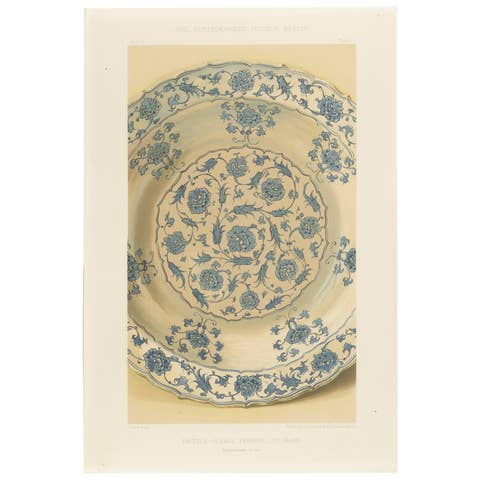
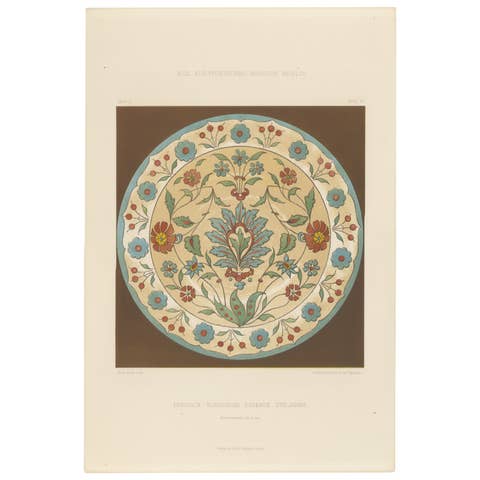
Persian Faience Bowl with Blue Floral Ornament – Julius Lessing, Berlin 1890
A refined chromolithograph from Persisch-Türkische Fayencen (Persian-Turkish Faience), published by Ernst Wasmuth in Berlin, 1890, under the direction of Julius Lessing for Vorbilder-Hefte aus dem Königlichen Kunstgewerbe-Museum, Heft 11. This plate (Tafel 14) depicts a magnificent Persian faience bowl from the 16th century, preserved in the Royal Museum of Decorative Arts, Berlin (Kgl. Kunstgewerbe-Museum Berlin).
This large bowl, with a diameter of 35 cm and a height of 11 cm, exemplifies the height of Persian ceramic artistry during the Safavid period. The delicate blue floral ornamentation, painted over a pale ivory glaze, reveals an exquisite mastery of underglaze decoration. Clusters of stylized roses and arabesques encircle the body, flowing naturally around the vessel’s curves, while the undulating rim is bordered with a scrolling vine pattern in harmonious repetition.
The piece’s refined translucence and painterly quality highlight the fusion of Persian craftsmanship with influences from Chinese porcelain—particularly evident in the use of cobalt blue under transparent glaze. Such wares were prized both domestically and throughout the Ottoman and Mughal empires for their elegance and technical excellence.
Drawn by Wechs, and printed by *Verlag Lith. Druck von Ernst Wasmuth, Berlin*, this chromolithograph was part of Julius Lessing’s initiative to document the decorative arts of the Islamic world. The *Vorbilder-Hefte* series became an invaluable source of inspiration for artists and designers during the late 19th century, celebrating the timeless harmony and sophistication of Persian ornamentation.
Condition report:
Excellent condition with bright, unfaded colors and clean paper. Minor age toning near the margins; otherwise crisp and well-preserved with full borders intact.
Framing tips:
A perfect statement piece when framed with a light ivory mat and simple dark wood frame. Its soft blues pair beautifully with neutral interiors or as part of a collection of Persian or Oriental ceramic designs.
Technique: Chromolithograph
Maker: Julius Lessing, Berlin, 1890