About this sheet
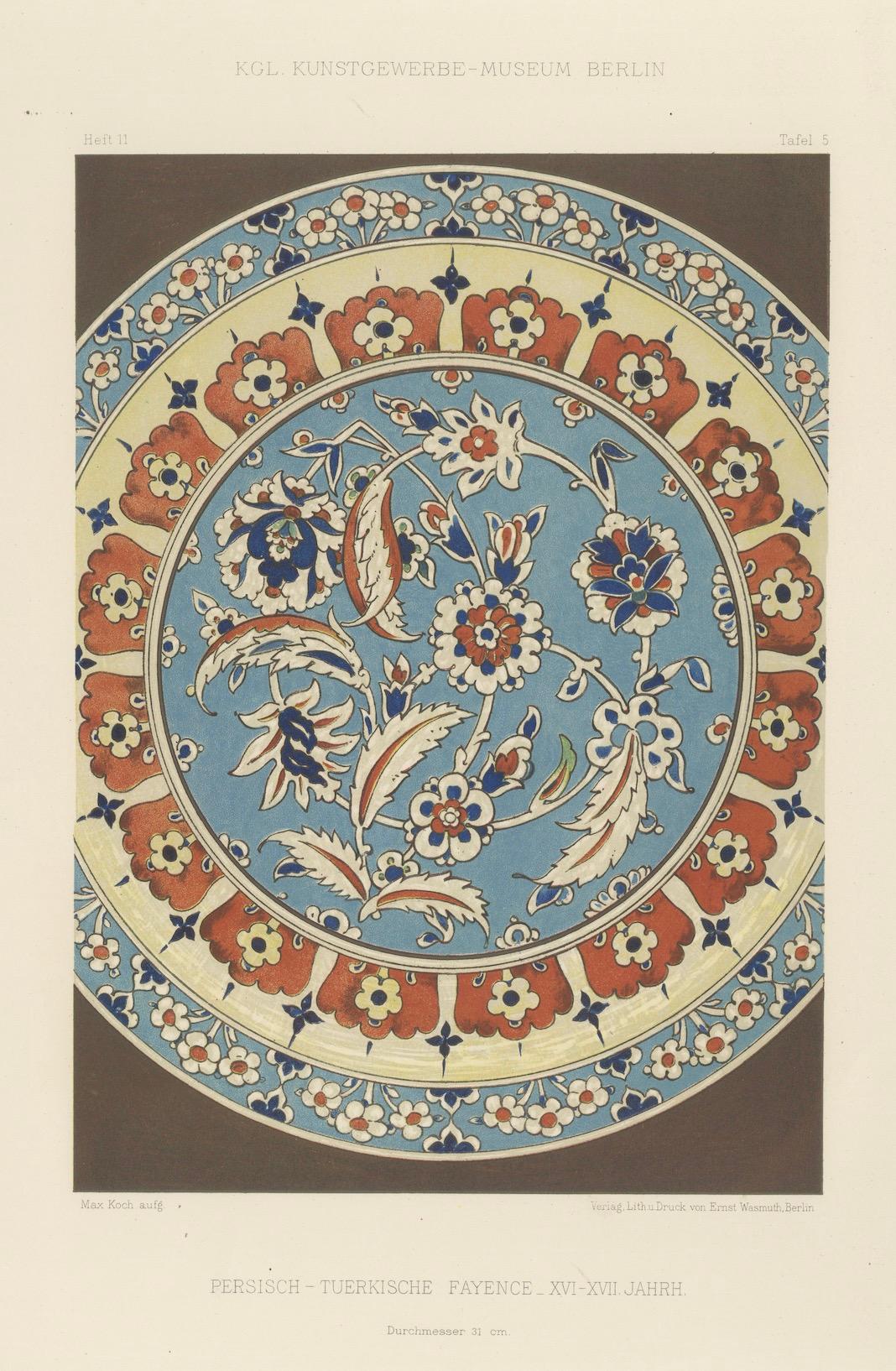
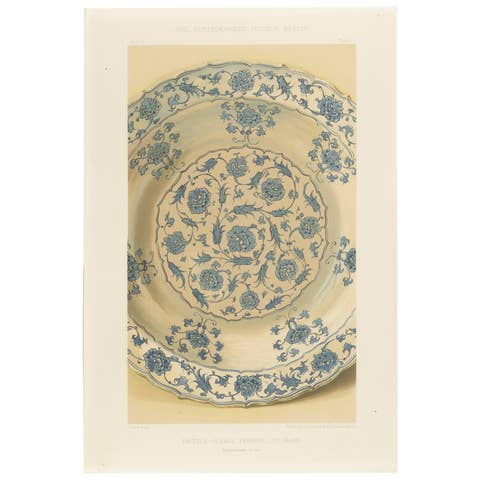
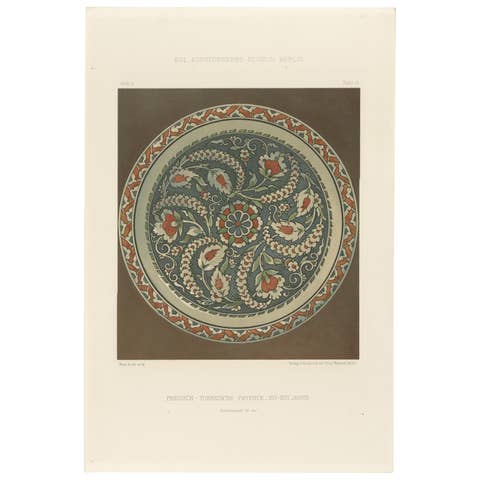
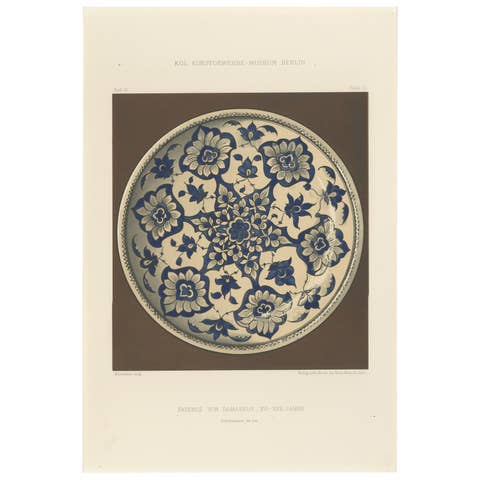
Persian-Turkish Faience Plate with Carnation and Tulip Motif – Julius Lessing, Berlin 1890
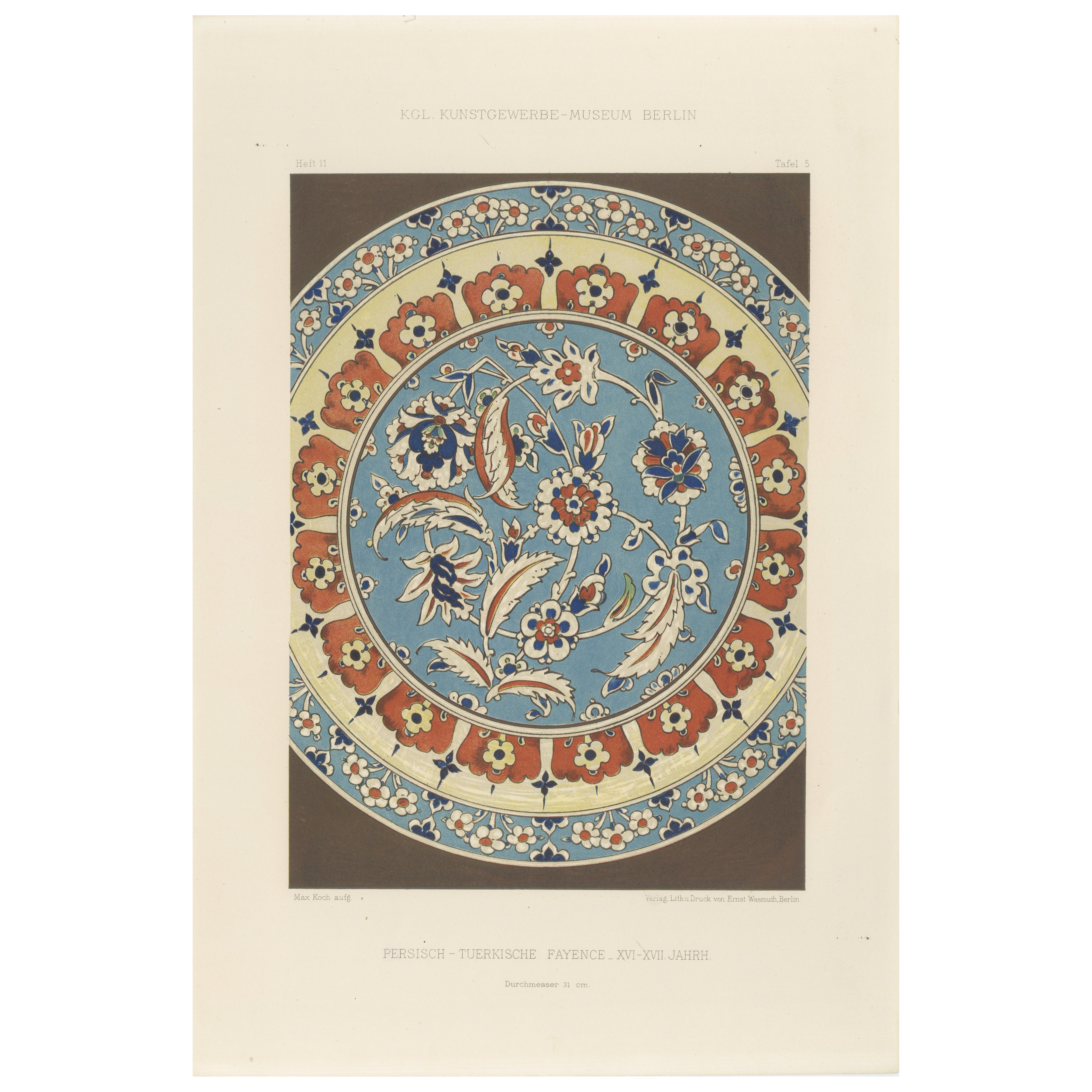
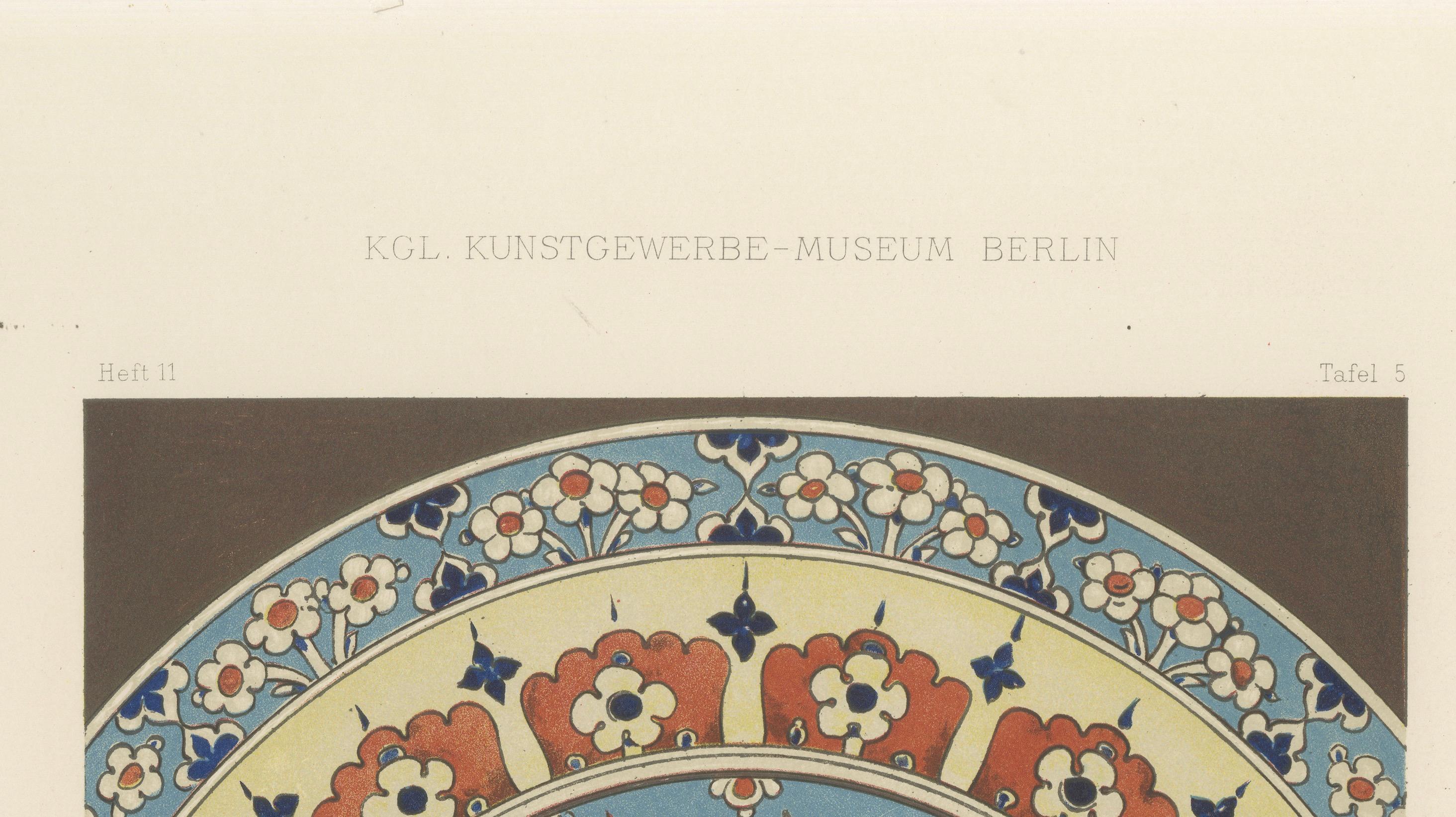
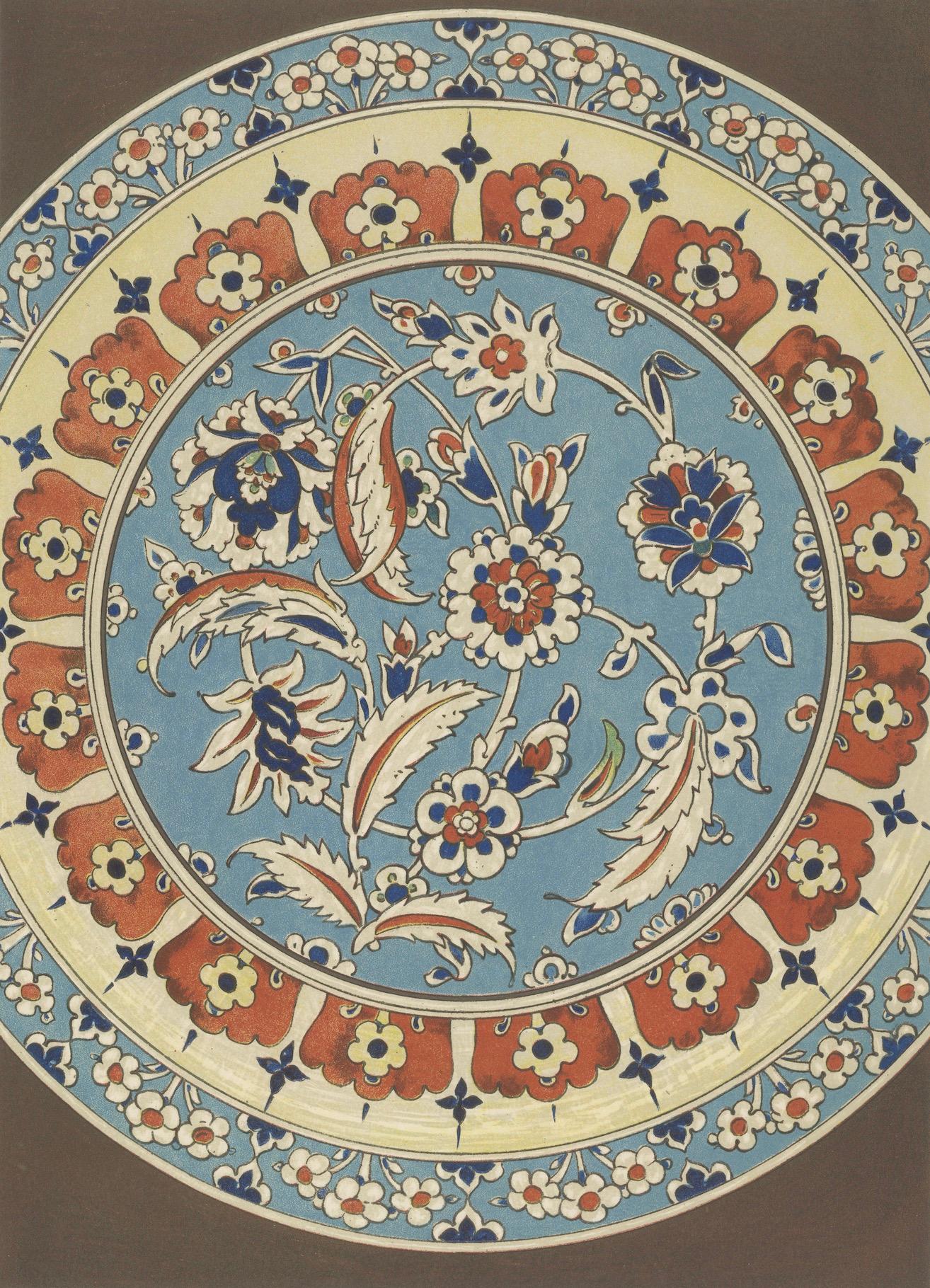
A richly detailed chromolithograph from Julius Lessing’s Persisch-Türkische Fayencen (Persian-Turkish Faience), published by Ernst Wasmuth, Berlin, in 1890 as part of Vorbilder-Hefte aus dem Königlichen Kunstgewerbe-Museum, Heft 11. This print (Tafel 5) reproduces a 16th–17th-century faience plate from the collection of the Royal Museum of Decorative Arts in Berlin, celebrated for its refined Islamic ceramics.
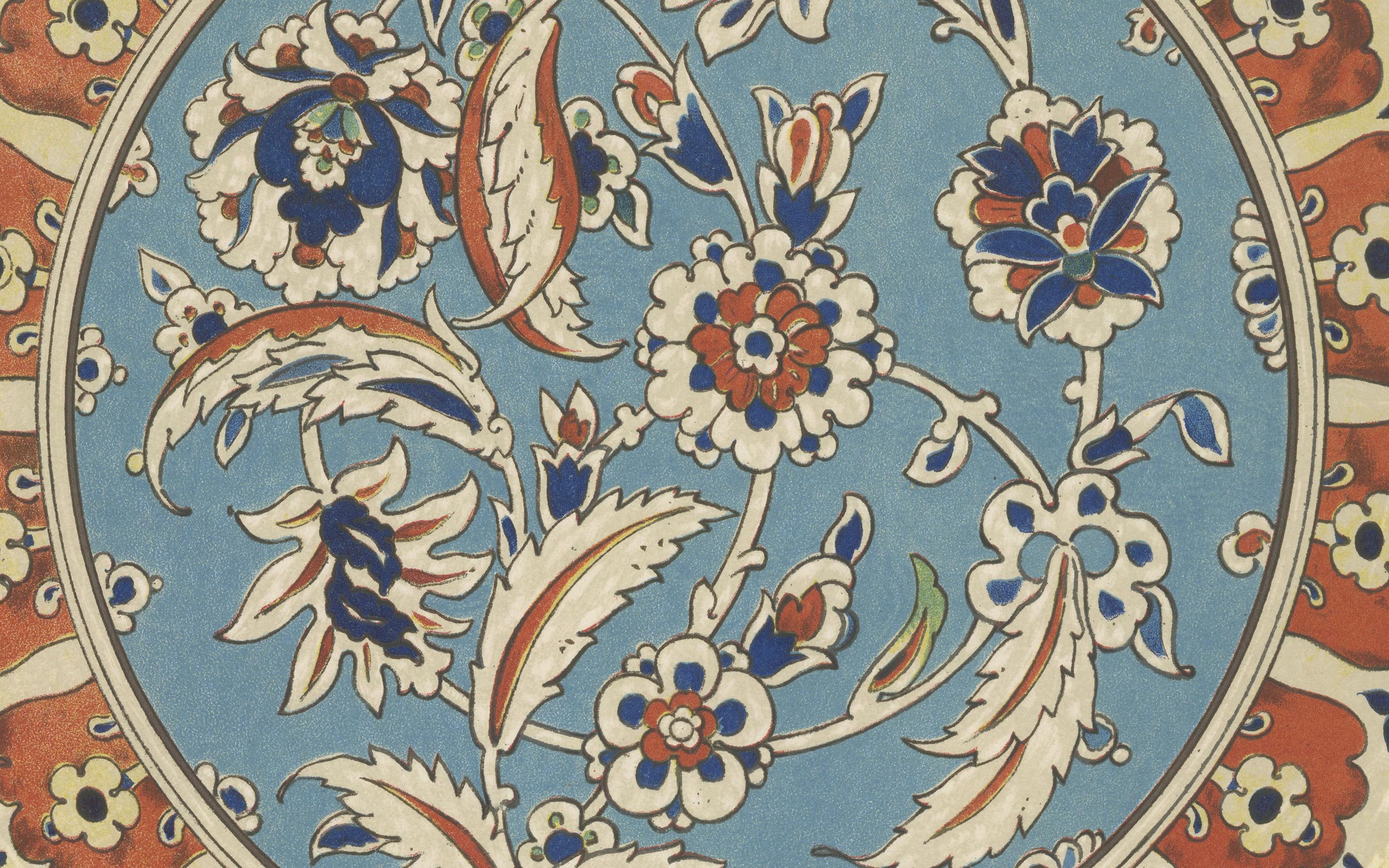
The design showcases a beautifully balanced floral composition in the Iznik style, with curving stems of carnations, tulips, and stylized blossoms set against a brilliant turquoise ground. The central medallion is framed by a bold red floral band and an outer border of delicate white and blue rosettes, creating a vivid interplay of color and rhythm. The contrasting hues of deep coral red, cobalt blue, and creamy white evoke the brilliance of Ottoman faience, while the intricate linear ornamentation reflects the Persian tradition of symmetrical botanical design.
This type of decoration flourished in the workshops of Iznik during the 16th century under Ottoman patronage, inspired by Persian Safavid prototypes. It epitomizes the meeting of two great artistic cultures—Persia’s refined stylization and Turkey’s mastery of ceramic craftsmanship. The result is both ornamental and deeply symbolic, representing natural abundance and spiritual harmony.
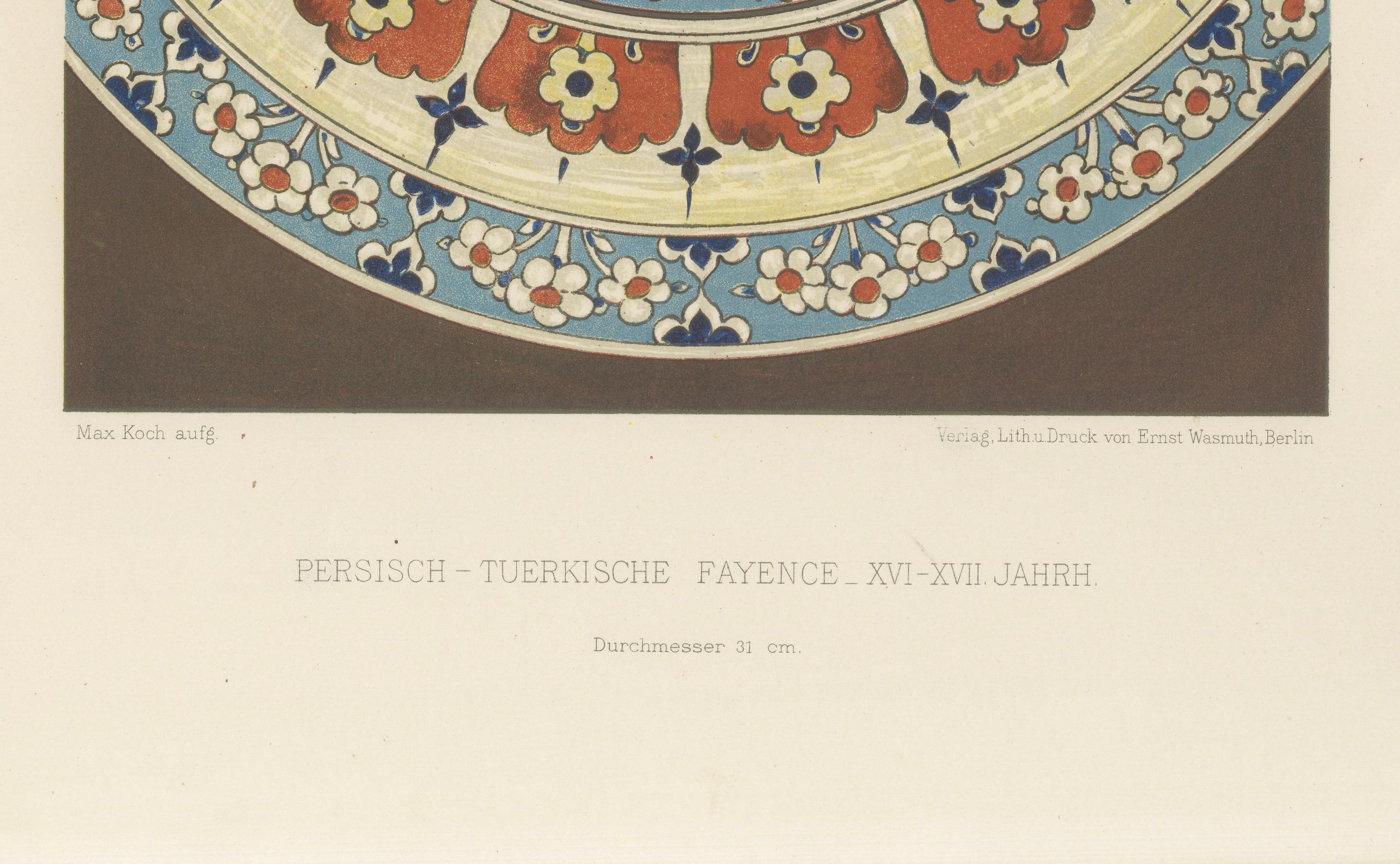
Drawn by Max Koch and printed by Ernst Wasmuth in Berlin, this plate was produced under the supervision of Julius Lessing (1843–1908), the pioneering art historian and director of the Königliches Kunstgewerbemuseum. His *Vorbilder-Hefte* series was designed to document and share great works of decorative art for artists, craftsmen, and collectors, and remains one of the most beautiful 19th-century chromolithographic publications on Islamic art.
Condition report:
Excellent condition with full margins and bright, saturated colors. Very light age toning and faint handling marks near edges. The image area is clean and sharp, with superb preservation of original chromatic detail.
Framing tips:
A neutral ivory mat paired with a gold or dark wood frame brings out the warm reds and cool blues harmoniously. For an elegant wall display, this print pairs well with other plates from Lessing’s *Persisch-Türkische Fayencen* series.
Technique: Chromolithograph
Maker: Julius Lessing, Berlin, 1890