About this sheet
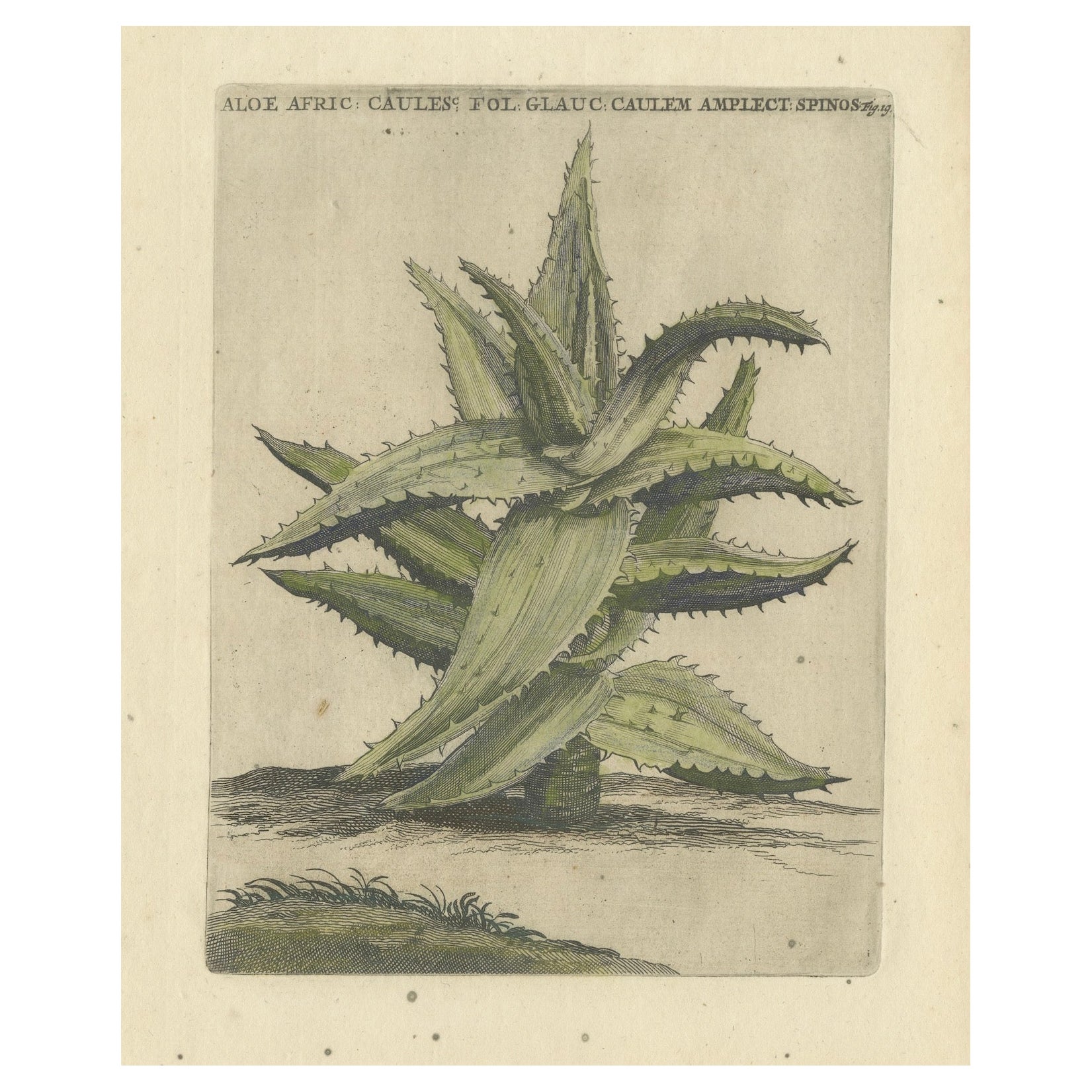
This engraving is a botanical illustration possibly from Caspar Commelin's "Praeludia Botanica," published in 1703. It depicts the Aloe ferox, a species of African aloe, known for its large, spiny leaves. The engraving is titled in Latin, Aloe Afric: Caulesc: Fol: Glauc: Caulem Amplect: Spinos," which translates to "Caulescent African Aloe, broad, clasping, spiny leaves."
This engraving is potentially a proof print of Caspar Commelin's work, "Horti Medici Amstelaedamensis Plantæ Rariores et Exoticæ ad Vivum Æri Incisæ," published in 1706 by Fredericum Haringh in Leiden (Lugduni Batavorum).
The style, botanical detail, and Latin labeling in the engraving align with the scientific and illustrative approach typical of the Commelins' botanical works. The use of detailed plant illustrations in their publications, engraved directly from life ("ad vivum"), aimed to document the rare and exotic plants housed at the Amsterdam Hortus Medicus.
Given that proof prints were often created to check the quality and accuracy of engravings before the final prints were included in a published work, this piece could be part of the preparatory stages of Commelin’s famous botanical publications. The 1706 edition of Caspar Commelin's work, following Jan Commelin's earlier efforts, fits the timeline and the subject matter of this engraving.
The illustration matches the descriptions and layout found in the final published works, so it is likely a proefdruk from the "Horti Medici Amstelaedamensis" or a related botanical collection.
Jan Commelin, a 17th-century medical doctor and director of botany at the Amsterdam Hortus Medicus, was a pioneering figure in the classification of exotic plants sent from distant regions. He authored the influential "Horti Medici Amstelodamensis Rariorum," published in 1697, a work that cataloged rare plants from around the world. After his death, his nephew Caspar Commelin continued and completed the project, contributing to the documentation of over 360 species, including 229 from Africa, 97 from the Americas, and 41 from Asia.
The Commelins are regarded as some of the most important early botanists for their role in cataloging and classifying the newly discovered plant species being brought to Europe during the age of exploration. Their meticulous work laid the foundation for later botanical studies and greatly contributed to the knowledge of global plant biodiversity.
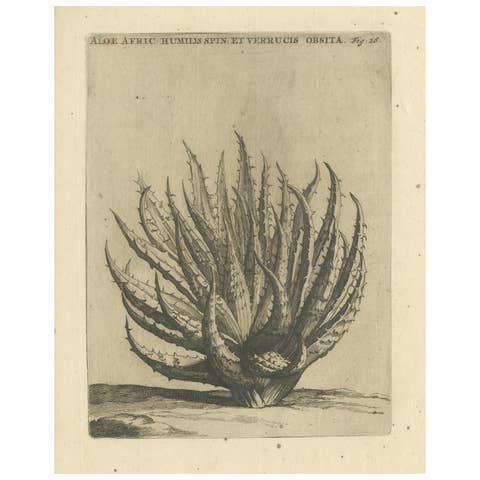
The engraving shows a fully grown aloe plant with thick, pointed leaves arranged in a rosette pattern. The leaves are broad and spiny, curving outward from the base. The plant is set against a simple background, allowing the viewer to focus on the botanical details.
- Leaf Texture: The engraving carefully captures the rough texture and the jagged edges of the aloe’s leaves. Each leaf is spiny, with serrated margins typical of the Aloe ferox species.
- Base and Growth Pattern: The base of the plant is well-detailed, showing the attachment of the leaves to the stem. The illustration emphasizes the caulescent (stem-forming) nature of the plant, with leaves growing from the central axis.
The coloring of the illustration, with shades of green and subtle highlights, indicates that this is a hand-colored engraving, a common practice for botanical works during the 17th and 18th centuries to give a more lifelike representation of the plants.
What It Shows: This engraving illustrates the Aloe ferox, an African species known for its medicinal properties. The aloe is native to South Africa and has been used for centuries for its healing qualities, particularly for its sap, which has soothing and laxative effects. The detailed illustration is meant to show both the aesthetic and botanical features of the plant, such as its spiny leaves and succulent structure.
This engraving would have been an important reference for European botanists and herbalists in the 18th century, as they sought to categorize and understand the medicinal and economic potential of plants brought from the colonies and distant lands.