About this sheet
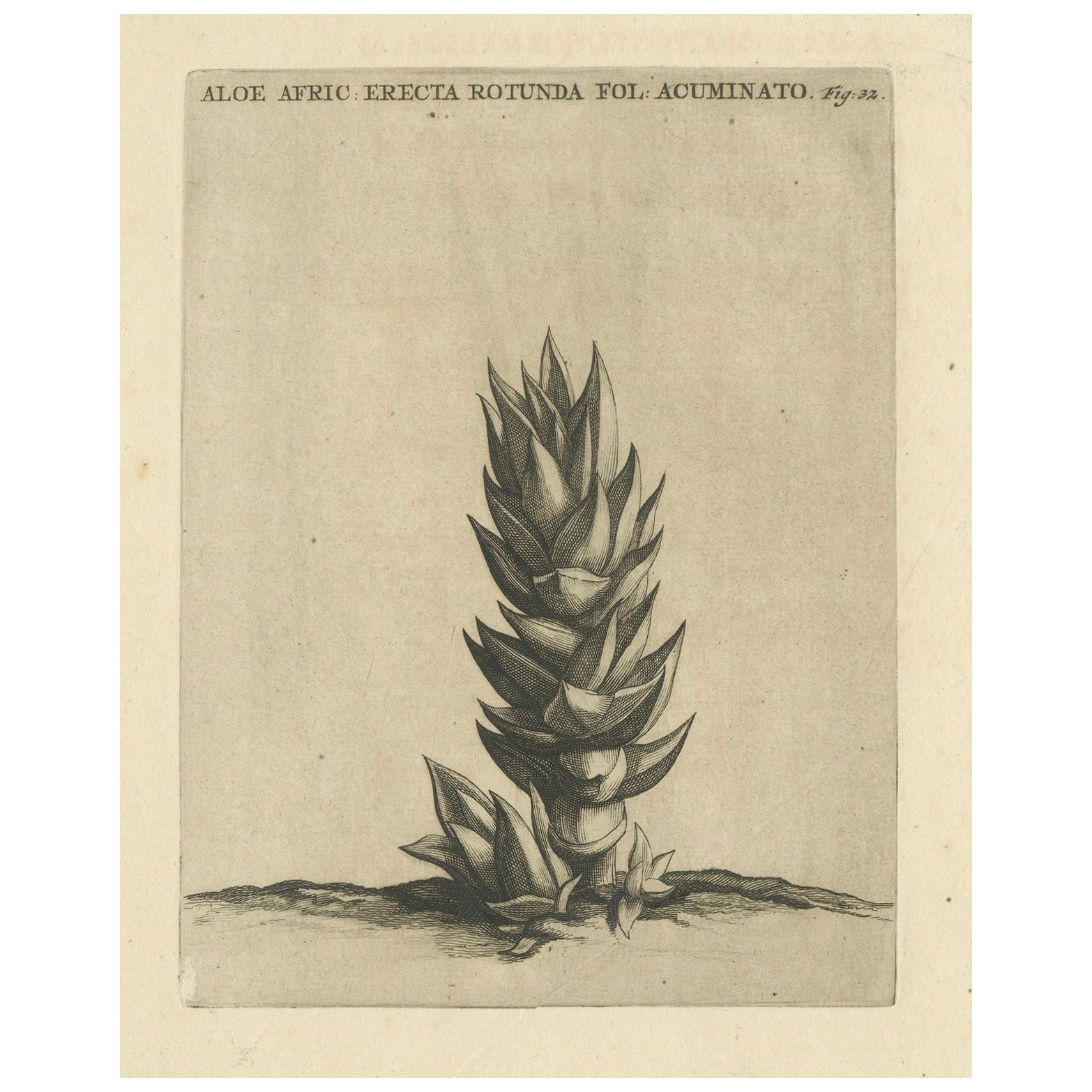
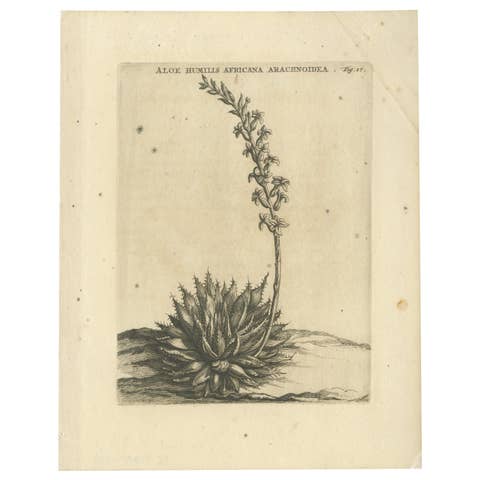
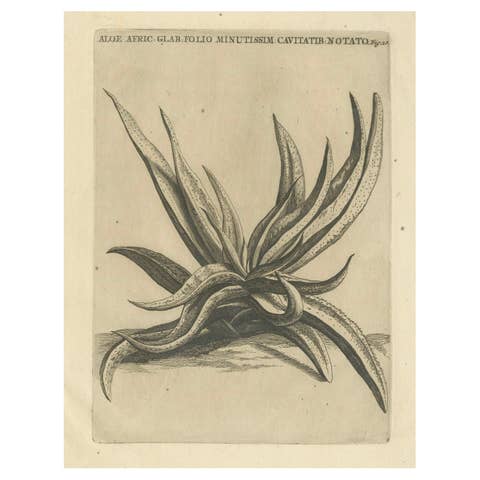
Botanical Engraving of Aloe Afric Erecta from Caspar Commelin's Work, 1706
This engraving is likely a botanical illustration from Caspar Commelin's "Praeludia Botanica," published in 1703. It depicts Aloe Afric Erecta Rotunda Fol Acuminato, an African aloe species with erect, round, pointed leaves. The Latin title translates to "African Aloe with erect, round, pointed leaves."
This engraving could be a proof print (proefdruk) of Caspar Commelin's work, "Horti Medici Amstelaedamensis Plantæ Rariores et Exoticæ ad Vivum Æri Incisæ," published in 1706 by Fredericum Haringh in Leiden (Lugduni Batavorum).
The style and botanical detail in the engraving align with the scientific and illustrative approach typical of the Commelins' botanical works. These illustrations were often created directly from life ("ad vivum") to document rare and exotic plants, many of which were housed at the Amsterdam Hortus Medicus.
Given that proof prints were commonly produced to ensure accuracy before inclusion in published works, this engraving may be part of the preparatory process for Commelin's publications. It fits with the layout and descriptions found in the 1706 edition of Caspar Commelin's botanical works, which continued the legacy initiated by his uncle, Jan Commelin.
The engraving shows a compact aloe plant with erect, pointed leaves arranged in a spiral formation. The leaves are thick and rounded at the base, tapering to a sharp point at the tip.
- Leaf Structure: The illustration emphasizes the aloe’s pointed, angular leaves, which are stacked closely along the plant’s central axis. The texture and shading of the leaves are captured in fine detail, highlighting their natural shape and structure.
- Growth Pattern: The aloe is portrayed in a compact, upright form, with its leaves spiraling upward from the base. The simple background directs attention to the botanical details of the plant.
What It Shows:
The engraving provides a detailed depiction of an African aloe species, Aloe Afric Erecta, known for its compact, upright form and pointed leaves. The plant is native to Africa and valued for its ornamental and medicinal properties. This engraving serves as an accurate scientific illustration, helping botanists and herbalists study the plant's unique characteristics.
This engraving likely contributed to European efforts in the 18th century to classify and document exotic species, focusing on their botanical features and potential uses.