About this sheet
St Mary’s Church, Bury St Edmunds, Suffolk – Antique Engraving, 1779
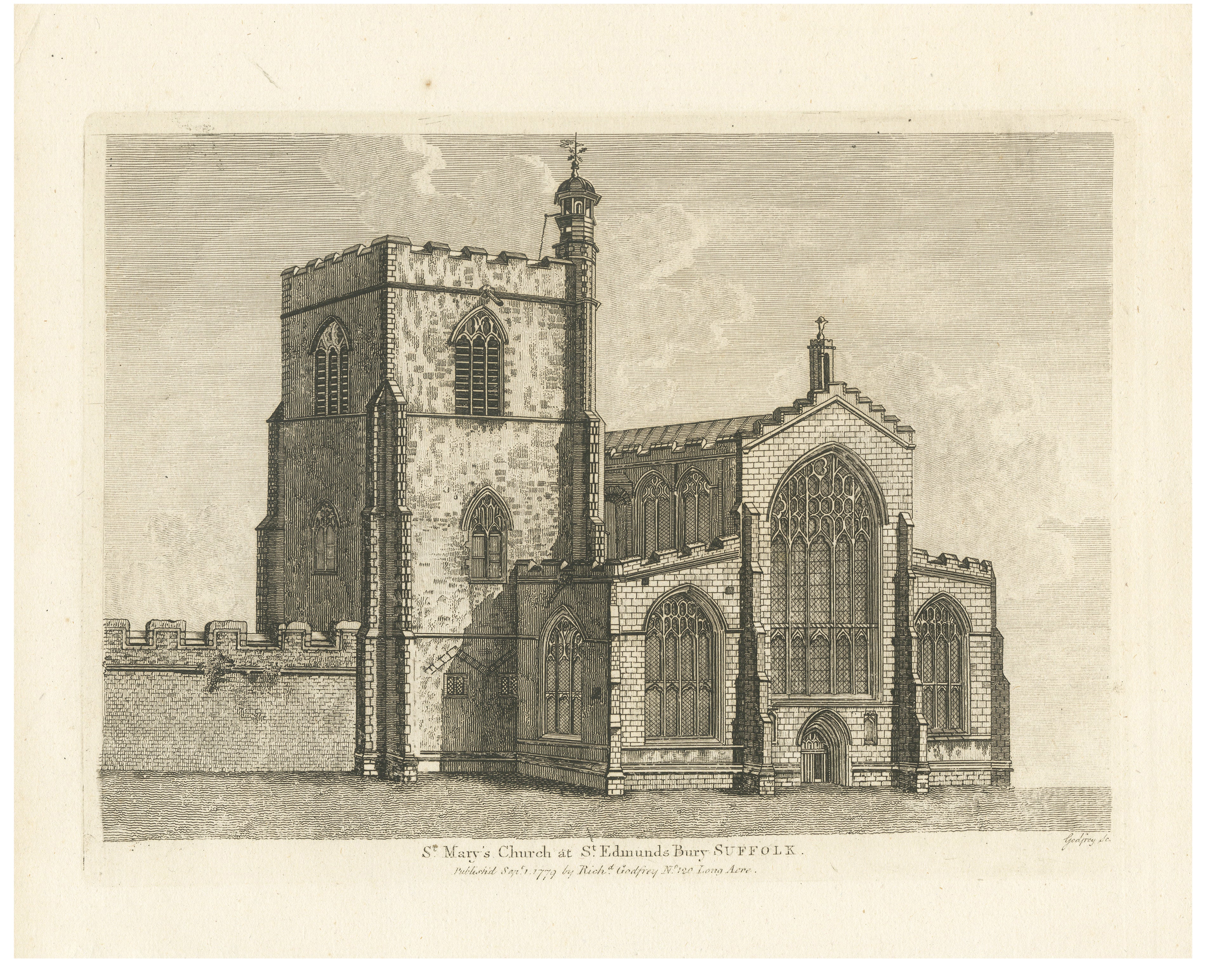
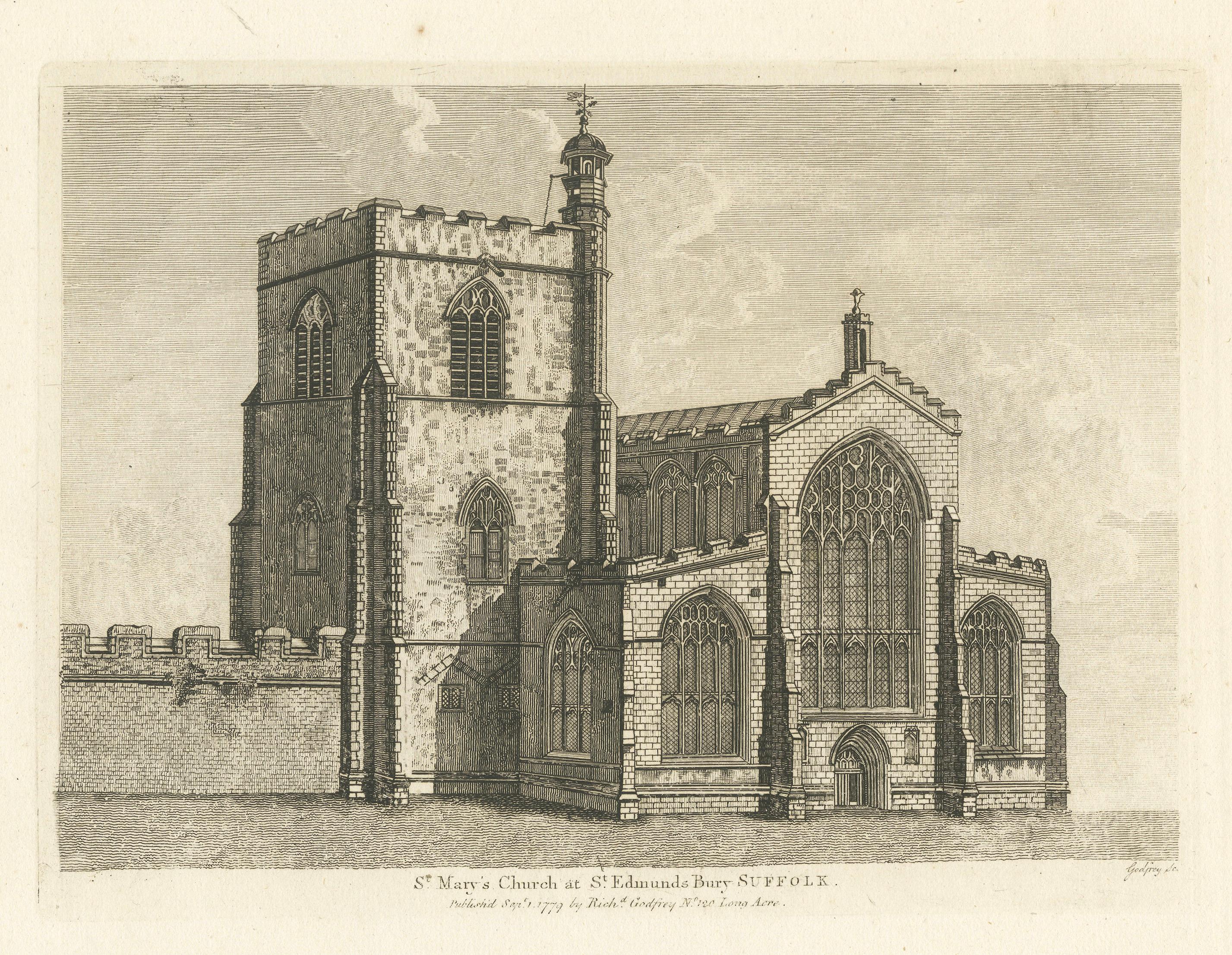
This finely executed 18th-century copperplate engraving depicts St Mary’s Church in Bury St Edmunds, one of the most historically significant ecclesiastical buildings in Suffolk, England. The print presents a detailed architectural view of the church exterior, capturing the imposing Gothic structure with remarkable clarity and precision. Published on September 1, 1779, by Richard Godfrey of No. 120 Long Acre in London, the engraving was produced for the antiquarian publication The Antiquarian Repertory, an influential late 18th-century work dedicated to documenting Britain’s historic monuments, architecture, and antiquities.
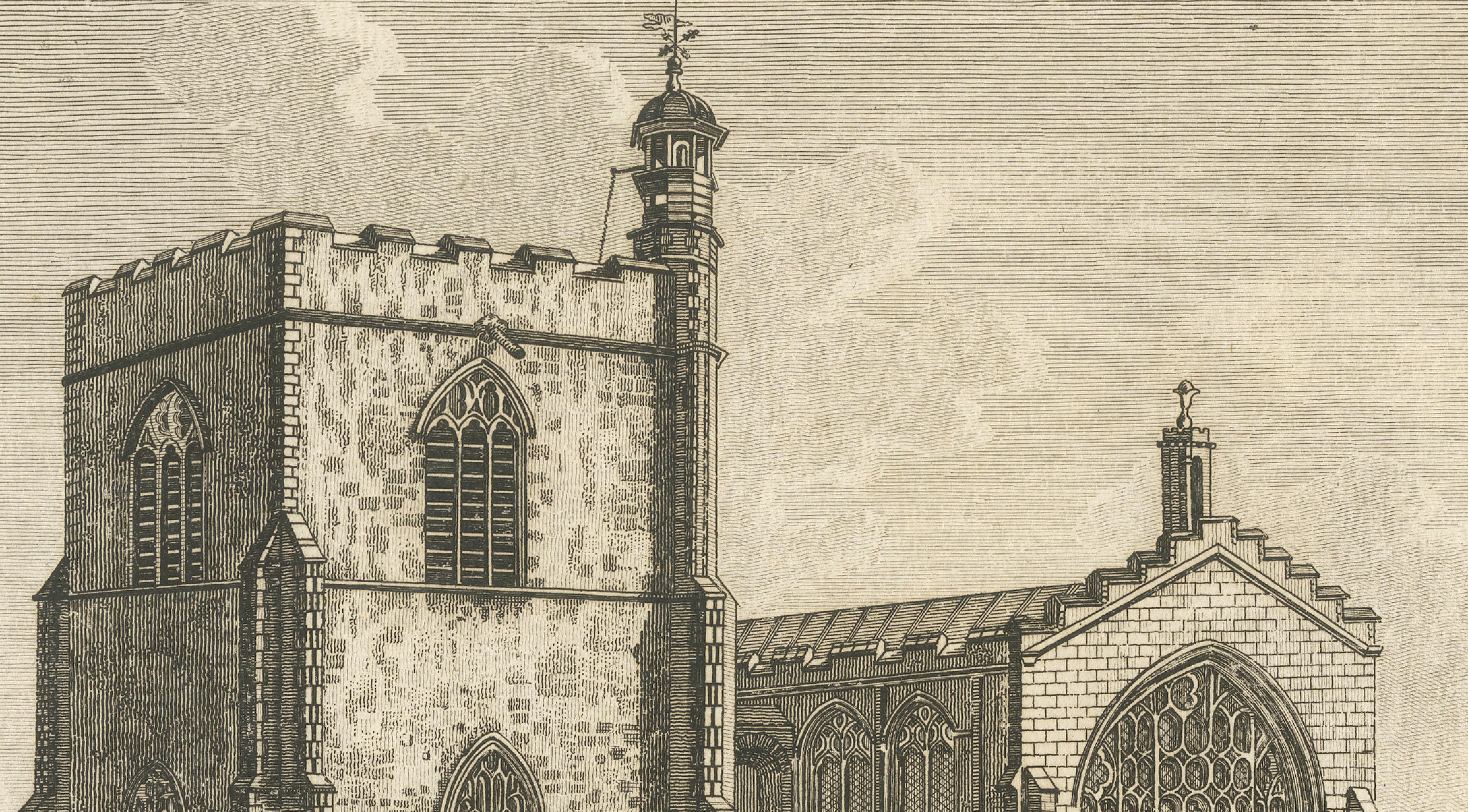
The composition shows the church from an oblique perspective, allowing the viewer to appreciate the building’s massive square tower alongside the nave and the large traceried windows characteristic of late medieval English Gothic architecture. The crenellated tower, strong buttresses, and tall pointed windows emphasize the verticality and solidity typical of parish churches built or expanded during the Perpendicular Gothic period. The detailed stonework and window tracery are carefully rendered, reflecting the antiquarian interest in recording architectural heritage with accuracy.
St Mary’s Church in Bury St Edmunds stands beside the famous ruins of the medieval Abbey of St Edmund, once one of the wealthiest Benedictine monasteries in England. Following the Dissolution of the Monasteries under Henry VIII in the 16th century, the abbey fell into ruin, while St Mary’s Church continued to serve as an important parish church for the town. The building itself dates largely from the 14th and 15th centuries and has long been associated with significant historical figures and events. It is also known as the burial place of Mary Tudor, Queen of France and sister of King Henry VIII, whose tomb lies within the church.
During the 18th century, growing interest in Britain’s medieval heritage led antiquarians and scholars to document historic buildings through engravings such as this one. Publications like *The Antiquarian Repertory* played an important role in preserving visual records of historic sites before restoration campaigns and later architectural changes altered their appearance.
The engraving is finely engraved with delicate line work that highlights the architectural details while maintaining a balanced and elegant composition. Today it remains both a valuable historical record of the church and a beautiful example of Georgian antiquarian illustration.
Condition: Good condition for age with general age-related toning and occasional light spotting, mostly visible in the margins. The engraving itself remains clear with a strong impression. Blank verso.
Framing tips: This architectural print displays beautifully in a classic dark wood or ebonized frame with an ivory or warm off-white mat. The generous margins allow for an elegant presentation that emphasizes the refined architectural detail.
Technique: Copperplate engraving
Maker: Richard Godfrey, London, 1779