Rare Engraved Prints of Skulls of an Eskimo Dog and The Icelandic SheepDog, 1842
€ 850
Original antique · The actual sheet photographed · Certificate of authenticity on request · Sold unframed · Worldwide shipping from € 15 (rates)
Date
1842
Sheet size
32 × 54 cm (12.6 × 21.3 in)
Condition
Good
Reference
PCT-57742
What the condition grades mean
Excellent
Bright and clean, with no faults worth mentioning.
Very good
Only light signs of age, such as faint toning.
Good
Normal signs of age for a sheet of this period: toning, some foxing, small marks or neat old repairs.
Fair
Clear faults such as staining, tears or repairs, priced to match.
Every fault we see is written in the condition note, and the whole sheet is shown uncropped in the photos.
Condition
Condition report: Crisp impression with sharp detail. Wide margins with minor foxing and light toning, mainly at the sheet edges, not affecting the illustrations. Plate mark visible.
About this sheet
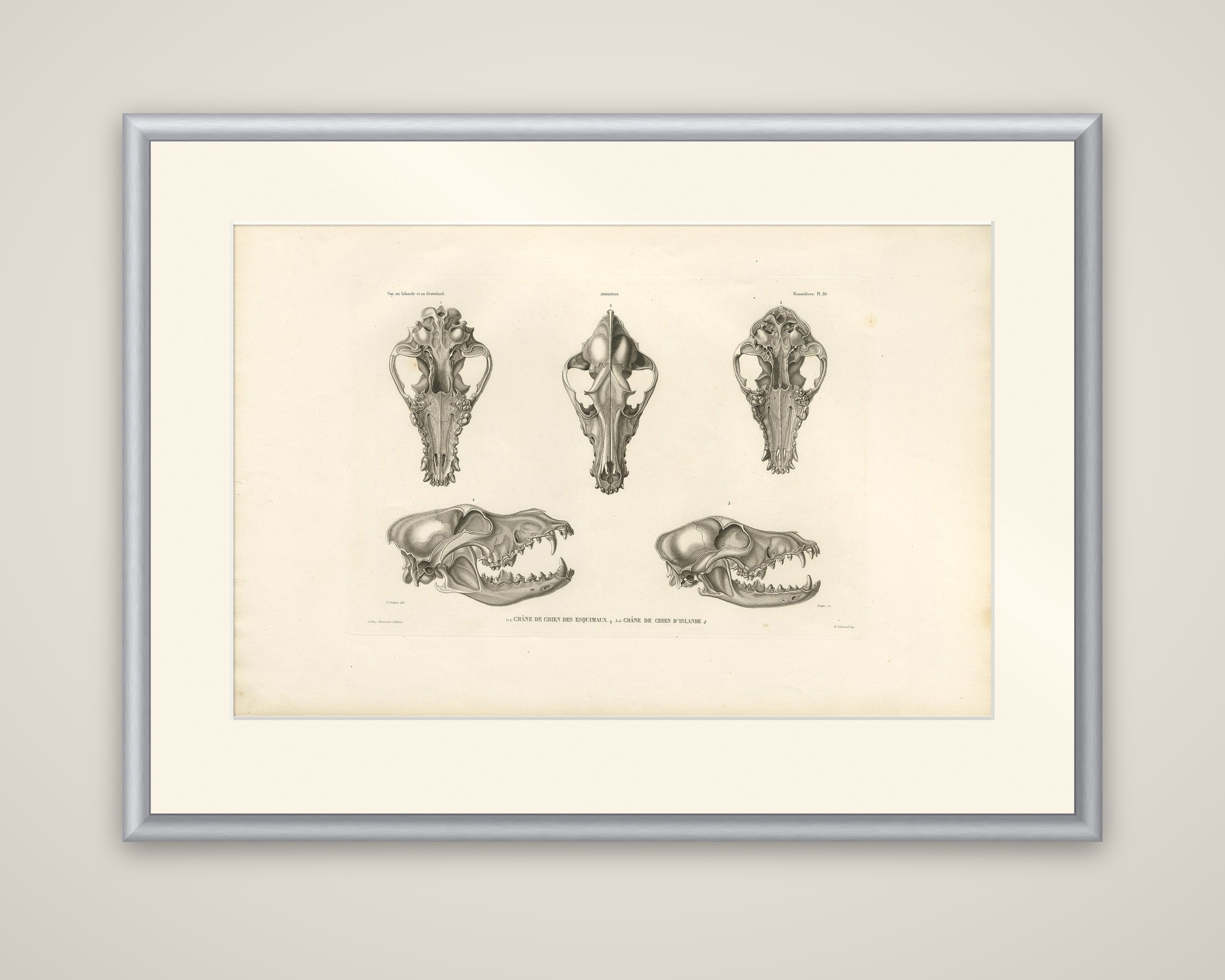
Skulls of an Eskimo dog and an Icelandic dog, an original lithograph from Paul Gaimard's Voyage en Islande et au Groenland, published in Paris in 1842. The plate is titled "Crâne de chien des Esquimaux" and "Crâne de chien d'Islande," and was drawn by Louis Bévalet and lithographed by J. Bernard. It is printed in black and gray tones without color.
Five skulls are arranged on the sheet. Across the upper row, three skulls seen from above and from below show the cranial vault, the broad zygomatic arches and the palate with its teeth. Along the lower row are two skulls in profile, the Greenland sled dog at the left and the smaller Icelandic dog at the right, each with its jaw open to show the full set of canines and cheek teeth. The shading is fine and exact, treating the bones as anatomical specimens, and the numbered views are keyed to the plate lettering.
The plate belongs to the osteological series of Gaimard's voyage, which aimed to record the animals and people of Iceland and Greenland. It compares the Greenland sled dog with the smaller Icelandic sheepdog, both important working animals in northern communities.