About this sheet
Antique Hand-Coloured Engraving – The Norman Staircase, Canterbury, c.1870s
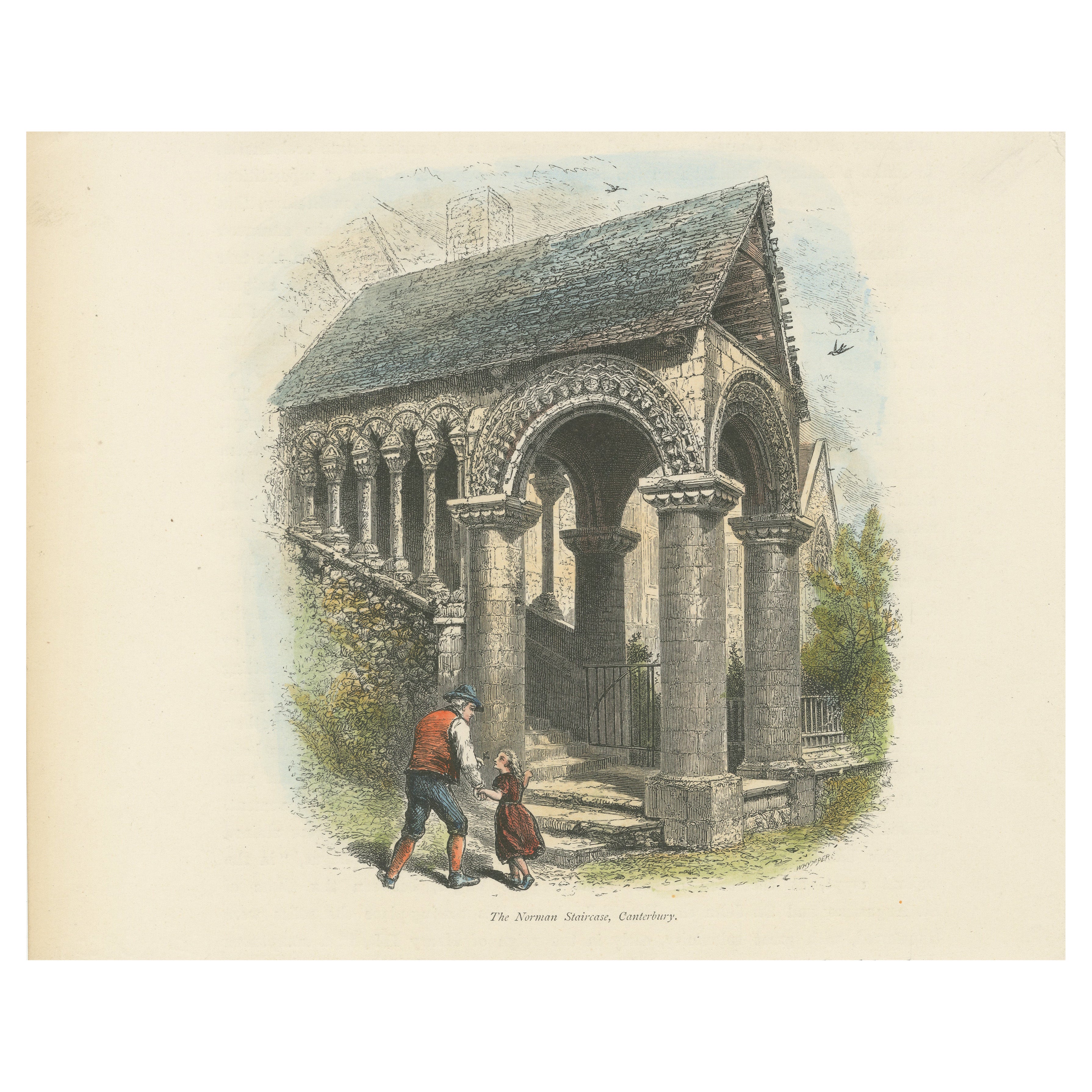
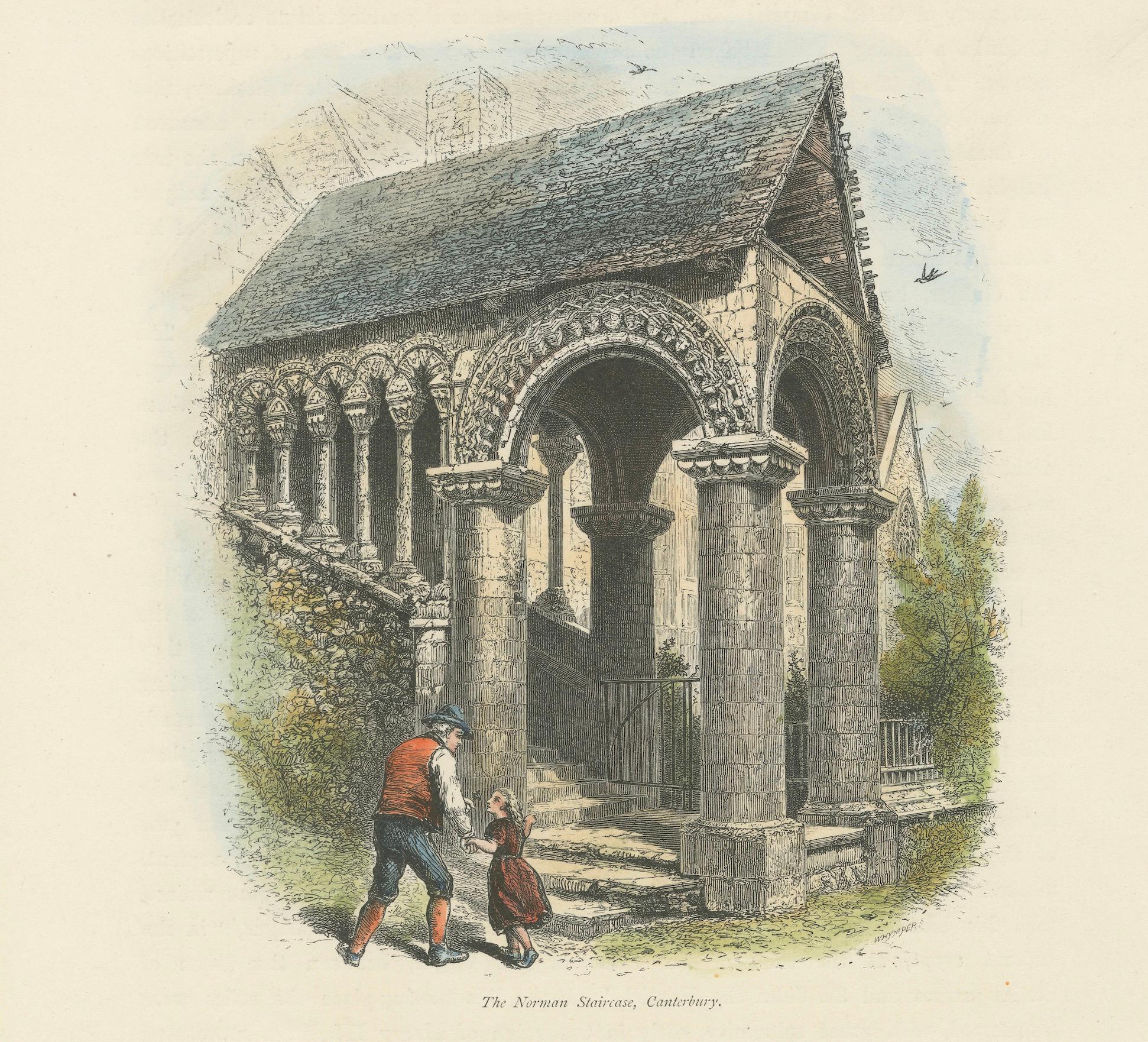
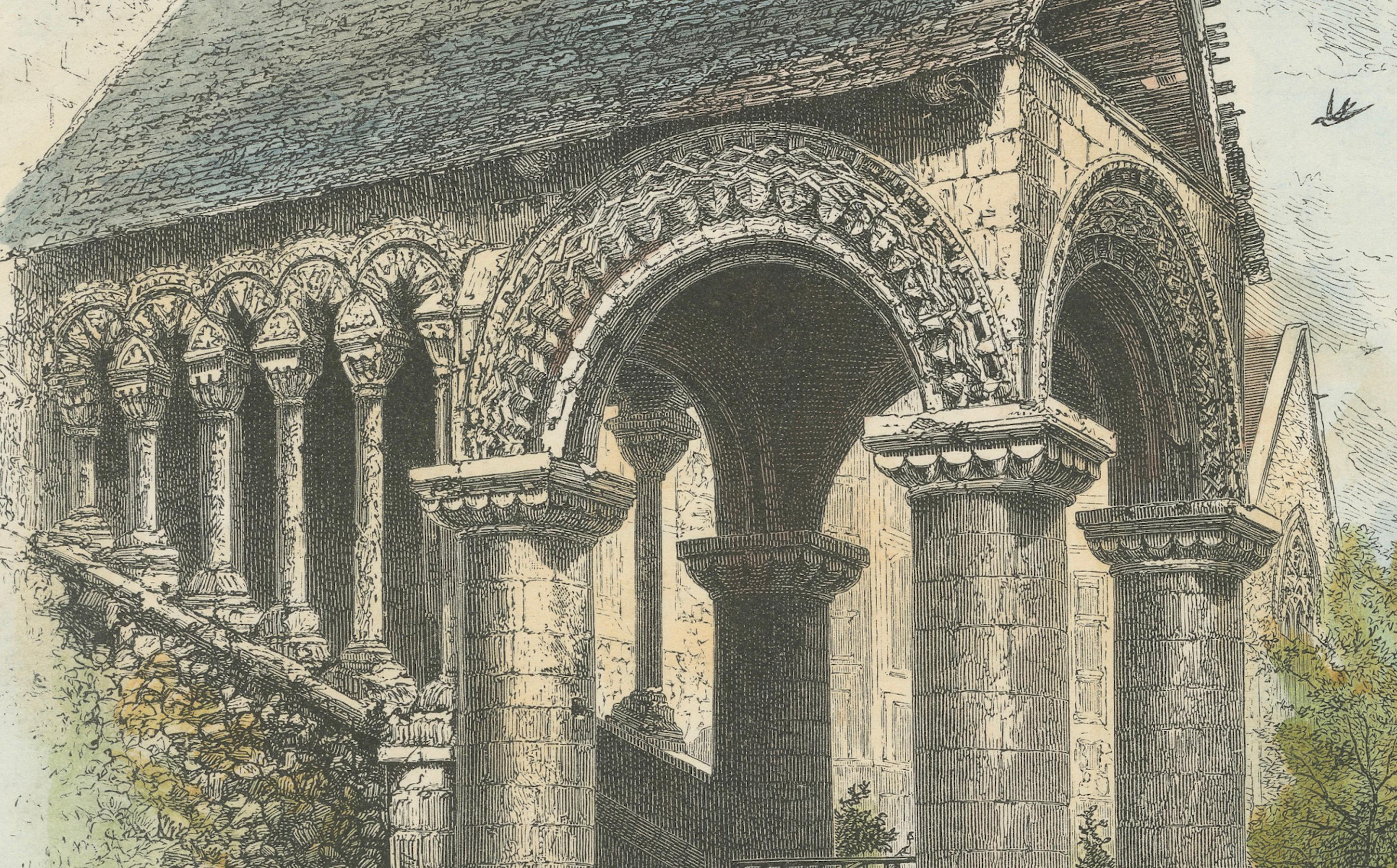
This finely detailed antique hand-coloured engraving depicts the historic Norman Staircase at Canterbury, one of the most celebrated surviving examples of Norman architecture in England. The scene captures the grand arched entrance with its richly carved capitals and archivolts, leading to the covered stone staircase. The intricate Romanesque ornamentation, including geometric and floral motifs, is rendered with exceptional precision, highlighting the craftsmanship of the medieval masons.
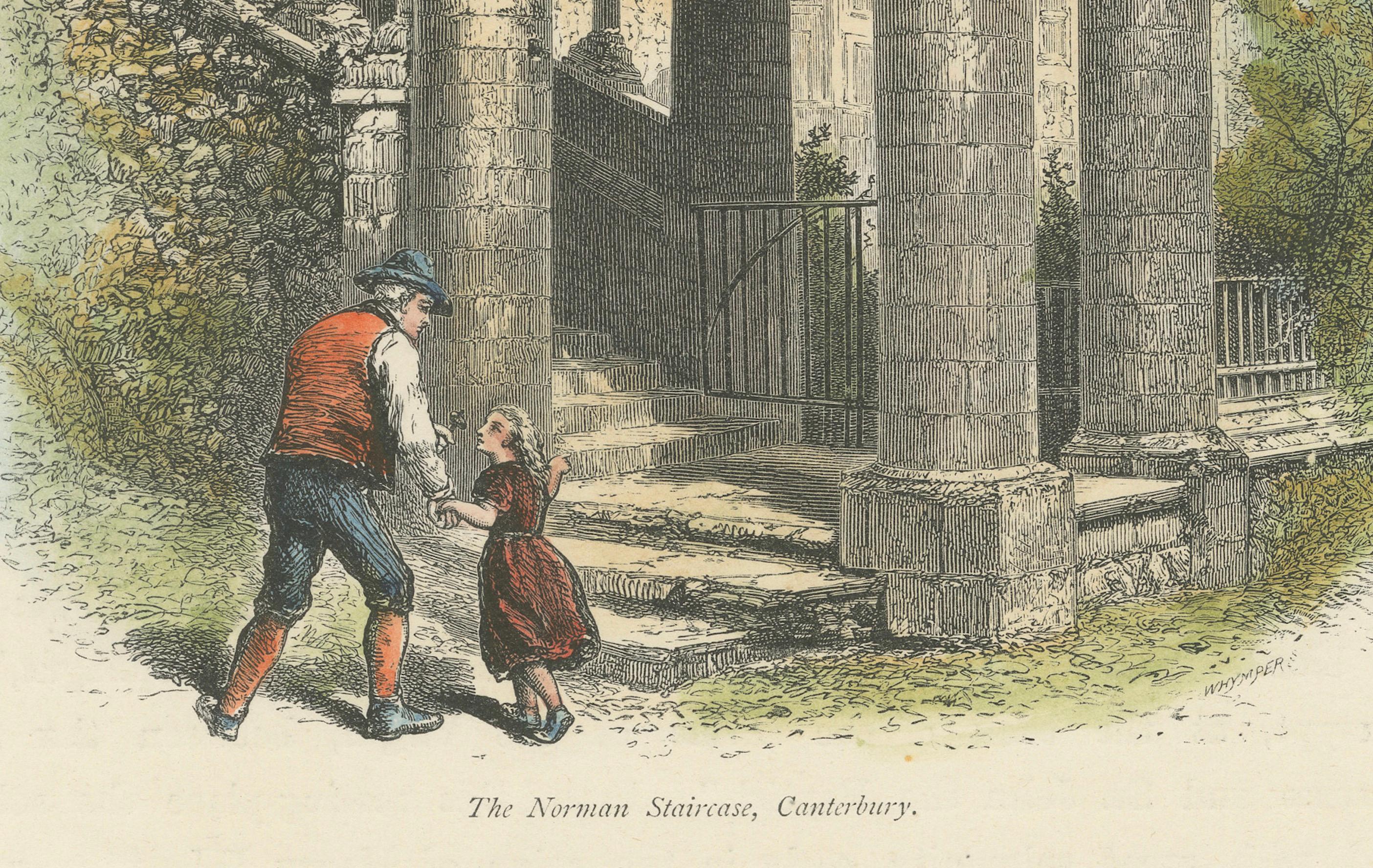
In the foreground, a man and a young girl are shown walking toward the staircase, adding a human scale and sense of daily life to the composition. The artist has employed subtle hand-colouring, with muted reds, earthy browns, greys, and greens, to bring depth and warmth to the stonework, surrounding foliage, and period clothing. The light blue sky with drifting birds adds an atmospheric touch, balancing the solidity of the structure with the softness of nature.
This engraving was likely produced in the late 19th century, a period when antiquarian interest in medieval architecture was at its height. Such images were popular in architectural studies, travel books, and illustrated histories, appealing to Victorian audiences fascinated by England’s Norman heritage. The Norman Staircase itself is part of the former medieval monastic buildings of Christ Church Priory, linked to Canterbury Cathedral, and dates back to the 12th century.
The work is printed from an engraved steel plate and delicately hand-coloured, a combination that allowed for fine architectural detail while providing a pleasing decorative finish. It stands as both a historical record and a piece of Victorian-era artistry.
Condition summary: Very good for age. Clean sheet with only minor age toning in margins. Colours remain fresh and well-applied. No tears, repairs, or foxing visible. Strong paper with good impression of the plate.
Framing tips: This piece would look striking in a dark wood or walnut frame to complement the warm tones of the stonework, paired with a cream or soft grey mount to enhance the hand-colouring. A gilt-lined inner mount could add a refined period touch.
Technique: Hand-coloured steel engraving
Maker: Whymper, British, c.1870s
Given that the work is signed “Whymper” and depicts the Norman Staircase in Canterbury, it is most likely from the period when Edward Whymper (1840–1911) was actively producing architectural and topographical illustrations — roughly the 1860s to 1880s.
Edward Whymper did extensive work for illustrated books and periodicals in the mid-Victorian period, including architectural subjects for publications such as The Leisure Hour, The Illustrated London News, and various antiquarian volumes. The combination of steel engraving with delicate hand-colouring also fits that timeframe, as by the 1890s such work was increasingly replaced by photomechanical printing.
Considering the style, printing technique, and Whymper’s career timeline, the estimate for this print is that it is most likely published between about 1865 and 1880.