About this sheet
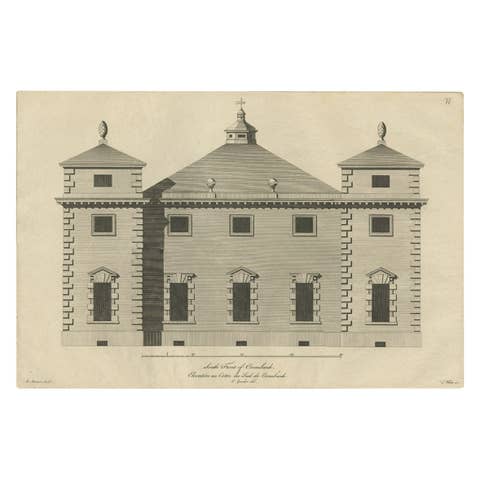
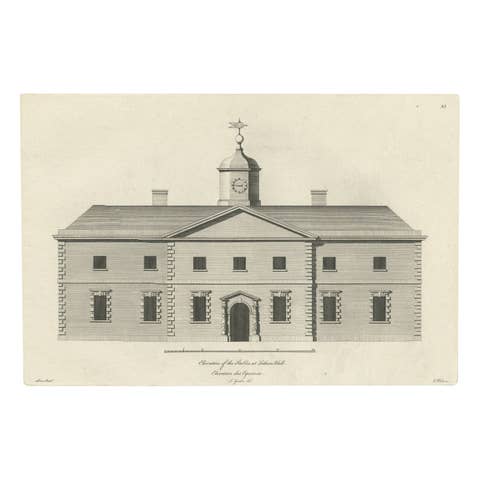
Antique print titled 'Elevation of the Flank of Sir Gregory Page'. Architectural elevation of the residence of Sir Gregory Page.
Sir Gregory Page, 2nd Baronet (c. 1695 – 4 August 1775), was an English art collector and landowner, and a baronet in the Baronetage of Great Britain. He was the eldest son of Sir Gregory Page, 1st Baronet, and his wife Mary, the daughter of Londoner Thomas Trotman. He followed his father in becoming a director of the East India Company, and from 1717 began expanding his land holdings in Kent and London. He succeeded to his father's baronetcy on 25 May 1720. He married on 26 May 1721 Martha, third daughter of Robert Kenward, of Kenwards in Yalding, Kent. They had no children. She died on 30 September 1767 and was buried 7 days later at Greenwich. Page invested a substantial part of his fortune into further property, particularly in what was then north-west Kent. In 1723, he built a manor house in the Westcombe Park area, just north of Blackheath, but later preferred to live in a huge mansion at Wricklemarsh nearby. This was designed by architect John James, built for £90,000, and stood in a 250 acres (100 ha) park, once the property of Sir John Morden. A ground plan and cross-section through the mansion's rooms were included in Vitruvius Britannicus in 1739, and according to a contemporary description, Wricklemarsh was:
"one of the finest houses in England, resembling a royal palace rather than a residence of a private gentleman. The gardens are laid out in the most elegant manner and both the paintings and furniture are surprisingly fine. All rooms are hung with green or crimson silk damask and the cornices, door-cases and chair-frames are all carved and gilt. The chimney pieces are all of fine polished marble."
This print originates from 'Vitruvius Britannicus' by Colen Campbell. Artists and Engravers: Colen Campbell's Vitruvius Britannicus is considered one of the greatest eighteenth-century English architectural works. Campbell published the first three volumes between 1715 and 1725, but the text was continued in two subsequent volumes by Woolfe and Gandon in 1767 and 1771. The work is comprised of large, finely engraved illustrations, plans, and cross sections of English country houses and parks.
Image size: 0.001 x 60 x 35 cm.