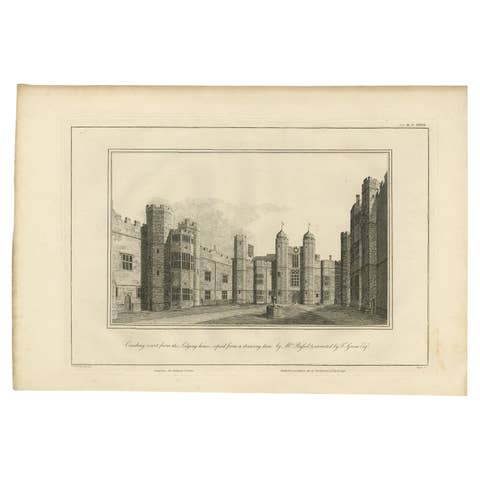
Inner Front of Cowdray House – Antique Engraving from the Gateway, Sussex 1796
€ 159
Original antique · The actual sheet photographed · Certificate of authenticity on request · Sold unframed · Worldwide shipping from € 15 (rates)
Date
1796
Technique
Engraved
Sheet size
36 × 55 cm (14.2 × 21.7 in)
Condition
Good
Reference
BGI-00009
What the condition grades mean
Excellent
Bright and clean, with no faults worth mentioning.
Very good
Only light signs of age, such as faint toning.
Good
Normal signs of age for a sheet of this period: toning, some foxing, small marks or neat old repairs.
Fair
Clear faults such as staining, tears or repairs, priced to match.
Every fault we see is written in the condition note, and the whole sheet is shown uncropped in the photos.
Condition
Very good impression with light, even age toning and a few light spots. Plate mark visible. Strong paper with full margins.
About this sheet
Inner Front of Cowdray House – Antique Engraving from the Gateway, Sussex 1796
This finely detailed antique engraving captures the inner front of Cowdray House in West Sussex, England, as viewed from the gateway. The composition presents the elegant Tudor façade with its central tower, crenellated parapets, mullioned windows, and decorative chimneys, all arranged around the open courtyard. In the center stands an ornamental fountain, adding a focal point to the scene and reinforcing the grandeur of this historic estate.
Cowdray House, constructed in the early 16th century for the Browne family, was one of England’s most important Tudor mansions, celebrated for hosting royal guests such as King Henry VIII and Queen Elizabeth I. This engraving records the house before the catastrophic fire of 1793, which left the building in ruins. The print is therefore not only an attractive architectural rendering but also an important historical record of the estate’s original appearance.
The work was engraved by James Basire (1730–1802), a master engraver renowned for his precision in architectural subjects, after an original drawing by Swiss topographical artist Samuel Hieronymus Grimm (1733–1794), whose accurate depictions were widely valued by antiquarians. The image reflects the Georgian-era fascination with Britain’s historic architecture, offering a meticulous record for both scholars and collectors.
This engraving would appeal to enthusiasts of English country houses, Tudor architecture, and 18th-century topographical prints. It also serves as a rare visual document of a building that has been largely lost to history.
Framing tips: A dark wood or black frame with a cream or soft ivory mat will emphasize the crisp architectural details while preserving the print’s period character.