About this sheet
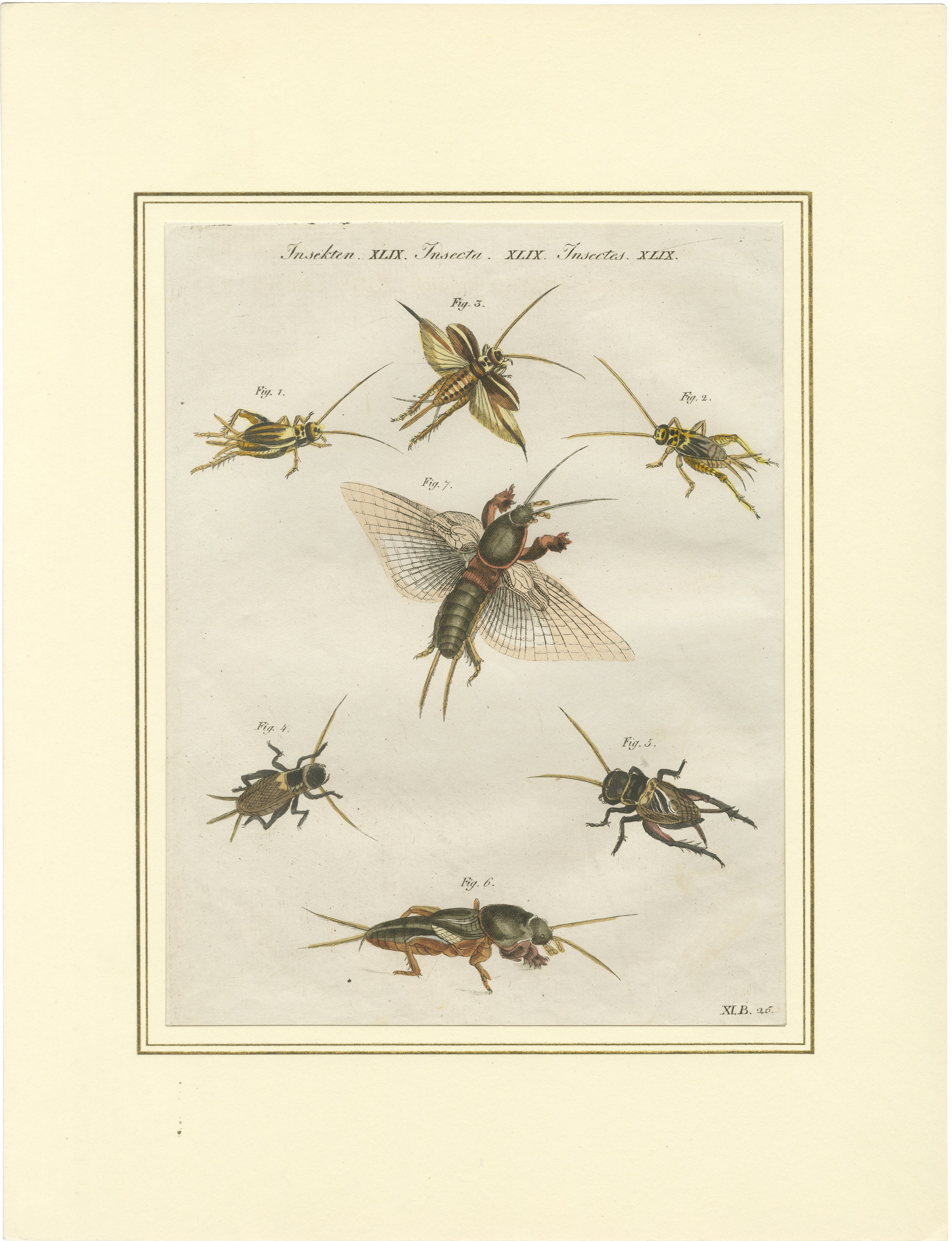
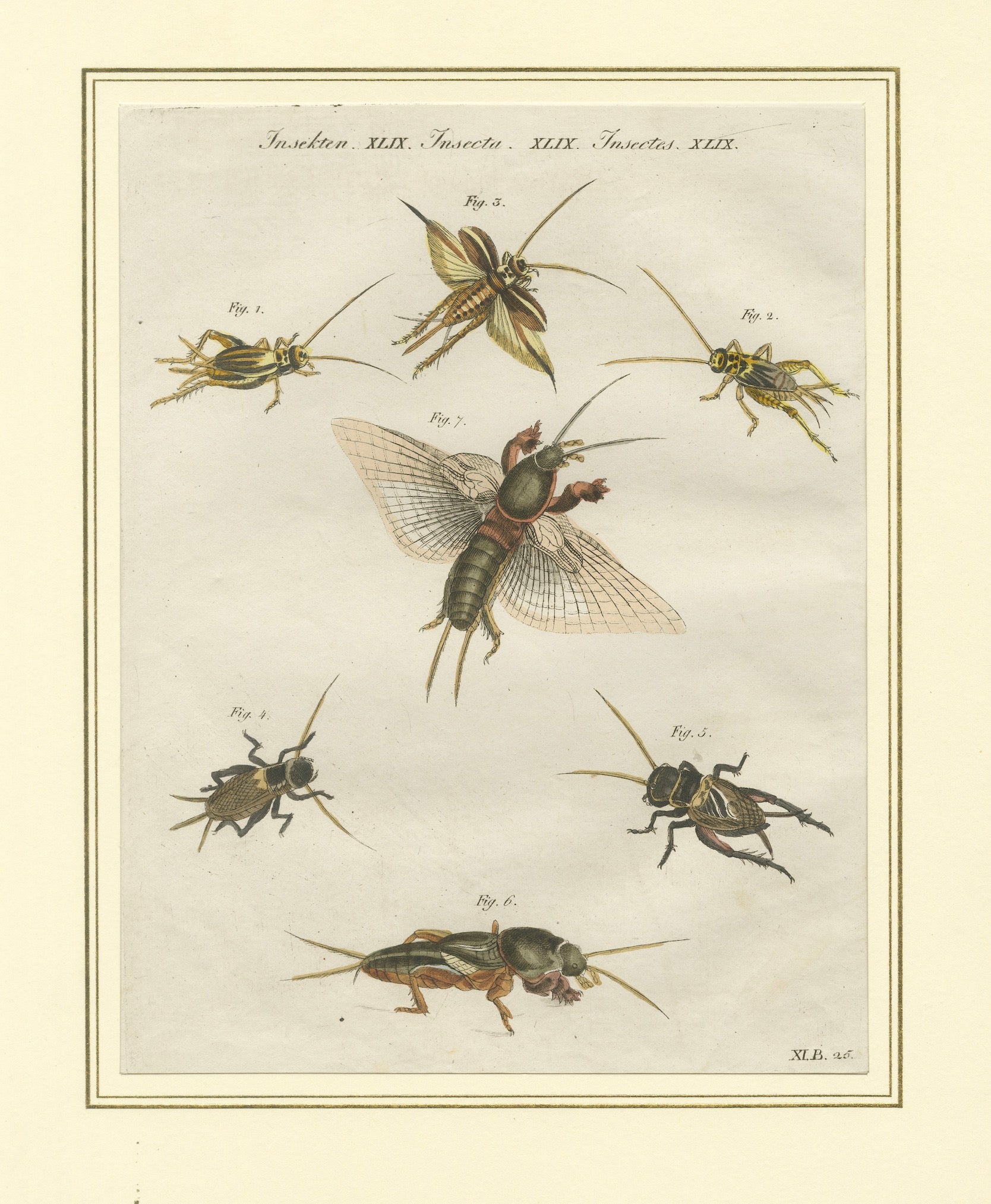
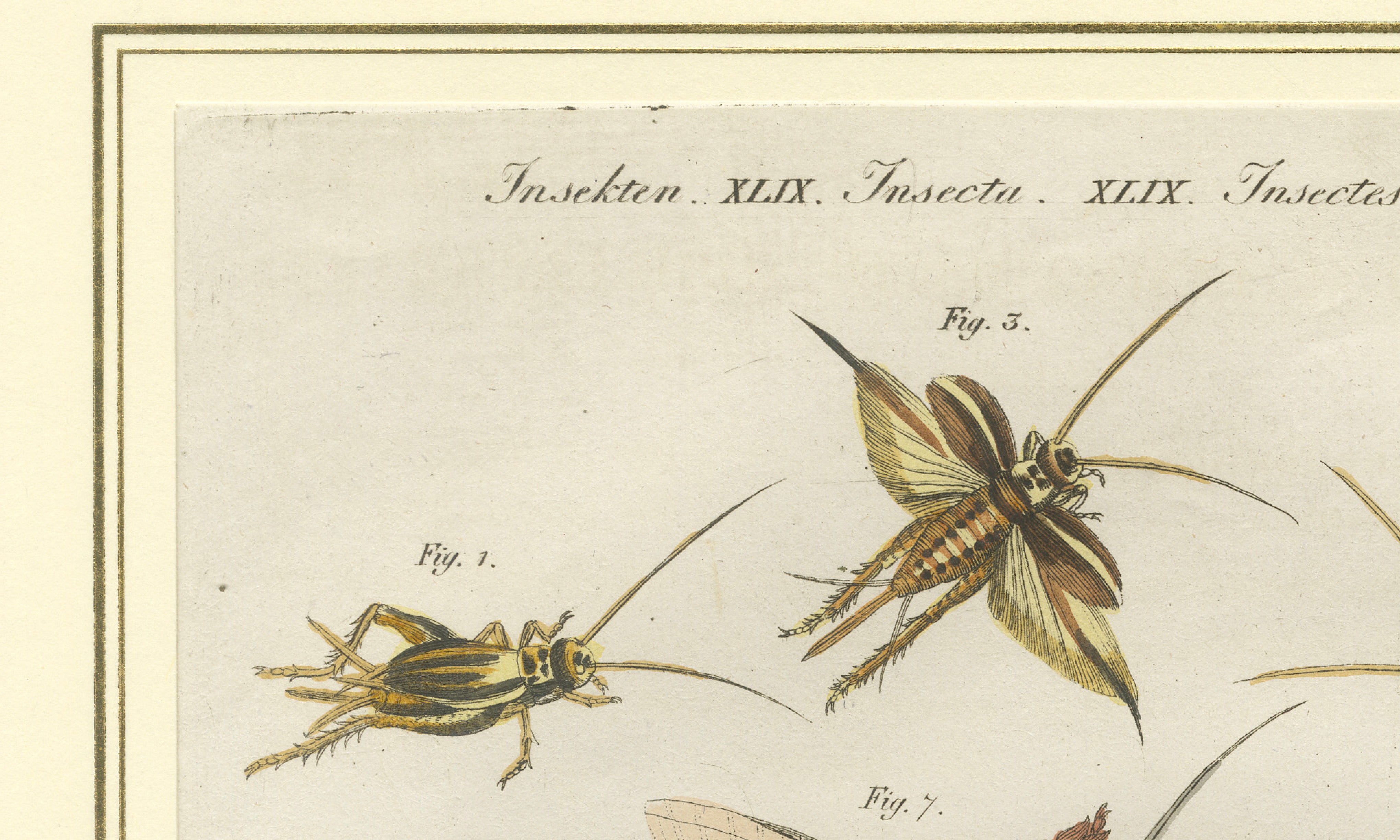
Original antique hand-colored copper engraving depicting seven different native crickets and related insects, published in Friedrich Justin Bertuch’s celebrated “Bilderbuch für Kinder” in Weimar in 1807.
The plate is headed “Insekten XLIX / Insecta XLIX / Insectes XLIX” and is historically described as:
“Verschiedene Einheimische Grillen-Arten”
– Various Native Species of Crickets.
The engraving presents seven different cricket forms, including field and ground crickets and the extraordinary mole cricket, shown both at rest and with its wings fully extended.
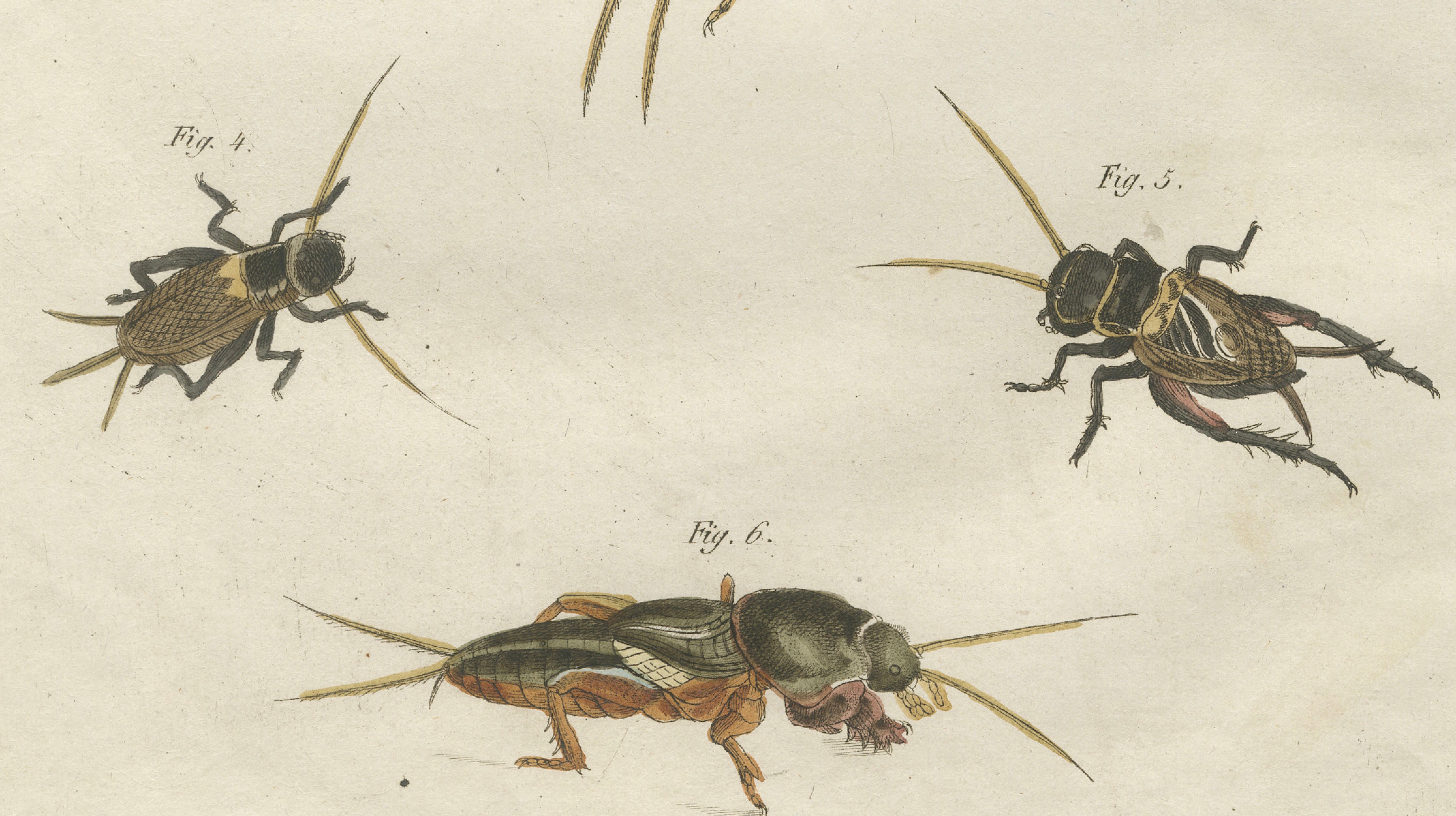
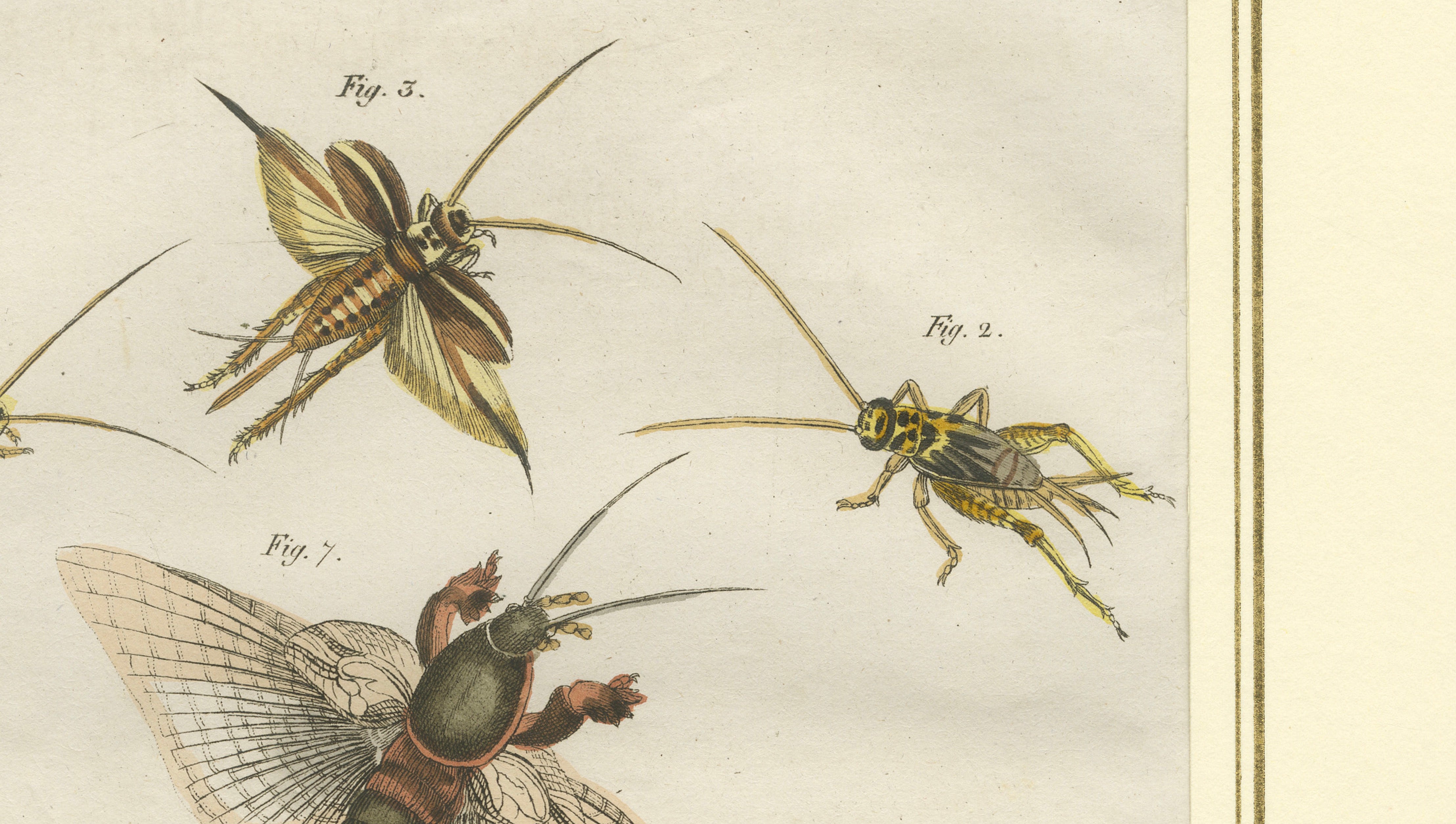
Fig. 1–5 – Various Crickets
The smaller insects surrounding the central figure represent several forms of true crickets and related Orthoptera.
Their characteristic features include exceptionally long antennae, powerful hind legs adapted for jumping and compact bodies.
Crickets were familiar inhabitants of European fields, gardens and houses, but their remarkable anatomy and characteristic chirping made them popular subjects in early natural-history publications.
The sound commonly associated with crickets is produced principally by males rubbing specialized parts of their wings together, a process known as stridulation.
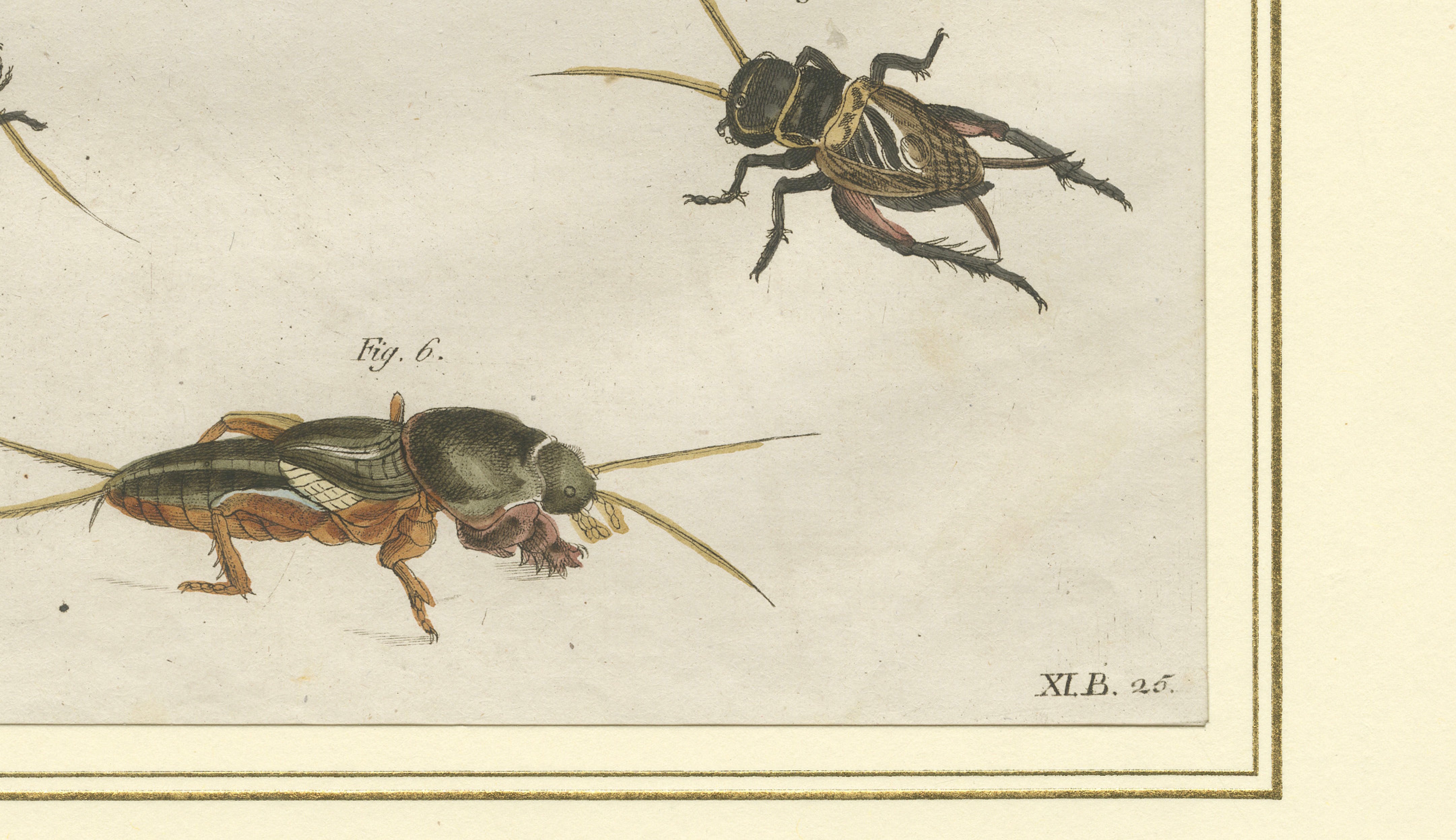
Fig. 6 – Mole Cricket
The remarkable insect at the bottom is a Mole Cricket, recognizable by its elongated body and enormously developed front legs.
Common name: European Mole Cricket
Scientific name: Gryllotalpa gryllotalpa
Unlike ordinary crickets, the Mole Cricket spends much of its life underground.
Its powerful front legs have evolved into broad digging structures that function almost like miniature shovels. With them the insect excavates extensive tunnels through moist soil.
The name Gryllotalpa literally combines the Latin words for “cricket” and “mole” – an exceptionally appropriate description of this unusual insect.
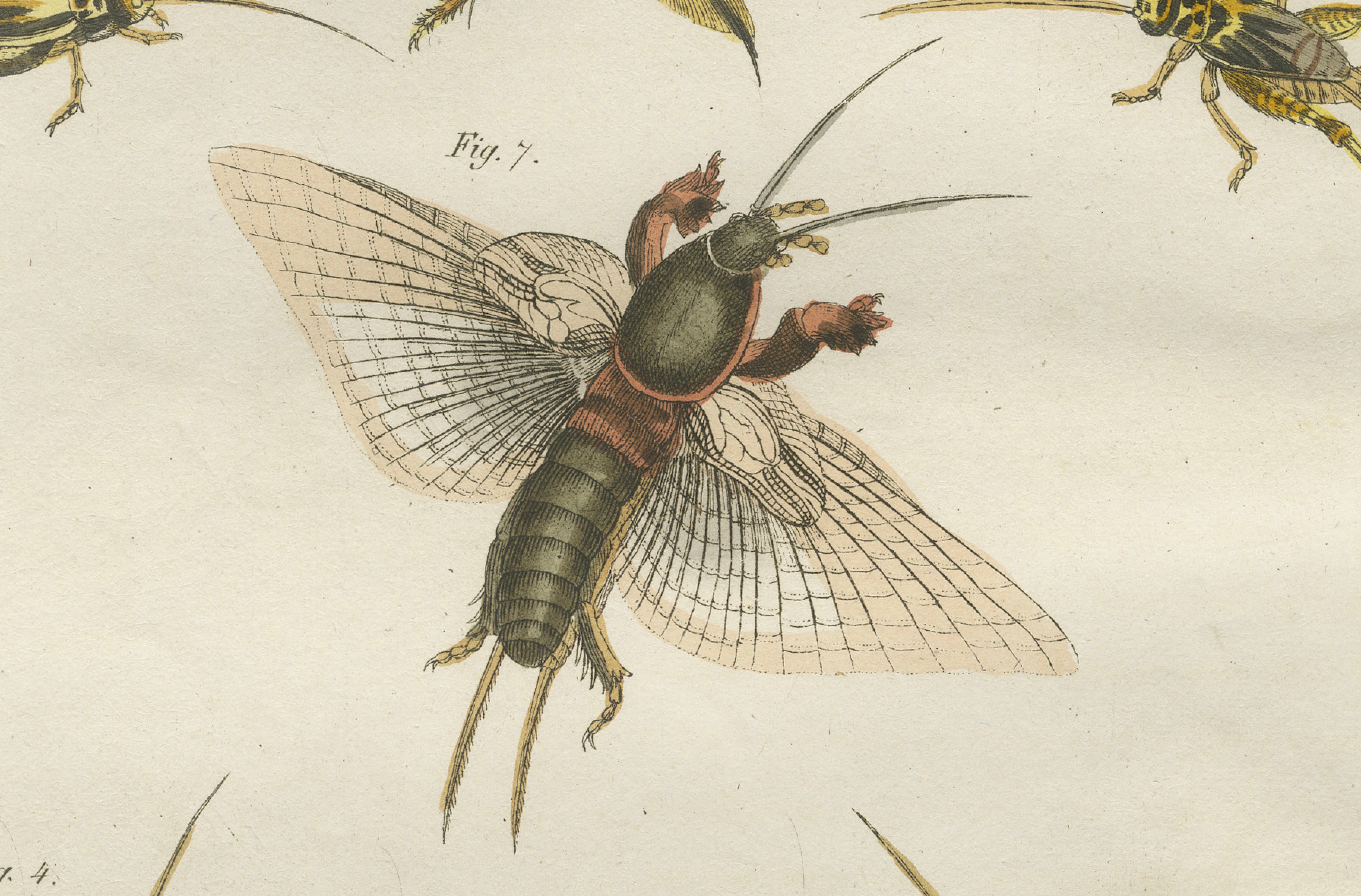
Fig. 7 – Winged Mole Cricket
The spectacular central figure shows a Mole Cricket with its wings fully extended.
This is particularly interesting because the familiar burrowing insect is rarely depicted in flight. The large, delicately veined wings contrast dramatically with its heavy body and powerful digging forelegs.
Despite their subterranean lifestyle, adult mole crickets possess functional wings and some species are capable of considerable flight, particularly when dispersing or seeking mates.
The central winged specimen gives this plate considerably more visual impact than a conventional cricket illustration.
Friedrich Justin Bertuch (1747–1822) was a German publisher, writer and patron of the arts. His monumental “Bilderbuch für Kinder” (Picture Book for Children), first published in Weimar in 1790, became one of the great illustrated educational encyclopedias of the late 18th and early 19th centuries.
Its hundreds of engraved and hand-colored plates introduced readers to animals, plants, geography, science, technology, antiquity and cultures from around the world.
This attractive entomological plate combines scientific observation with decorative composition. Seven insects are arranged almost like specimens in a natural-history cabinet, while the unusually large winged Mole Cricket forms a dramatic centerpiece.
Technique: Original hand-colored copper engraving
Publisher: Friedrich Justin Bertuch / Industrie-Comptoir
Publication: Bilderbuch für Kinder
Place: Weimar, Germany
Date: 1807
Plate: Insekten XLIX / Insecta XLIX / Insectes XLIX
Historical subject: Verschiedene Einheimische Grillen-Arten – Various Native Species of Crickets
Subjects: Crickets, Field Crickets and Mole Cricket
Mole Cricket scientific name: Gryllotalpa gryllotalpa
Plate reference: XI B. 26
Condition:
The engraving is loosely inserted in an acid-free matting board.
Please study the photographs carefully as they form part of the condition description.
Please note: This is an original antique hand-colored copper engraving from 1807, not a modern reproduction. The print is sold unframed. Framed images or interior views, if shown, are for presentation and inspiration only.
Other companion insect and natural-history plates from Bertuch’s “Bilderbuch für Kinder” are also available separately.
Keywords: Friedrich Justin Bertuch, Bilderbuch für Kinder, cricket engraving, antique cricket print, mole cricket, European mole cricket, Gryllotalpa gryllotalpa, field cricket, house cricket, Orthoptera, winged mole cricket, insect engraving, entomology print, antique entomology, insect anatomy, natural history illustration, cabinet of curiosities, hand-colored copper engraving, German engraving, Weimar, 1807, early 19th century, original antique print