About this sheet
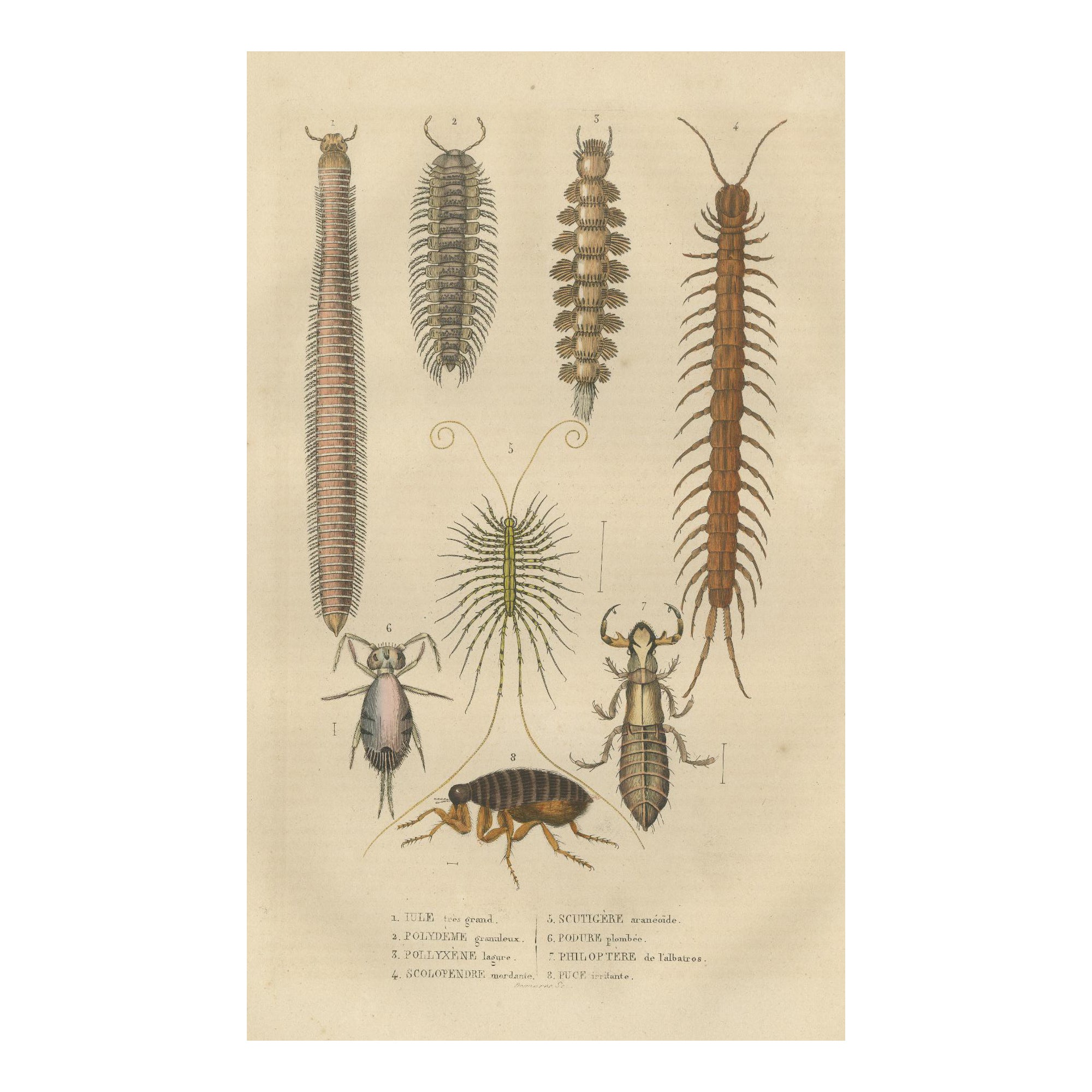
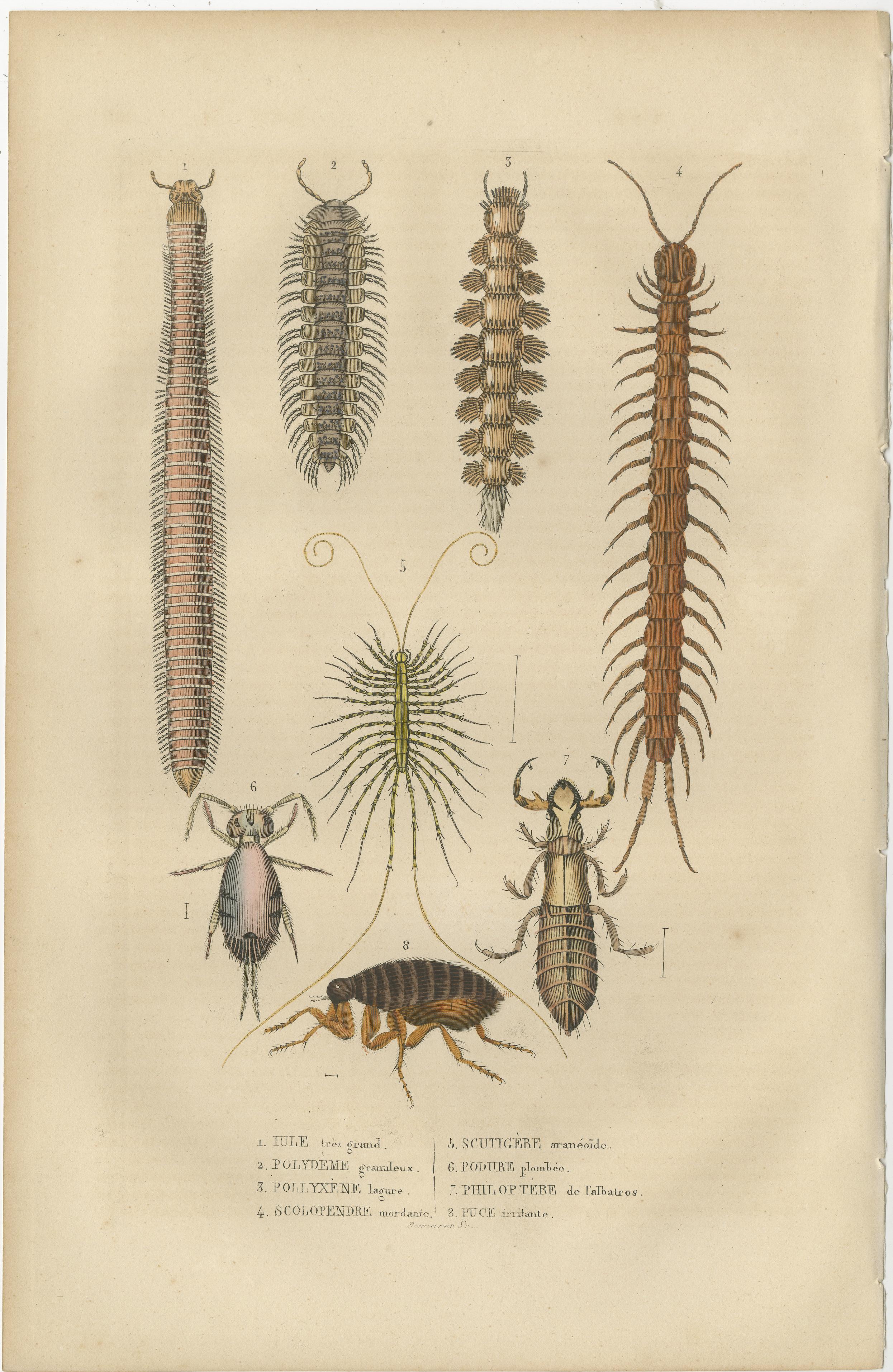
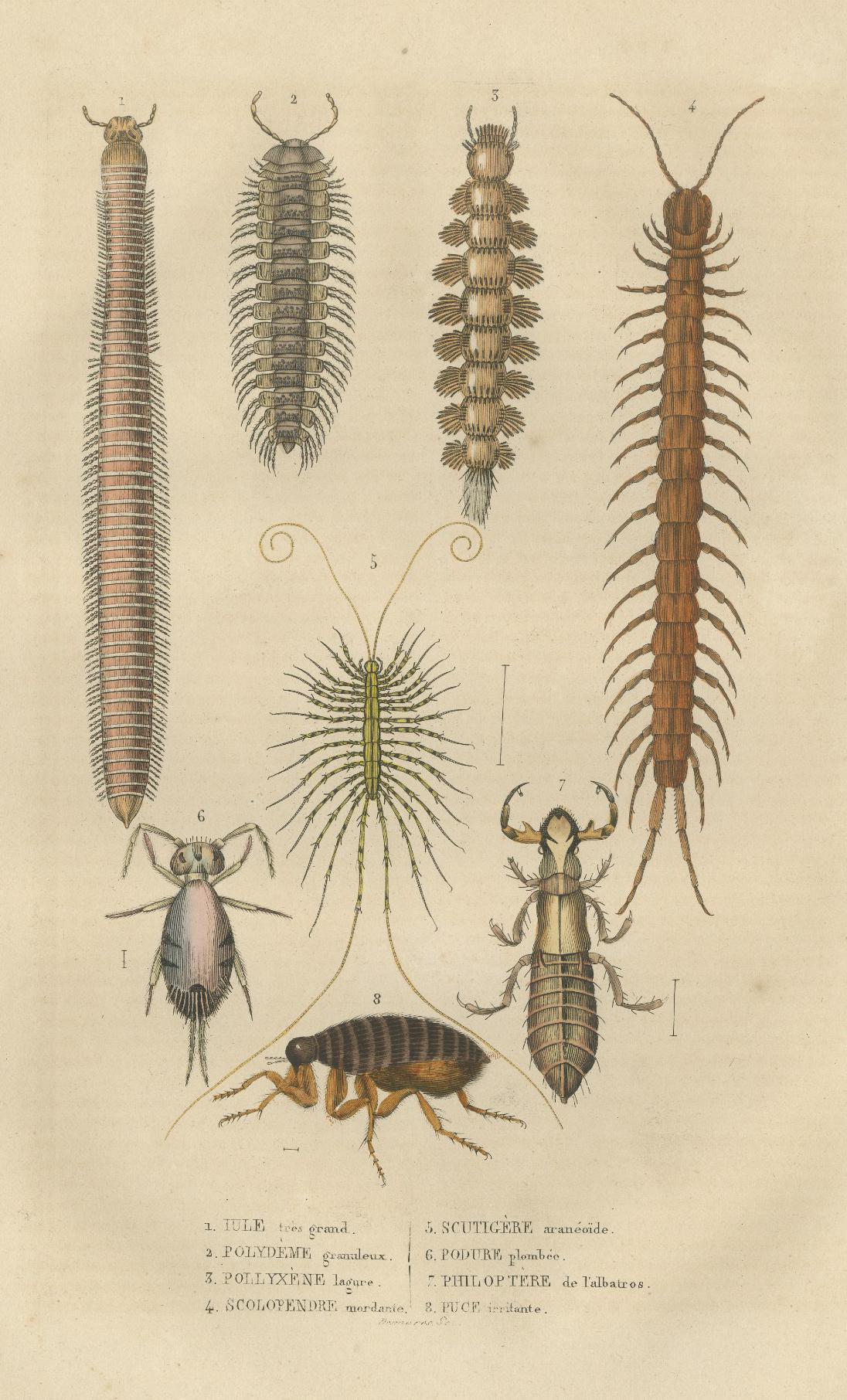
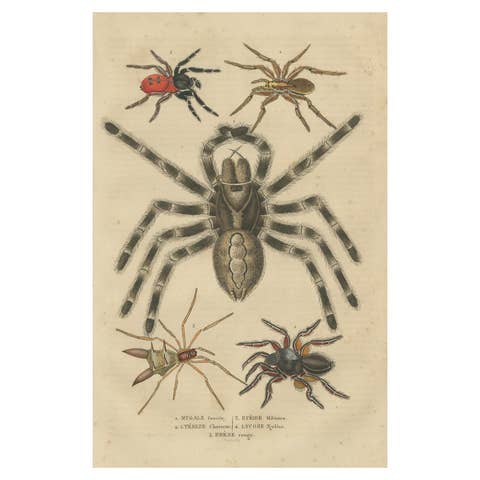
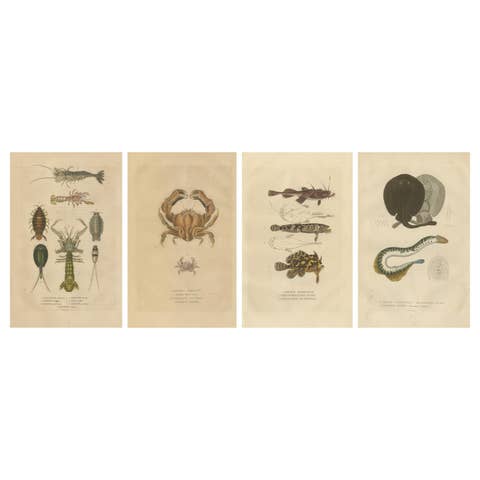
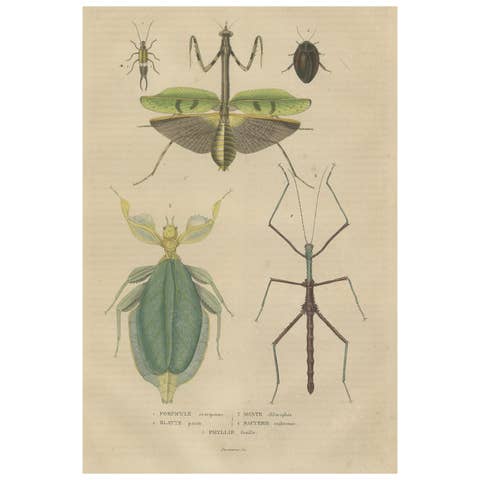
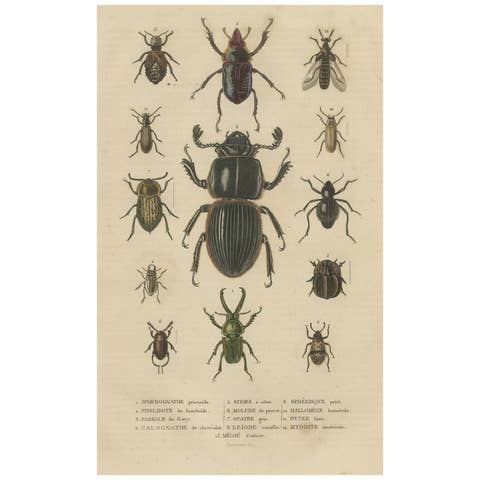
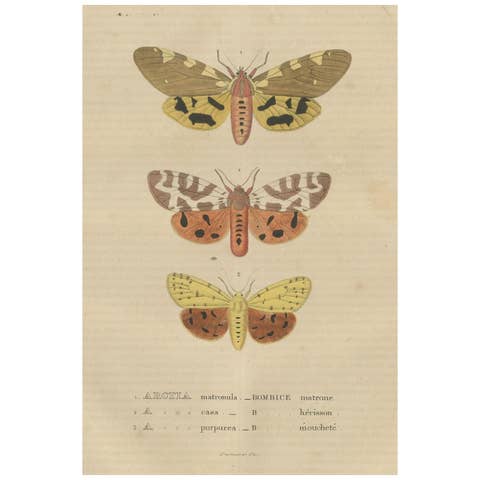
This image is a beautifully detailed handcolored engraving from 1845, featuring a series of marine invertebrates and insects. It includes eight specimens, each meticulously illustrated with a focus on anatomical accuracy and detail. The creatures are numbered and labeled in French, indicating their scientific names, which adds to the scholarly nature of the piece.
Here's a description of each specimen:
1. "Iule très grand" – a depiction of a large millipede, showcasing its elongated body and numerous segmented sections.
2. "Polydesme granuleux" – Another type of millipede, distinguished by its granulated texture and banded body segments.
3. "Polyxene lasuré" – A creature with a segmented body and a less pronounced cylindrical shape, possibly a type of marine polychaete.
4. "Scutigère mardarine" – This creature resembles a centipede with its elongated body and many pairs of legs.
5. "Scutigère aranéoide" – An arthropod that features a segmented body and long, spindly legs, similar to that of a spider.
6. "Poudre plombée" – The image is not clear enough to identify this specimen accurately without further context.
7. "Philoptère de l'albatros" – This is likely a louse found on an albatross, emphasizing the intricate detail of its limbs and body structure.
8. "Puce irritante" – This could refer to a flea, known for its jumping ability and irritant bites.
Each specimen is drawn with precision, showcasing the characteristics that would be key to identification and study, such as body segmentation, leg arrangement, and antennae. The coloration of these engravings is subtle yet distinct, bringing life to the depictions in a way that black and white illustrations cannot.
The paper exhibits a creamy hue, indicative of its age, with some slight discoloration and edge wear that adds to the historical authenticity of the print. The condition of the image, with its rich detail and preservation of color, suggests it has been well cared for over the years. This engraving would likely have been used for educational purposes or to grace the pages of a naturalist's collection. It is a fine example of 19th-century scientific illustration.
This print not only serves as a scientific record but also as a work of art, reflecting the dual interests of the Victorian era in both natural history and illustration. It is a remarkable piece that would be a significant addition to any collection of natural history art or an elegant decorative piece for those with a taste for the historic and the natural world.
The style of the illustration is reminiscent of 19th-century scientific prints, which were often used in natural history books to document various species.
More info on the book in which it was published:
The 'Dictionnaire Classique des Sciences Naturelles' by Pierre Auguste Joseph Drapiez stands as a remarkable testament to 19th-century natural sciences. Published in Brussels in 1845, this work represents an expansive collation of knowledge, building upon the pioneering works of Buffon, Daubenton, Lacepede, Cuvier, de Jussieu, and other influential naturalists.
The prints within this compendium likely showcase a rich amalgamation of artistic precision and scientific accuracy. Drapiez, himself a Belgian naturalist, would have aimed for detailed representations of flora, fauna, and scientific phenomena, mirroring the illustrative styles prevalent during his time. Given the era's emphasis on illustration, these prints were likely engraved meticulously, possibly portraying intricate anatomical details or lifelike depictions of the natural world.
With Drapiez's background in natural history, the prints might bear testament to his commitment to scientific authenticity, aiming to educate and inspire scholars and enthusiasts alike. These engravings would have complemented the text, offering visual aids that elucidate the concepts and specimens discussed in the volume.
Overall, the prints of 'Dictionnaire Classique des Sciences Naturelles' likely serve as both artistic representations and invaluable scientific resources, encapsulating the essence of 19th-century natural history exploration and documentation.