About this sheet
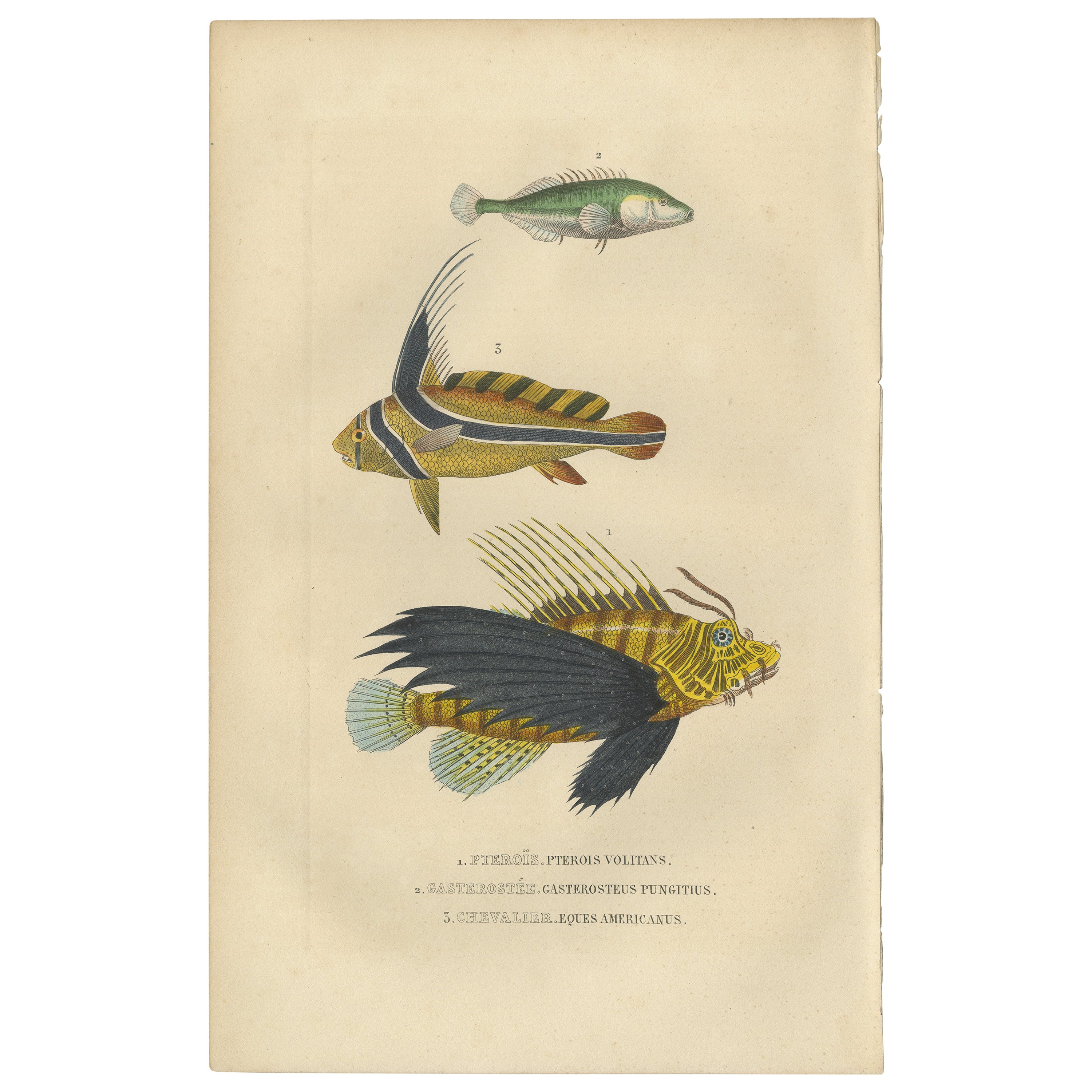
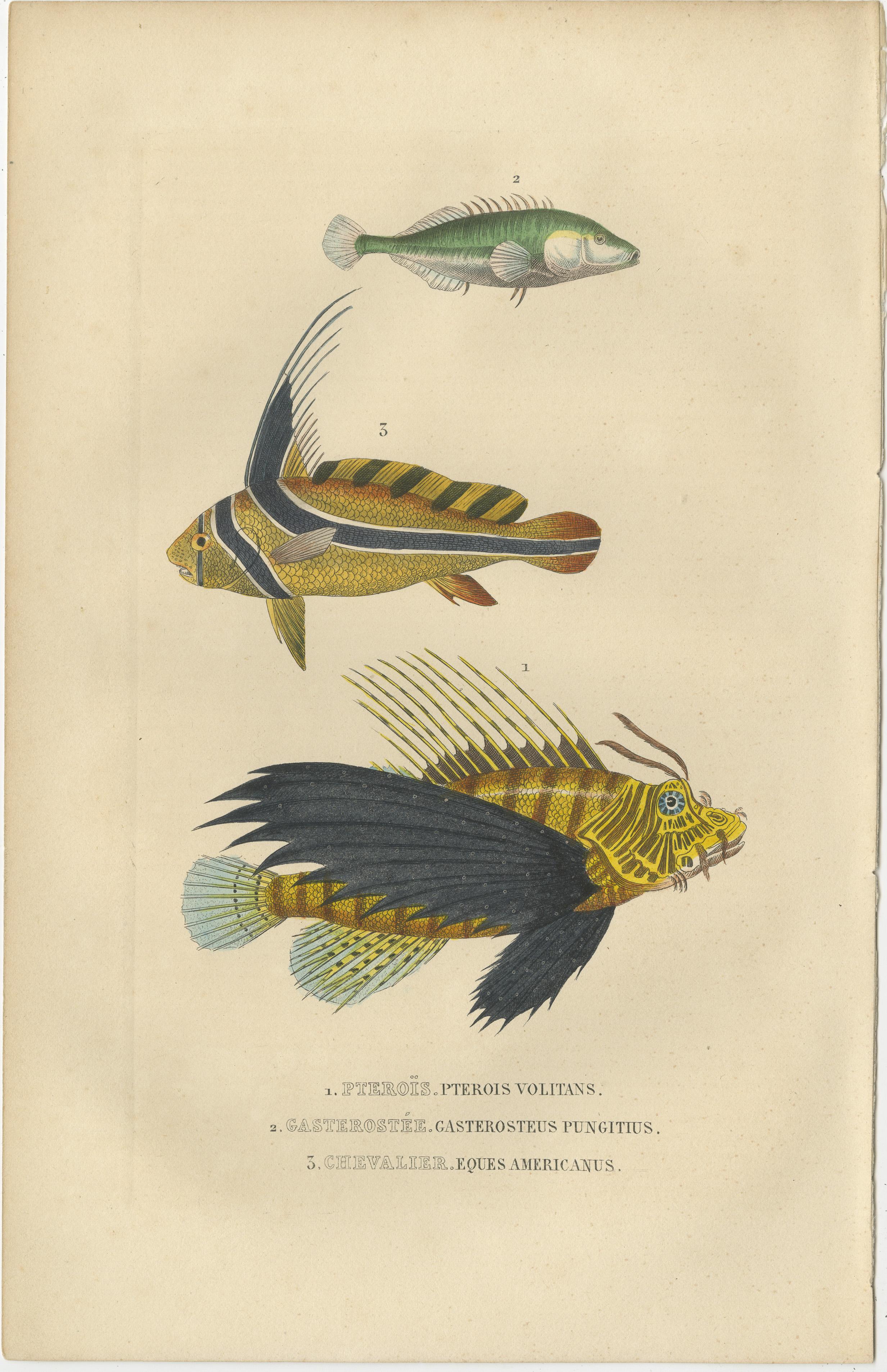
The image depicts illustrations of three different fish species, each labeled with both a common name and a scientific name:
1. **Ptreoïs (Pterois volitans)**: This is the lionfish, known for its striking appearance and venomous spines. It has a series of long, feather-like dorsal fins and bold vertical stripes on its body, which are often reddish-brown to maroon with white stripes.
2. **Gasterostée (Gasterosteus aculeatus)**: This is commonly known as the three-spined stickleback. It is a small fish with three prominent dorsal spines. Its body is slender and it typically has a greenish or brownish coloration with lighter undersides.
3. **Chevalier (Eques americanus)**: While the specific common name "Chevalier" isn't widely recognized in modern taxonomy, this could be referring to a type of horsefish or drumfish. The illustration appears to show a fish with a robust, compressed body and vertical stripes, which are characteristic of some members of the drumfish family.
The style of the illustration is reminiscent of 19th-century scientific prints, which were often used in natural history books to document various species.
More info on the book in which it was published:
The 'Dictionnaire Classique des Sciences Naturelles' by Pierre Auguste Joseph Drapiez stands as a remarkable testament to 19th-century natural sciences. Published in Brussels in 1845, this work represents an expansive collation of knowledge, building upon the pioneering works of Buffon, Daubenton, Lacepede, Cuvier, de Jussieu, and other influential naturalists.
The prints within this compendium likely showcase a rich amalgamation of artistic precision and scientific accuracy. Drapiez, himself a Belgian naturalist, would have aimed for detailed representations of flora, fauna, and scientific phenomena, mirroring the illustrative styles prevalent during his time. Given the era's emphasis on illustration, these prints were likely engraved meticulously, possibly portraying intricate anatomical details or lifelike depictions of the natural world.
With Drapiez's background in natural history, the prints might bear testament to his commitment to scientific authenticity, aiming to educate and inspire scholars and enthusiasts alike. These engravings would have complemented the text, offering visual aids that elucidate the concepts and specimens discussed in the volume.
Overall, the prints of 'Dictionnaire Classique des Sciences Naturelles' likely serve as both artistic representations and invaluable scientific resources, encapsulating the essence of 19th-century natural history exploration and documentation.
Keywords: Scorpion, squid, octopus