Japanese Cavalryman and General from 1844 in Wahlen's Historical Lithograph
€ 250
Original antique · The actual sheet photographed · Certificate of authenticity on request · Sold unframed · Worldwide shipping from € 15 (rates)
Date
1844
Sheet size
25.7 × 17 cm (10.1 × 6.7 in)
Condition
Good
Reference
BG-12722-69, BG-12722-70
What the condition grades mean
Excellent
Bright and clean, with no faults worth mentioning.
Very good
Only light signs of age, such as faint toning.
Good
Normal signs of age for a sheet of this period: toning, some foxing, small marks or neat old repairs.
Fair
Clear faults such as staining, tears or repairs, priced to match.
Every fault we see is written in the condition note, and the whole sheet is shown uncropped in the photos.
Condition
Given age. Faintly browned, and with some small stains. Some glue remains (from binding) in the far left margin (not affecting image). General age-related toning and/or occasional minor defects from handling. Please study the scans.
About this sheet
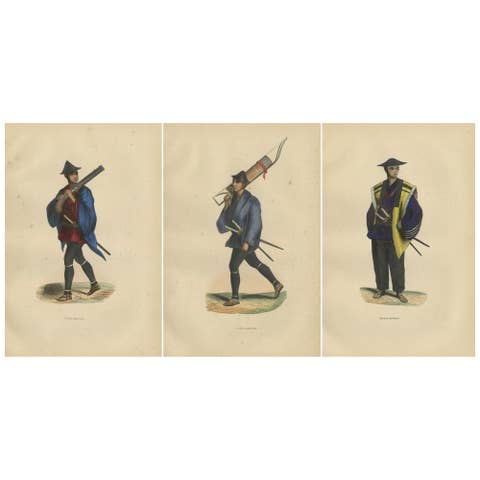
These hand-colored lithographs feature a Cavalier Japonais (Japanese Cavalryman) and General Japonais (Japanese General) on horseback.
These prints are from the 1844 Asia volume of Auguste Wahlen’s "Moeurs, Usages et Costumes de tous les Peuples de Monde" (Customs, Manners and Dress of All the Peoples of the World). The prints were created using hand-colored lithography on vellum paper, enhanced with Arabic gum to give the colors a vibrant, glossy finish.
Notable Features: - Cavalier Japonais: The cavalryman is shown riding at a gallop, wearing traditional armor with distinct layered garments. His swift movement conveys the dynamic nature of mounted Japanese warriors. - General Japonais: The general is depicted in a commanding pose on horseback, adorned in more elaborate and decorative attire, symbolizing his higher rank and authority.
Attractiveness: The prints are highly attractive due to their intricate detailing of the horses' tack, the flowing garments, and the vivid hand-coloring that brings the scene to life. The use of motion in the cavalryman’s pose adds a sense of action, while the general’s poised stance conveys authority, making the images visually engaging and historically informative.