Rare Anatomy Engraving – Skeleton and Flayed Figure, Blome, 17th Century
€ 640
Original antique · The actual sheet photographed · Certificate of authenticity on request · Sold unframed · Worldwide shipping from € 15 (rates)
Mapmaker / artist
Michael Vandergucht after G. Freeman, published by Richard Blome, London, 1686
Technique
Engraved
Sheet size
34 × 22.2 cm (13.4 × 8.7 in)
Reference
PCT-61838
What the condition grades mean
Excellent
Bright and clean, with no faults worth mentioning.
Very good
Only light signs of age, such as faint toning.
Good
Normal signs of age for a sheet of this period: toning, some foxing, small marks or neat old repairs.
Fair
Clear faults such as staining, tears or repairs, priced to match.
Every fault we see is written in the condition note, and the whole sheet is shown uncropped in the photos.
Condition
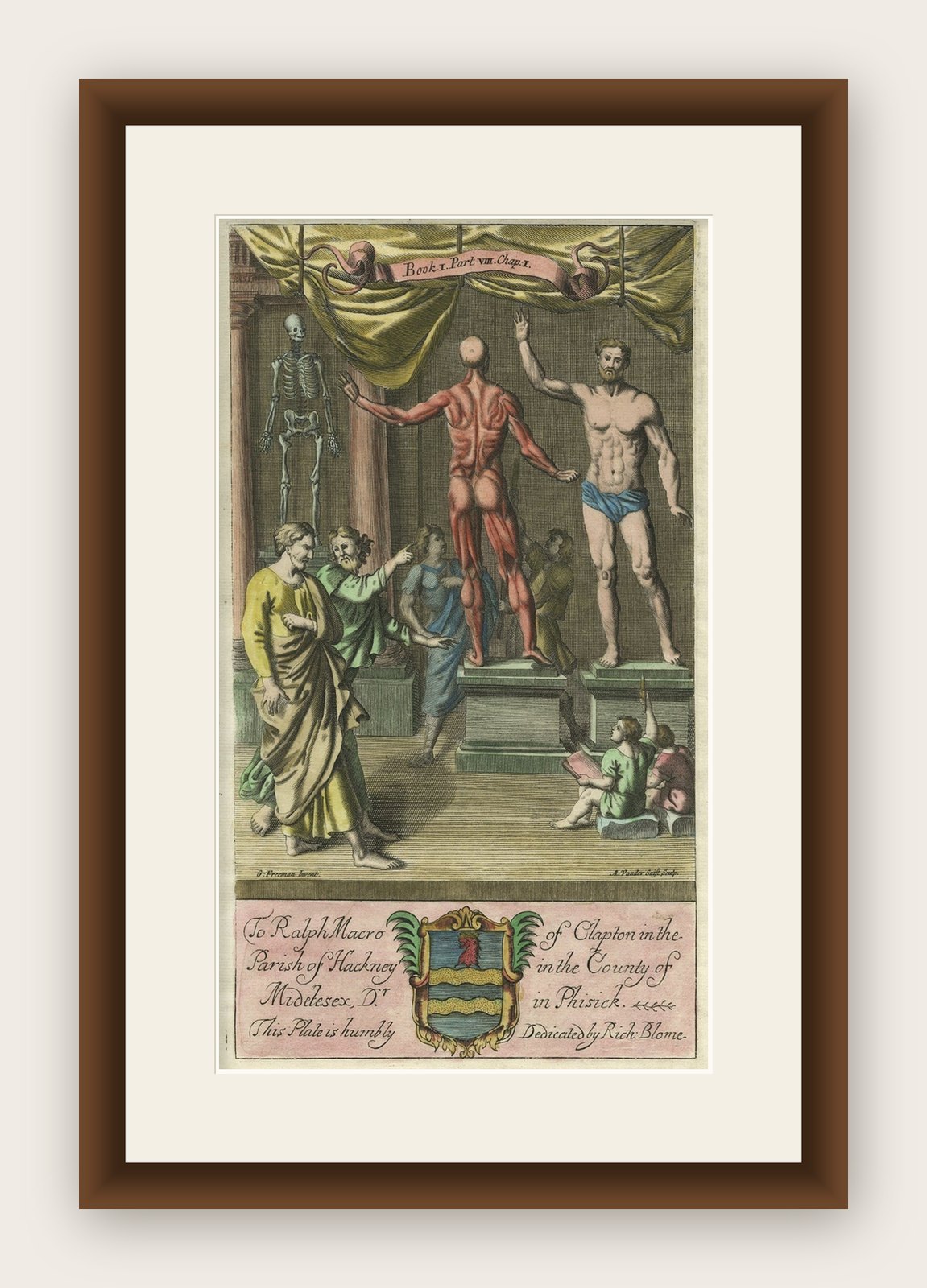
Very good impression with rich detail. Some light toning and faint spotting consistent with age. Minor handling traces in the margins, but the engraved image remains clean and strong. Hand-coloring added later.
About this sheet
Anatomy Display – Antique Engraving by Michael Vandergucht, 1686
This fascinating late 17th-century engraving depicts an anatomy display, showing a skeleton, an écorché (a flayed figure with muscles exposed), and a nude male model. Around them, scholars and students observe, gesture, and take notes, representing the teaching of anatomy in an academic setting. The composition, combining classical drapery with scientific inquiry, illustrates the Renaissance and Baroque fascination with the human body as both a work of art and a subject of medical study.
The plate was published in Richard Blome’s The Gentleman’s Recreation (London, 1686), an ambitious encyclopedic work covering diverse subjects from hunting and heraldry to sciences, philosophy, and anatomy. Blome’s volume was one of the first attempts in England to provide a wide-ranging reference for the educated gentleman. The dedication at the bottom of the plate is to Ralph Macro of Hackney, Middlesex, with a heraldic shield prominently displayed.
The engraving is the work of Michael Vandergucht (1660–1725), a Flemish-born engraver who spent most of his career in London. He produced numerous book illustrations and scientific engravings, often collaborating with leading publishers and authors of the time. This print, based on a design by G. Freeman, exemplifies the precise and clear style Vandergucht employed in scholarly works.
Such prints hold importance not only as examples of scientific illustration but also as reflections of the cultural milieu in which science, medicine, and art intersected. They offered viewers both a technical guide and a moral reflection on the human body and mortality.
Framing tips: A black or dark wood frame with a cream or light mat will highlight the engraving’s fine lines. A gilt frame enhances its Baroque character, making it suitable for display in both scientific and art-focused collections.