About this sheet
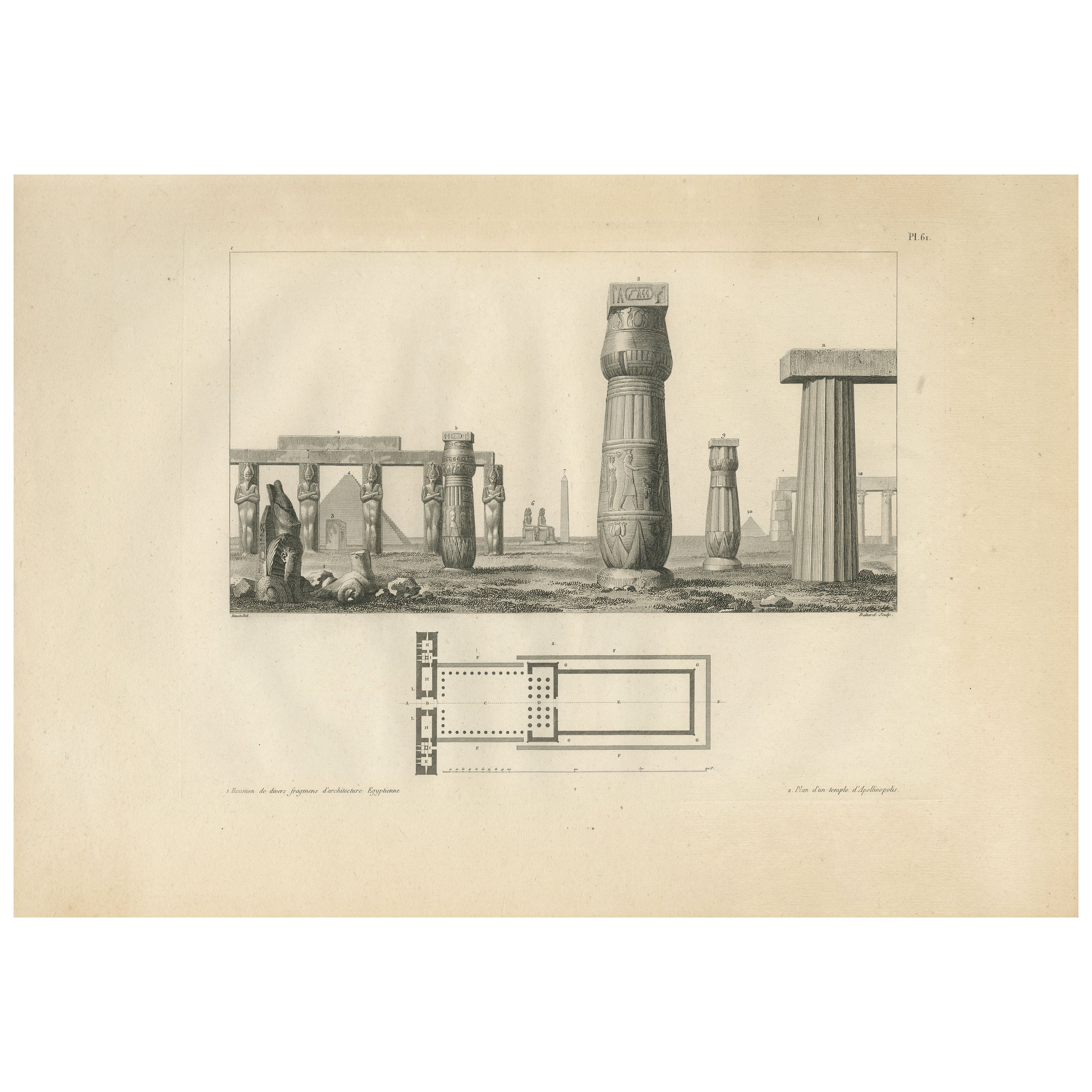
Egypt Temple Ruins with Architectural Plan – Denon Voyage Egypt Engraving 1802
This finely engraved plate originates from Voyage dans la Basse et la Haute Égypte, published in Paris in 1802 by Didot and illustrated by Dominique Baron Vivant Denon. Produced in the immediate aftermath of Napoleon Bonaparte’s Egyptian campaign, the work represents one of the earliest and most influential visual records of ancient Egyptian architecture created from direct observation.
Note: The map is offered unframed, enabling custom framing to personal or interior preferences.
The composition presents a reconstruction view of Egyptian temple ruins, with monumental columns, pylons, and sculptural elements rendered in careful perspective. In the foreground and middle distance, richly carved column fragments rise from the desert floor, while in the background additional architectural remains and obelisks establish depth and scale. Below the main view, Denon includes a measured ground plan of the temple complex, reflecting the scientific and archaeological ambitions of the French expedition.
Unlike later Romanticized depictions of Egypt, this engraving emphasizes documentation and structural clarity. Denon’s approach combines artistic sensitivity with empirical precision, offering European audiences one of their first coherent visual understandings of Egyptian monumental architecture. The inclusion of the architectural plan underscores the Enlightenment ideals that shaped the expedition, positioning the print at the intersection of art, archaeology, and early Egyptology.
The plate was engraved on copper after Denon’s original drawings and printed on firm laid paper, as issued in the French first edition. Such architectural plates are among the most sought-after from the Voyage, appealing both to collectors of Napoleonic material and to interior designers seeking intellectually grounded statement works with strong graphic presence.
Condition report:
Good antique condition. Light age-related toning and scattered faint spotting, consistent with early 19th-century laid paper. Minor surface marks visible. Plate mark clearly visible. No significant tears or losses; margins ample.
Framing tips:
This plate benefits from a generous ivory or soft off-white mat to emphasize its architectural clarity and balanced composition. A dark walnut, ebonized, or restrained gilt frame complements the scholarly character of the subject. Suitable for both classic and contemporary interiors as a single statement piece.
Technique: Copper engraving
Maker: Dominique Baron Vivant Denon, Paris, 1802