About this sheet
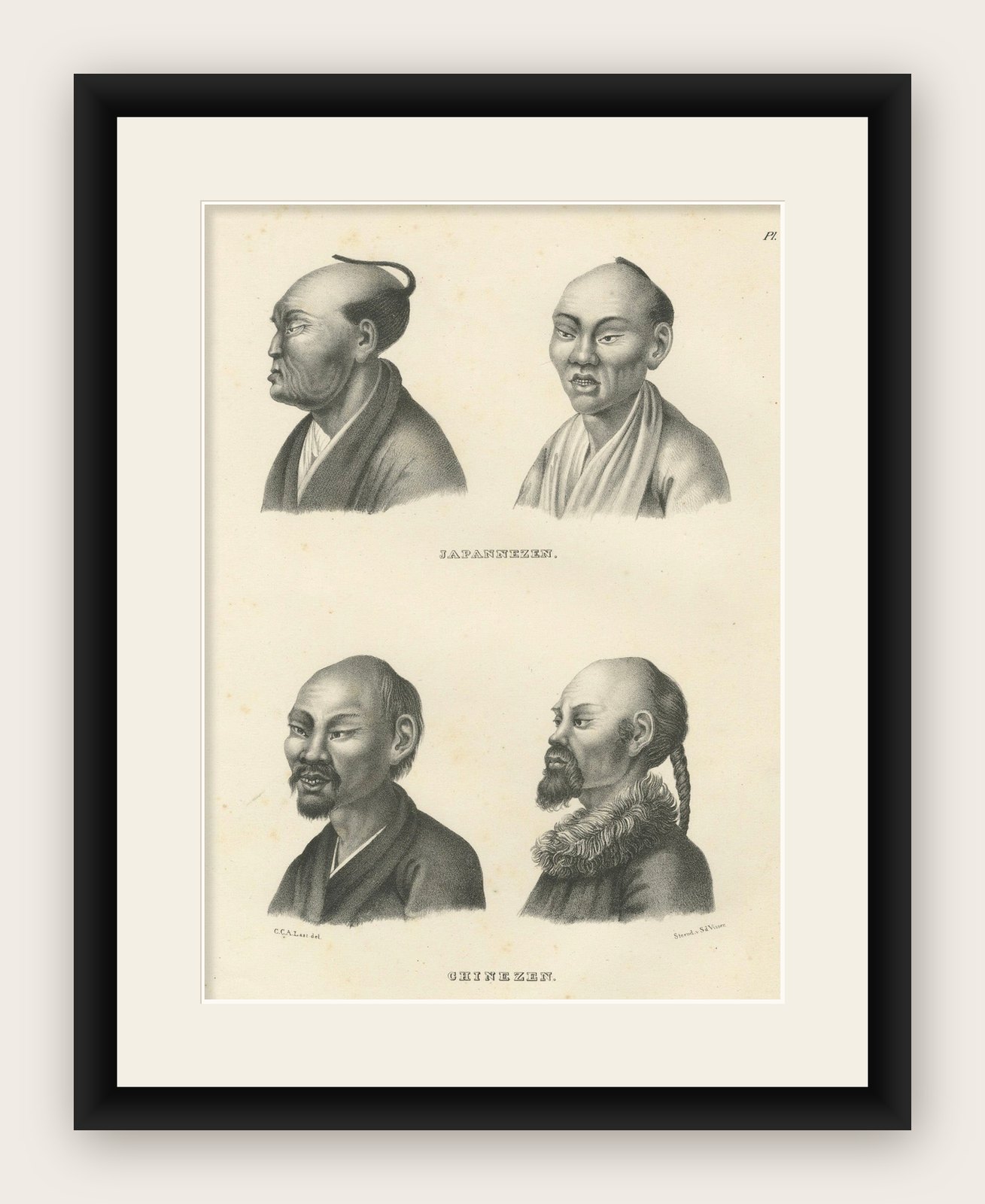
This image is lithograph by Karl Joseph Brodtmann, showcasing a comparative portrait of two Japanese men ("Japannezen") and two Chinese men ("Chinezen"). The work is part of Brodtmann’s ethnographic studies, likely aimed at depicting different ethnic groups in a similar style for European audiences.
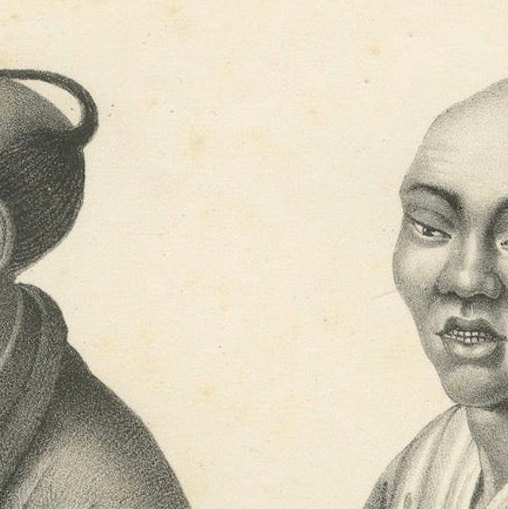
The lithograph features four portraits, two Japanese men at the top and two Chinese men at the bottom. The Japanese men are depicted with characteristic hairstyles of the Edo period, including a topknot (chonmage) and a more formal or traditional appearance. Both men have different expressions, one with a profile view and the other facing forward, showcasing different aspects of their facial features.
The two Chinese men at the bottom also present distinct characteristics. One has a goatee and a simple appearance, while the other man is shown in profile with a long braid (queue), which was a common hairstyle for men during the Qing dynasty, along with a fur-trimmed garment. This specific clothing suggests a man from northern China or possibly someone from the higher classes, given the fur, which was often a symbol of wealth or status.
The portraits were probably intended to serve as ethnographic representations, illustrating the differences in physical appearance, hairstyle, and dress between these two Asian ethnic groups as observed by European artists.
The lithograph is part of "Volledige Natuurlijke Historie der Zoogdieren", a comprehensive natural history of mammals written by H.R. Schinz, a professor of natural history and physiology. This book was published in 1836 in 's-Gravenhage (The Hague) by S. de Visser en Zoon. The work includes 168 plates that are primarily drawn from nature, with most of them likely executed by Karl Joseph Brodtmann, who was a well-known lithographer of the time and frequently collaborated on such scientific and ethnographic projects.
Technique and Style: Brodtmann employed lithography, a popular printmaking technique in the 19th century that allowed for detailed, reproducible images. His style in this work is marked by realism, careful attention to anatomical accuracy, and a delicate use of shading to convey texture in clothing and facial features. This attention to detail helped make the images valuable not only as artistic works but also as tools for the study of different ethnicities and cultures.
The lithograph fits within the ethnographic portrait genre that emerged in the 19th century, driven by the European desire to categorize and study human diversity. Brodtmann’s works were often used to illustrate books or collections related to anthropology, geography, and history. His artistic style is characterized by a focus on individual and cultural specificity, in line with the scientific pursuits of his time.