About this sheet
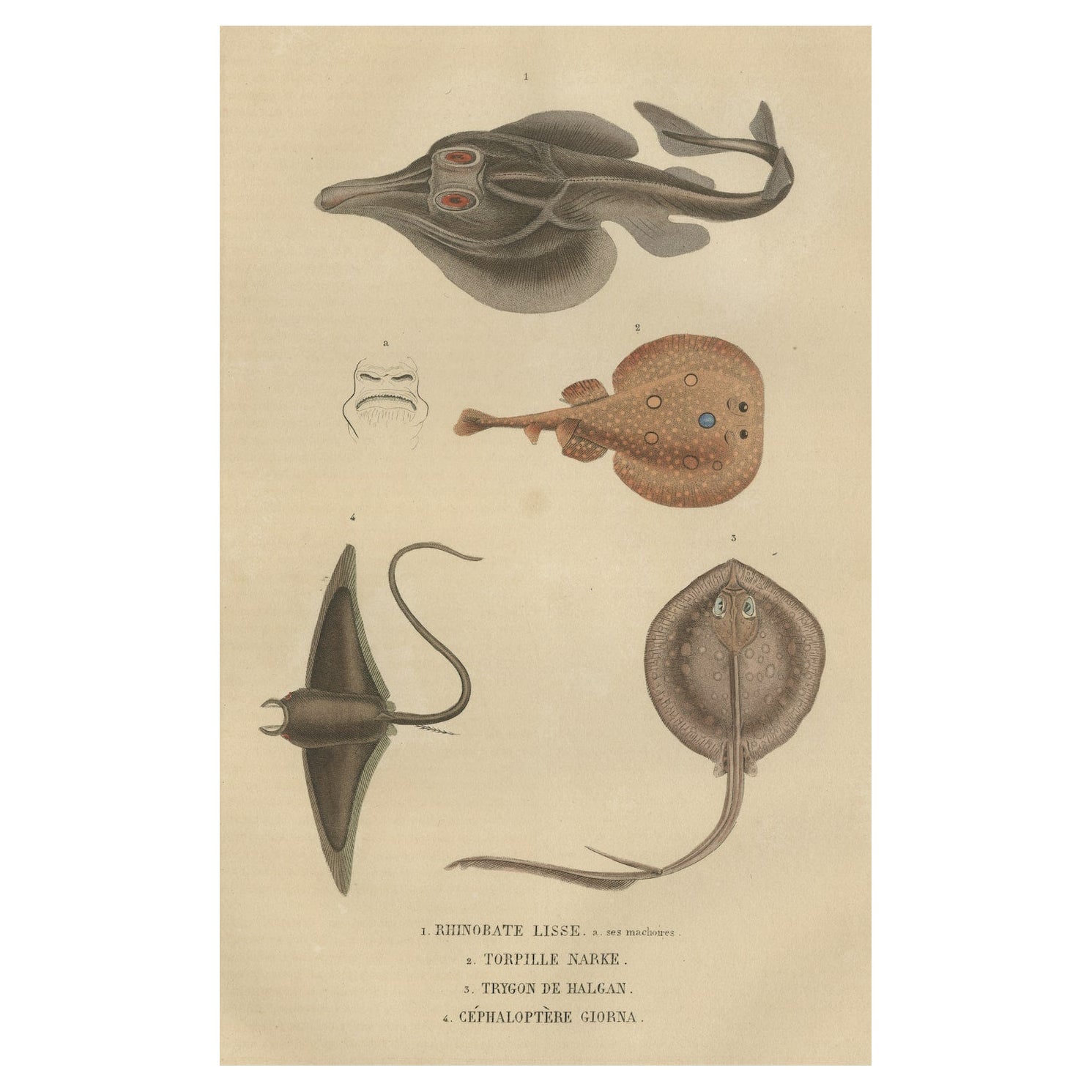
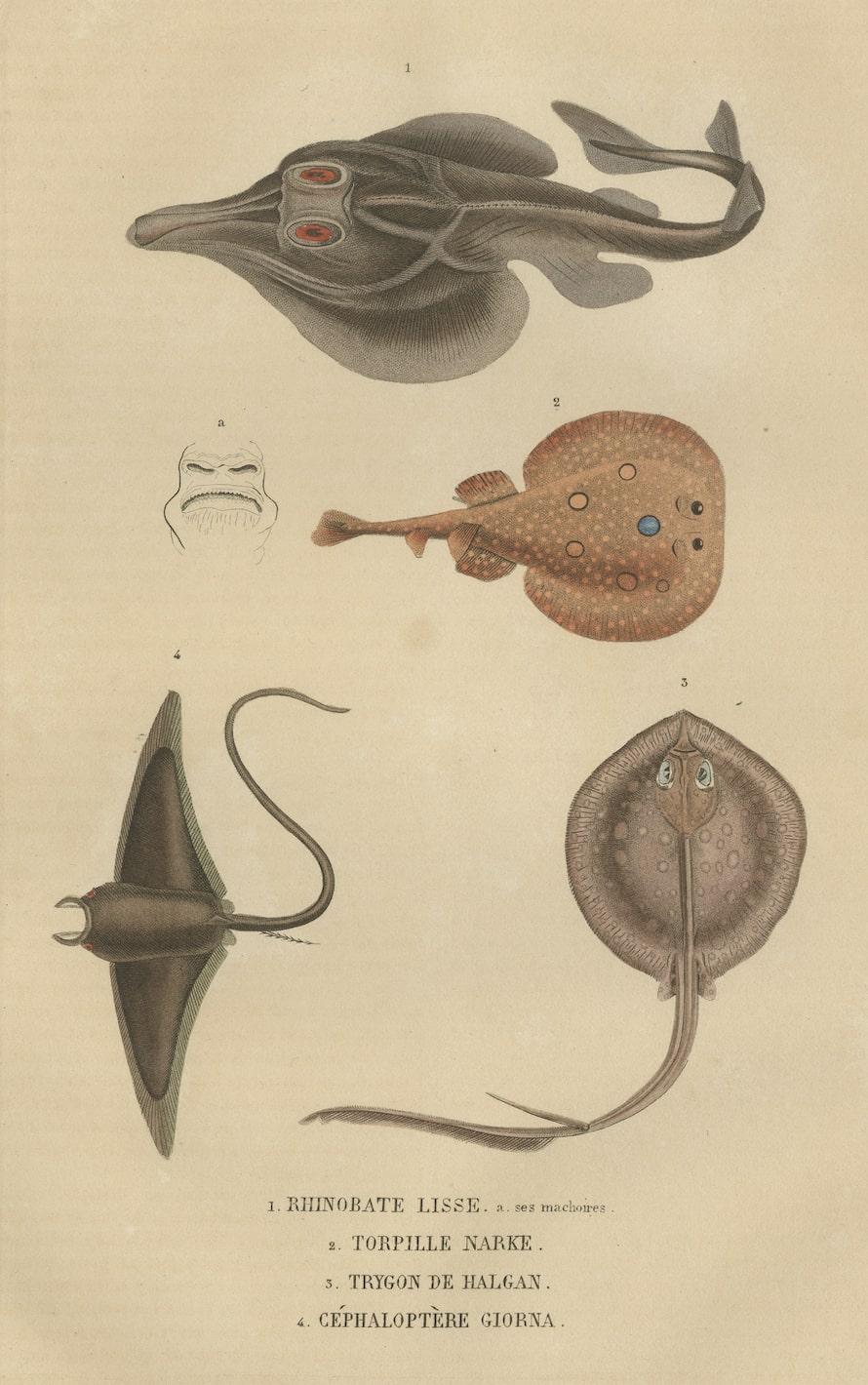
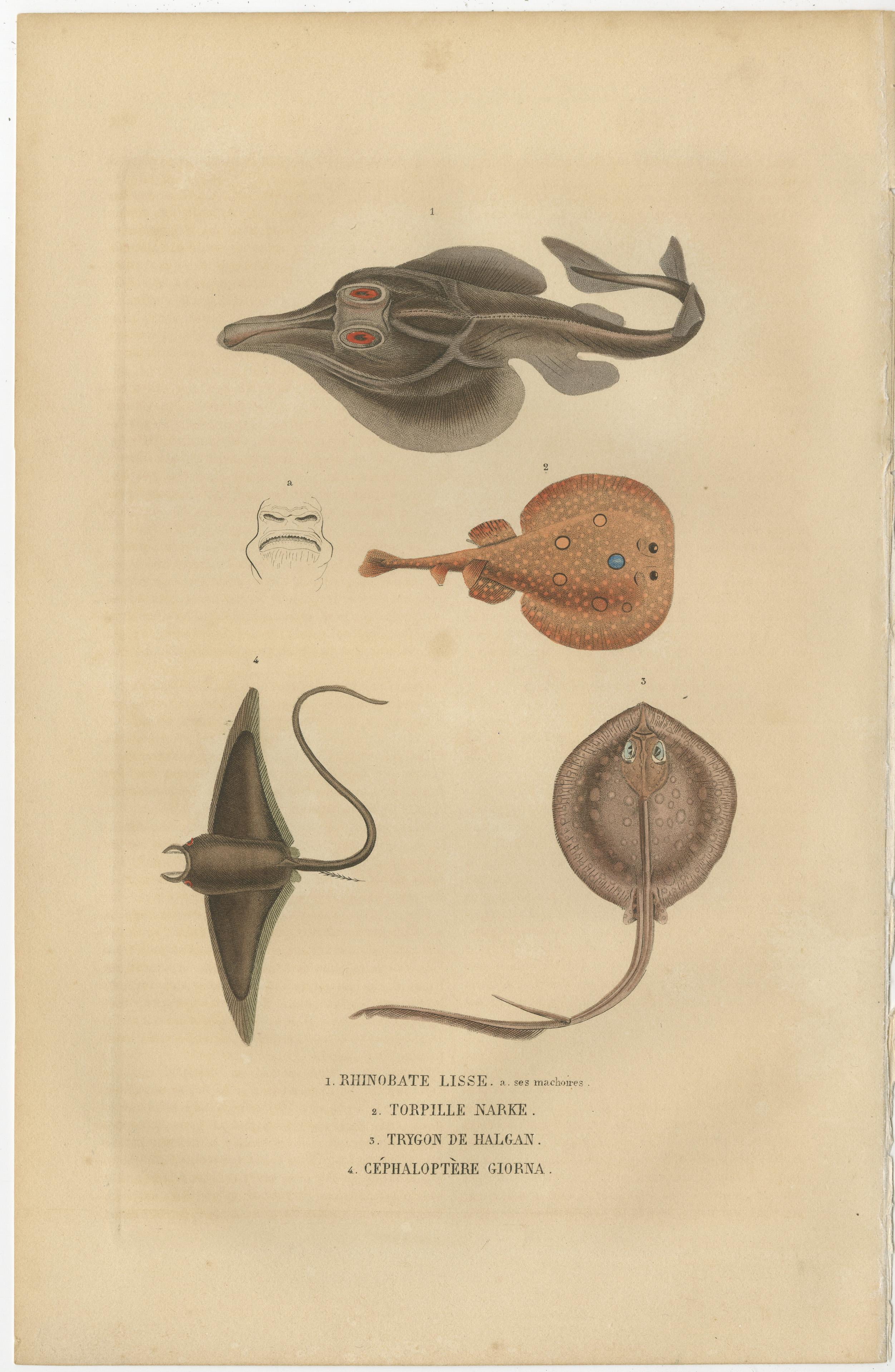
Here's a brief description of the animals mentioned on the orginal hand-colored antique print:
This antique print features marine creatures that present a captivating depiction of each species, highlighting their distinctive characteristics:
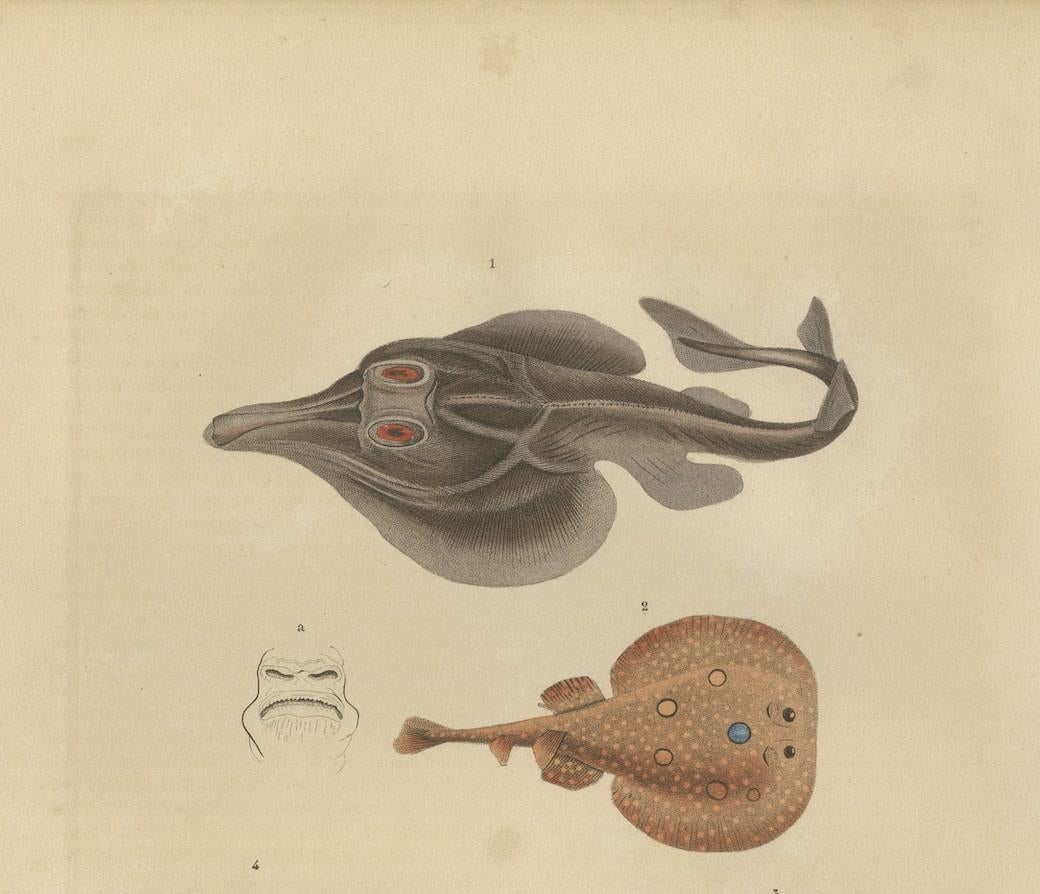
1. **Guitarfish (Rhinobate Lisse):** This print showcases the unique combination of a shark-like body with a flattened ray-like form, displaying its pointed snout resembling a guitar pick. The illustration emphasizes its sleek body, distinctive fins, and its patterned skin.
2. **Common Torpedo (Torpille Narke):** The print portrays the torpedo's rounded body and its characteristic dark coloration. It captures the torpedo's disc-shaped form and illustrate its intriguing ability to generate an electric charge for defense or stunning prey.
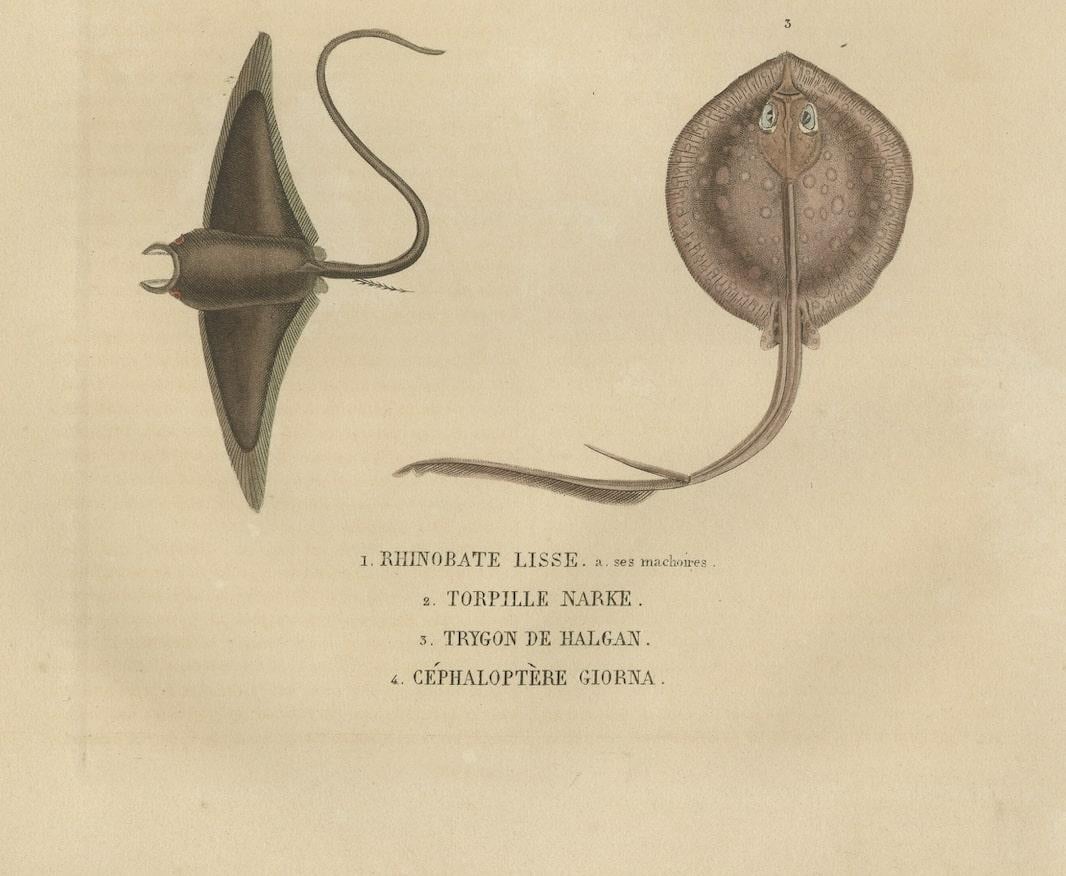
3. **Stingray (Trygon de Halgan):** This print showcases the classic diamond-shaped body of a stingray, featuring its broad, flat body, distinctive disc shape, and possibly its whip-like tail. The illustration emphasizes its textured skin and the iconic barb on its tail used for defense.
4. **Devil Fish or Giant Devil Ray (Cephaloptère Giorna):** The print depicts a majestic scene, showcasing the immense size of the devil fish or giant devil ray. It emphasizes the expansive wingspan and elegant movement of this massive species, capturing its presence in the depths of the ocean.
These antique prints serve as both scientific documentation and artistic representations, reflecting the fascination and exploration of the natural world during the era they were created.
Made by F.J. Desmares after Pierre Auguste Joseph Drapiez (1778-1856).
Engraving with original hand colouring, heightened with arabic gum on wove (vellin) paper.
More info on the book in which it was published:
The 'Dictionnaire Classique des Sciences Naturelles' by Pierre Auguste Joseph Drapiez stands as a remarkable testament to 19th-century natural sciences. Published in Brussels in 1845, this work represents an expansive collation of knowledge, building upon the pioneering works of Buffon, Daubenton, Lacepede, Cuvier, de Jussieu, and other influential naturalists.
The prints within this compendium likely showcase a rich amalgamation of artistic precision and scientific accuracy. Drapiez, himself a Belgian naturalist, would have aimed for detailed representations of flora, fauna, and scientific phenomena, mirroring the illustrative styles prevalent during his time. Given the era's emphasis on illustration, these prints were likely engraved meticulously, possibly portraying intricate anatomical details or lifelike depictions of the natural world.
With Drapiez's background in natural history, the prints might bear testament to his commitment to scientific authenticity, aiming to educate and inspire scholars and enthusiasts alike. These engravings would have complemented the text, offering visual aids that elucidate the concepts and specimens discussed in the volume.
Overall, the prints of 'Dictionnaire Classique des Sciences Naturelles' likely serve as both artistic representations and invaluable scientific resources, encapsulating the essence of 19th-century natural history exploration and documentation.