Illustrated Bivalve Shells from 'Dictionnaire Classique des Sciences Naturelles'
€ 110
Original antique · The actual sheet photographed · Certificate of authenticity on request · Sold unframed · Worldwide shipping from € 15 (rates)
Sheet size
26.5 × 17 cm (10.4 × 6.7 in)
Condition
Good
Reference
BG-13261-151, BG-13261-158
What the condition grades mean
Excellent
Bright and clean, with no faults worth mentioning.
Very good
Only light signs of age, such as faint toning.
Good
Normal signs of age for a sheet of this period: toning, some foxing, small marks or neat old repairs.
Fair
Clear faults such as staining, tears or repairs, priced to match.
Every fault we see is written in the condition note, and the whole sheet is shown uncropped in the photos.
Condition
Good. Moderate offsetting and soiling. Few browns spot due to aging and handling. Aged papers with typically warm, yellowish-brown hue. Some edges rough, but leaving space for framing. Please review the images for further condition details.
About this sheet
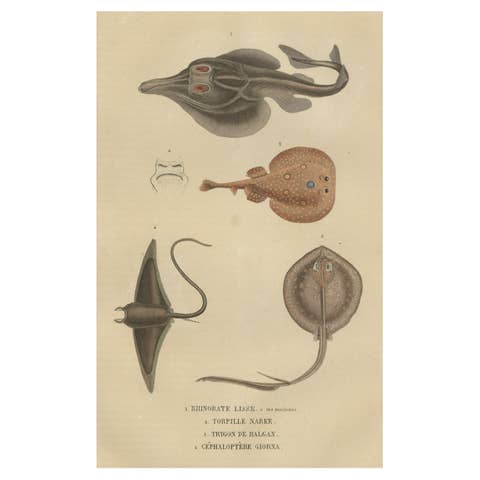
These two original antique prints are hand-colored engravings of various bivalve mollusks, which are a type of shellfish with a compressed body enclosed within a hinged shell. These specific illustrations are from the 'Dictionnaire Classique des Sciences Naturelles' by Pierre Auguste Joseph Drapiez, published in 1845.
Here are descriptions of the shells as labeled in the engravings:
From the first image: 1. Donax bec de Flûte: This shell has an oblong, slightly triangular shape with a pattern of fine, concentric lines and a color gradient from dark blue or black at the hinge, lightening to a sandy hue at the edges. 2. Donax des Canards: A similar shape to the first, but more elongated and with a more pronounced 'beak.' It has a simple, pale coloration with a delicate, pointed outline. 3. Capsa du Brésil: A broad, rounded shell with subdued brown and tan coloration and broad, radiating bands. 4. Telline Soleillevant: A colorful shell with a sunburst pattern in shades of pink, orange, and yellow emanating from the hinge area.