About this sheet
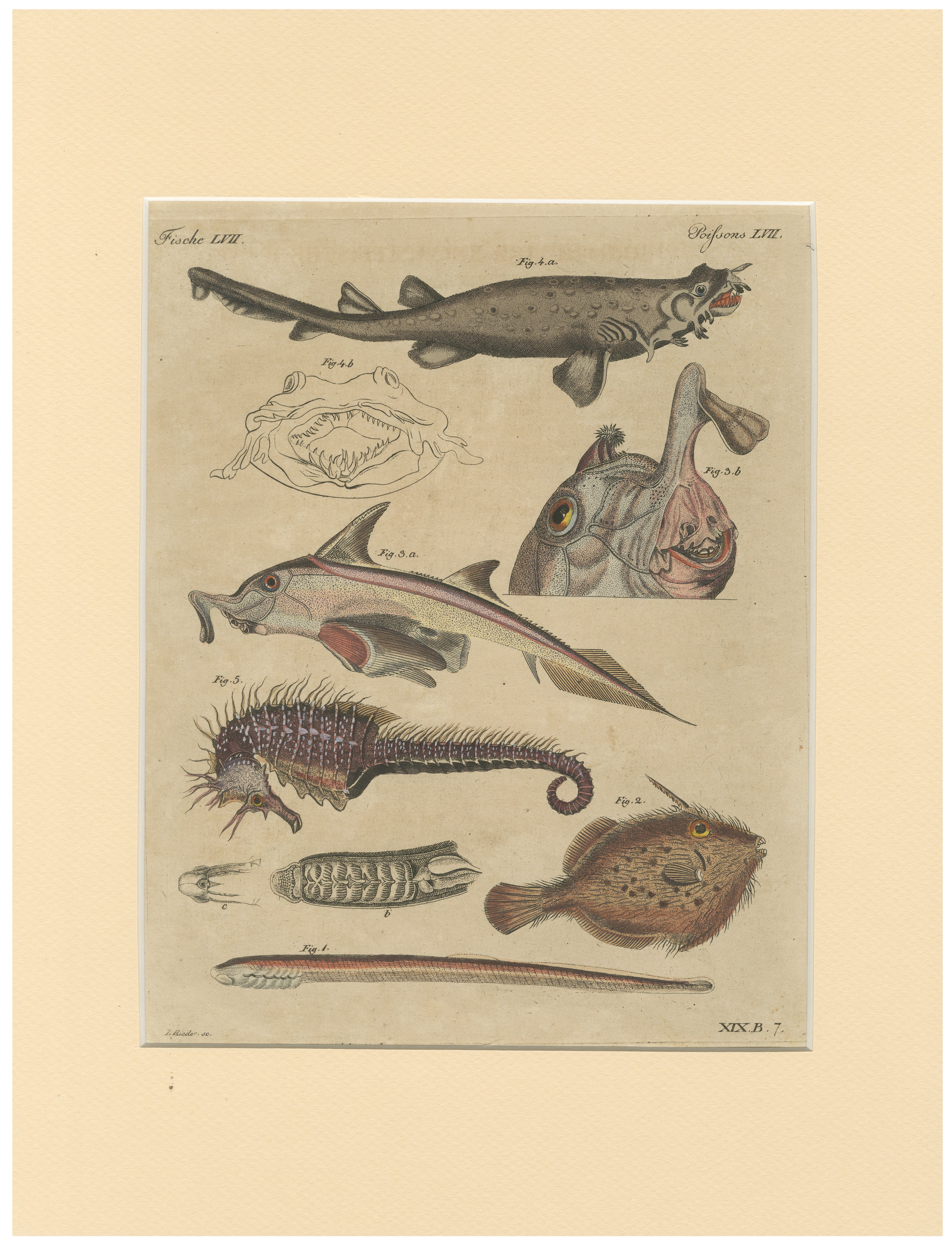
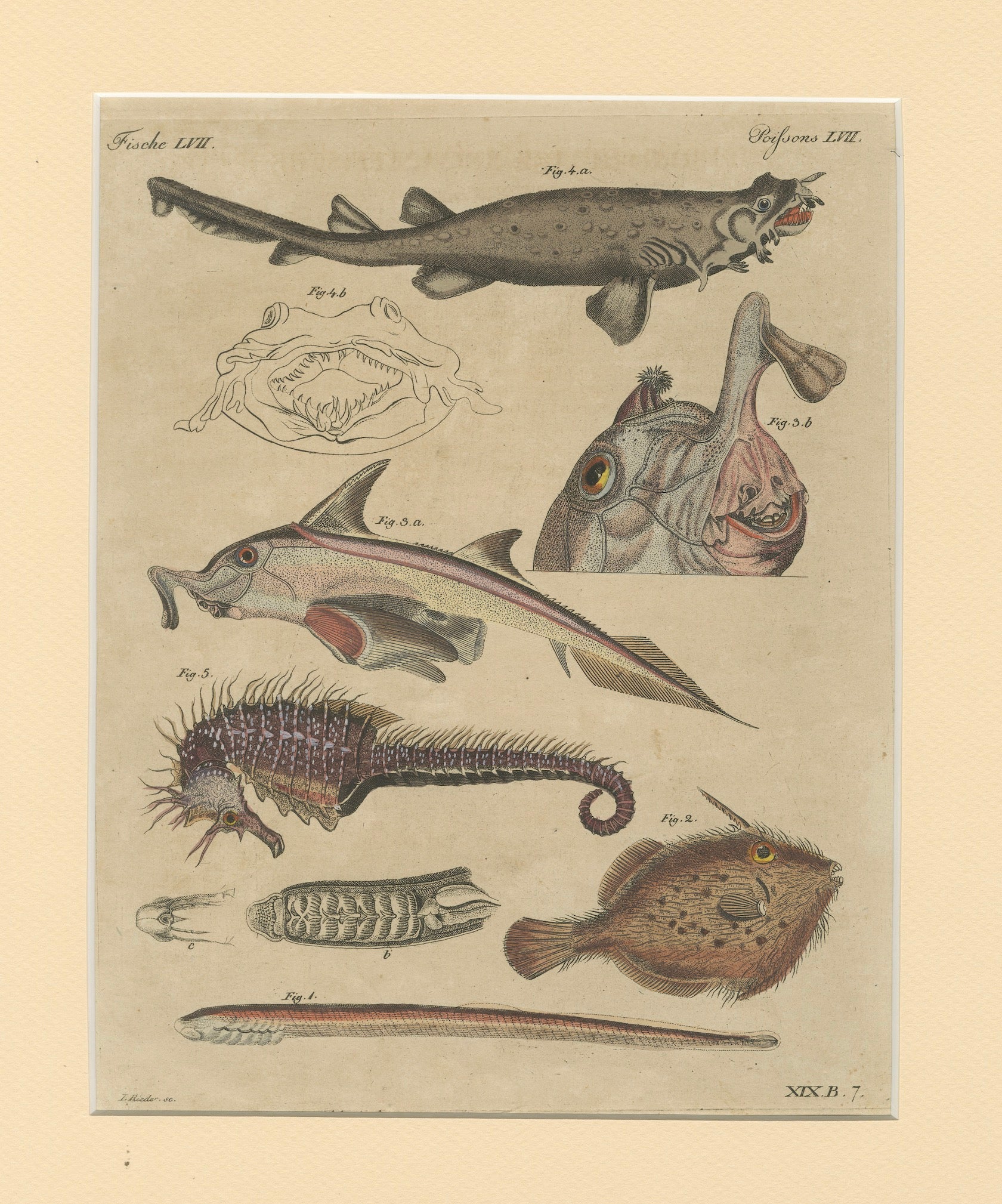
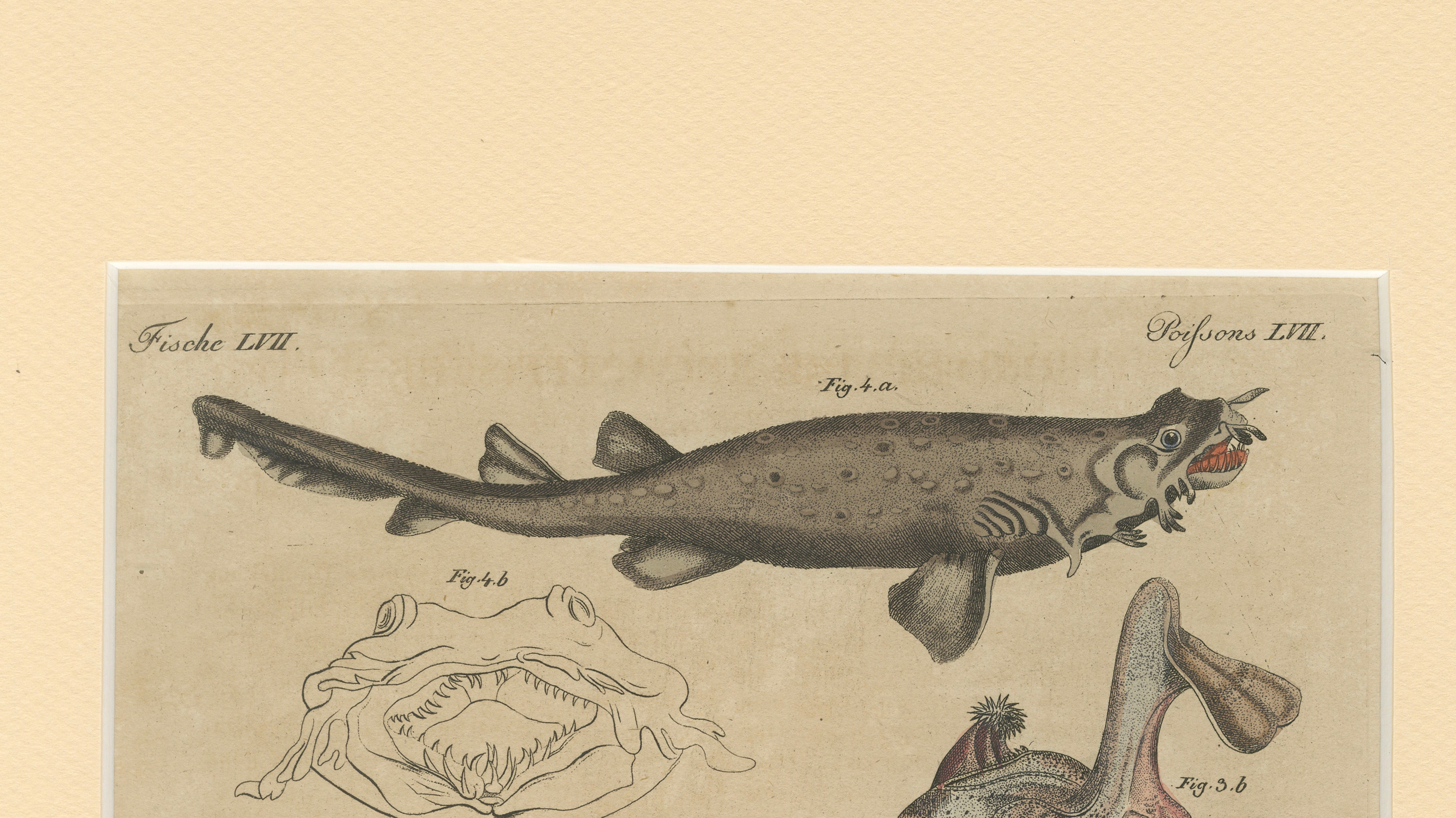
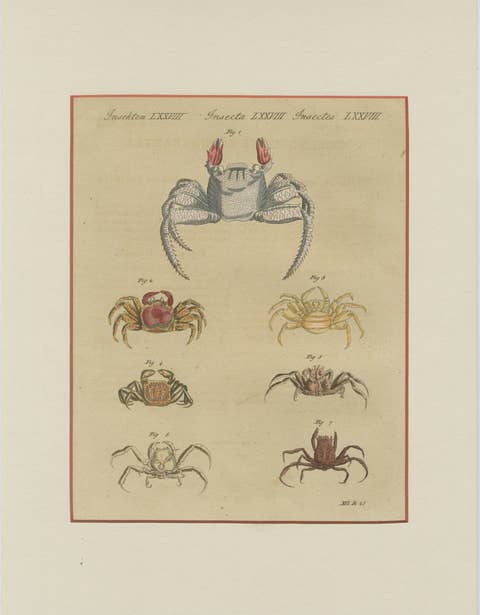
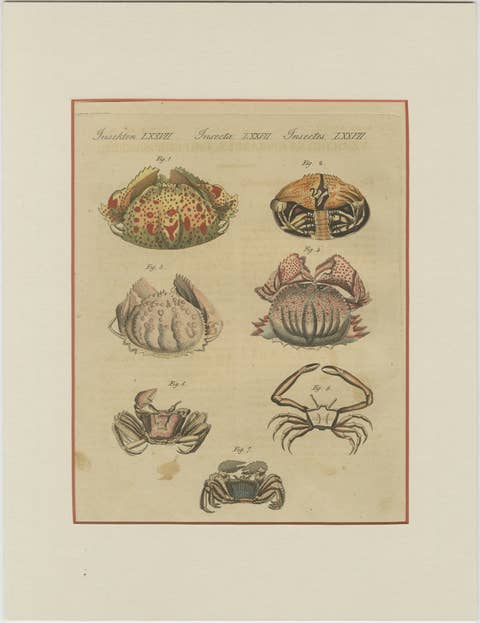
Original antique hand-colored copper engraving depicting five extraordinary marine creatures, published in Friedrich Justin Bertuch’s celebrated “Bilderbuch für Kinder” in Weimar in 1821.
The plate is headed “Fische LVII / Poissons LVII” and was described by Bertuch as “Sehr sonderbare Knorpelfische” – Very Remarkable Cartilaginous Fishes.
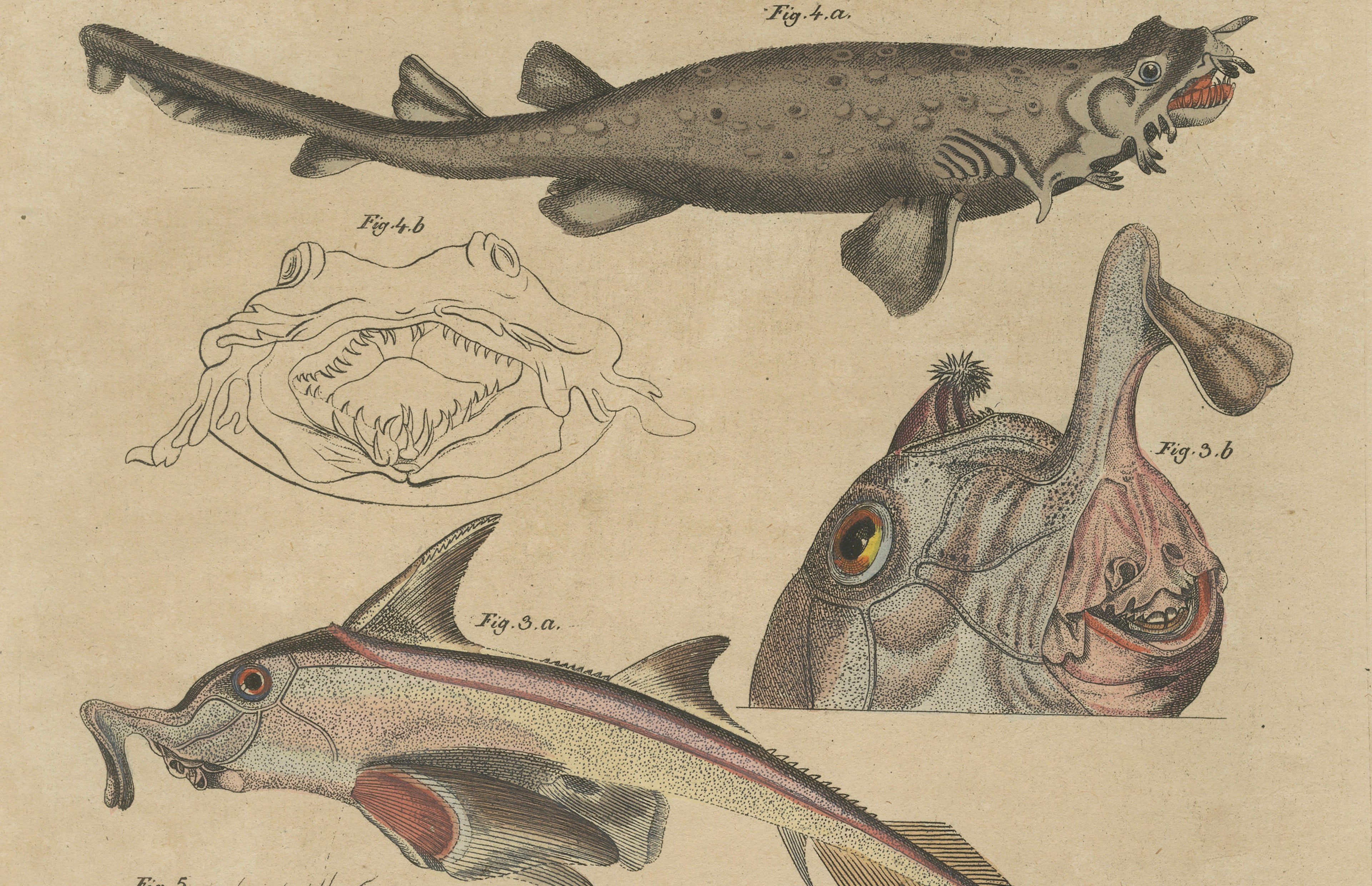
The engraving presents some of the strangest marine animals known to European naturalists of the early 19th century, including a shark with an extraordinary mouth, an elephantfish and an elaborate seahorse.
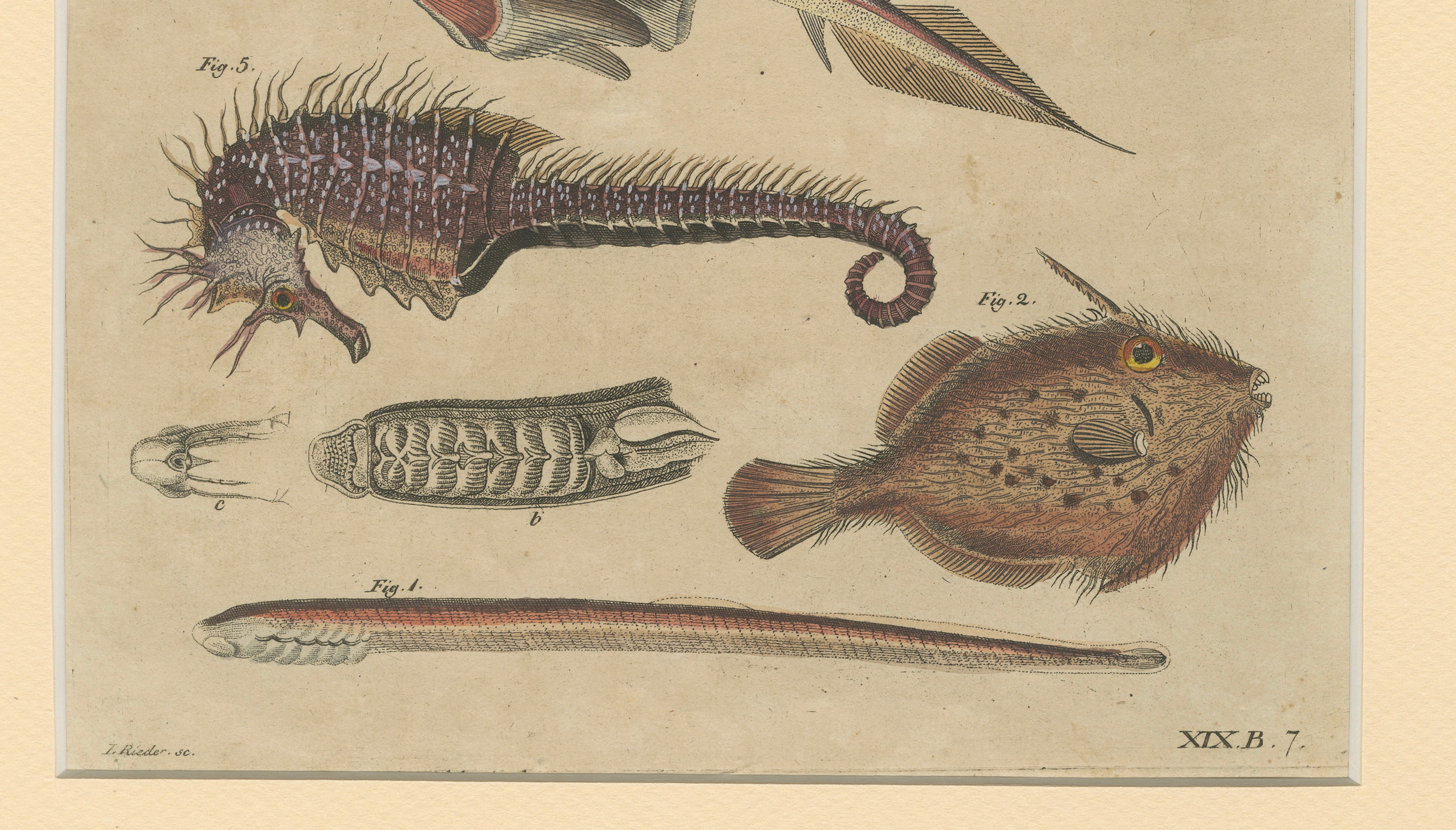
Fig. 1 – Red Ammocoete
Historical name: Roter Ammocöt / L’Amocète rouge
The extremely elongated fish at the bottom of the plate represents an ammocoete-type animal. Early naturalists used the name Ammocoetes for unusual eel-like forms associated with lampreys.
Its remarkably slender body gives it an almost snake-like appearance.
Fig. 2 – Hairy Triggerfish
Historical name: Haariger Balistes / Le Baliste velu
The curious rounded fish at lower right is a triggerfish-type animal distinguished by its unusual rough or hairy-looking surface and prominent dorsal spine.
Triggerfish are named for the specialized locking mechanism of their dorsal spines, which can be raised for defense.
Fig. 3 – Antarctic Elephantfish
Historical name: Antarktischer Gallorhynchus / Le Gallorhynque antarctique
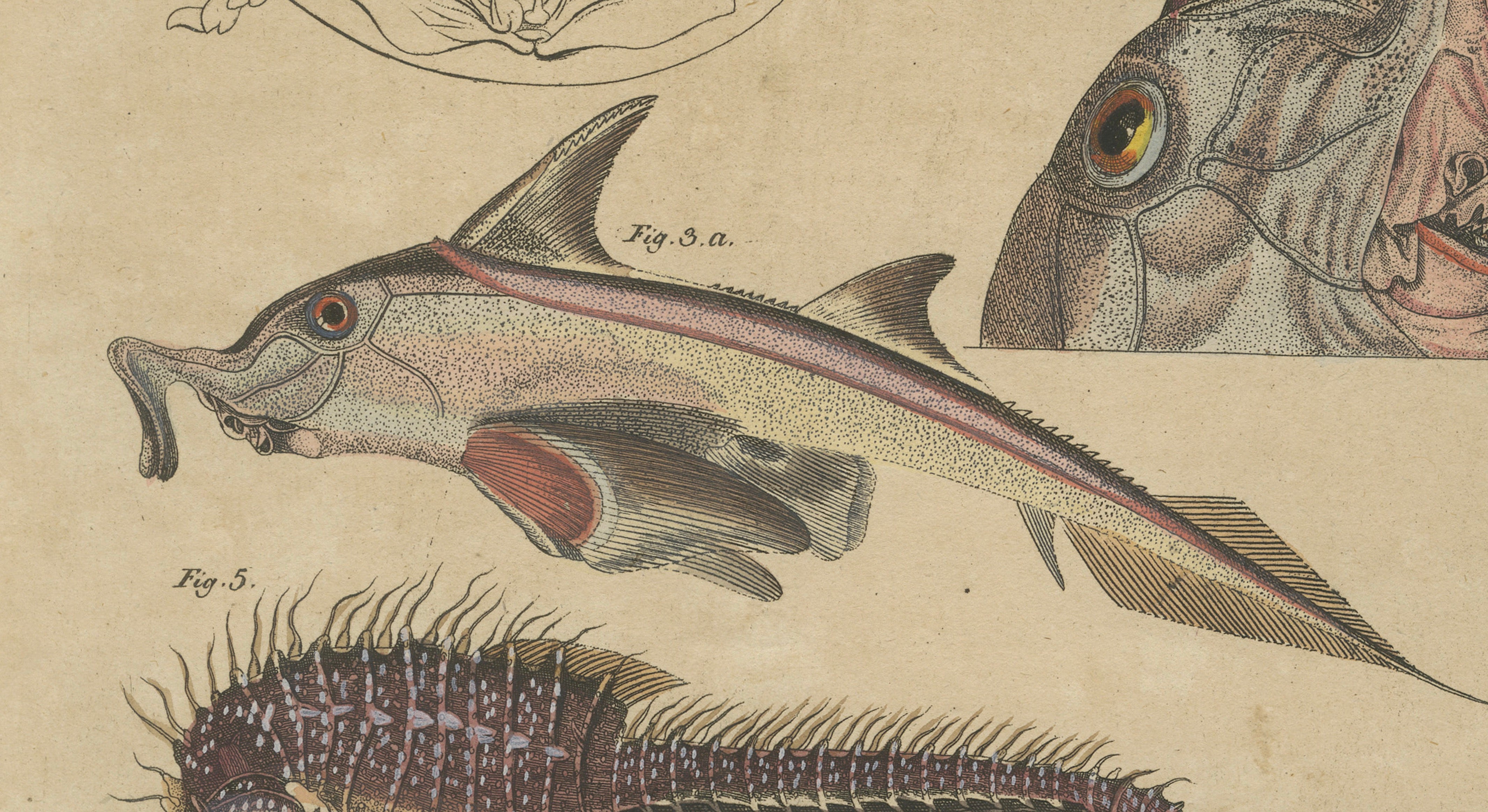
The long-bodied fish crossing the center of the plate is an elephantfish or plownose chimaera, recognizable by the remarkable flexible projection extending from its snout.
A separate enlarged study of the head shows this unusual structure and the animal’s mouth in greater detail.
Modern elephantfish belong to the chimaera group, ancient relatives of sharks and rays.
Fig. 4 – Frilled / Appendaged Shark
Historical name: Anhängiger Hai / Le Squale appendiculé
The upper animal is a particularly bizarre shark-like fish. Bertuch supplements the complete animal with an enlarged frontal study of its extraordinary mouth and numerous pointed teeth.
The illustration reflects the fascination early naturalists had with unusual sharks and other cartilaginous fishes whose anatomy differed dramatically from familiar European fishes.
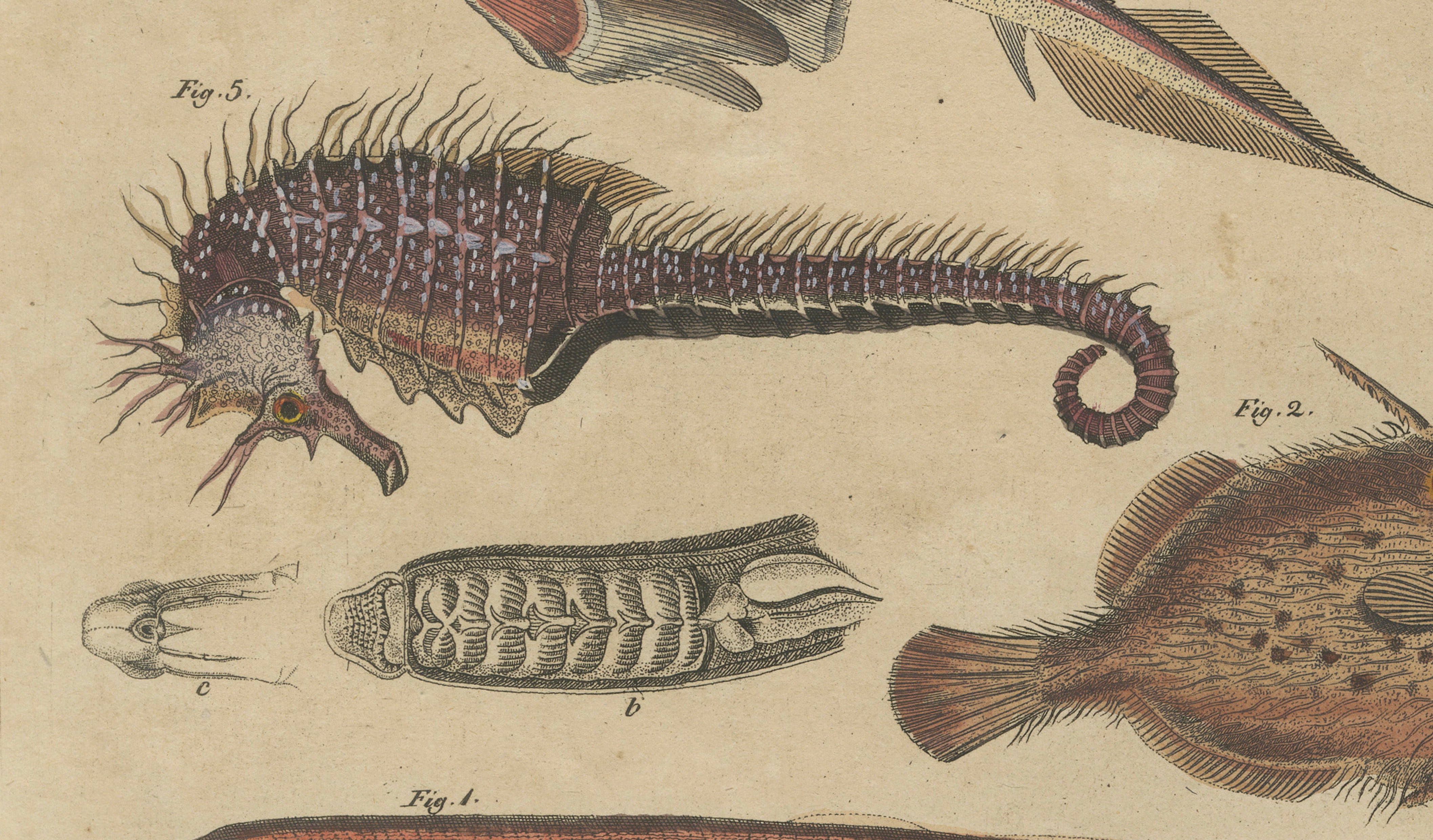
Fig. 5 – Filamentous Seahorse
Historical name: Fadenförmiges Seepferdchen / L’Hippocampe filamenteux
One of the most decorative subjects on the plate is the spectacular spiny seahorse at lower left.
Its elongated body is covered with numerous projecting filaments and spines, while the characteristic prehensile tail curls tightly inward.
Seahorses belong to the genus Hippocampus and are among the most unusual fishes in the world. Unlike most fishes, they swim upright, and the male carries the developing young in a specialized brood pouch.
Friedrich Justin Bertuch
Friedrich Justin Bertuch (1747–1822) was a German publisher, writer and patron of the arts. His monumental “Bilderbuch für Kinder” (Picture Book for Children), first published in Weimar in 1790, became one of the great illustrated educational encyclopedias of the late 18th and early 19th centuries.
Its hundreds of engraved and hand-colored plates introduced readers to animals, birds, insects, plants, marine life, geography, science, technology, antiquity and cultures from around the world.
This engraving comes from Volume X, published in 1821. Bertuch’s original contents specifically list Plate LVII as a group of exceptionally unusual cartilaginous fishes. ([Heidelberg Historical Collections][1])
The engraving is signed “L. Rieder sc.” at lower left and marked XIX B.7 at lower right.
This is an especially desirable Bertuch marine-life plate because of the extraordinary variety of subjects. The combination of seahorse, shark, elephantfish and enlarged anatomical studies gives it the appearance of an early marine cabinet of curiosities.
Technique: Original hand-colored copper engraving
Publisher: Friedrich Justin Bertuch / Industrie-Comptoir
Publication: Bilderbuch für Kinder
Place: Weimar, Germany
Date: 1821
Volume: X
Plate: Fische LVII / Poissons LVII
Historical title: Sehr sonderbare Knorpelfische – Very Remarkable Cartilaginous Fishes
Engraver: L. Rieder
Subjects: Seahorse, Shark, Elephantfish, Triggerfish and Ammocoete
Condition:
Good antique condition with overall age-related toning, scattered foxing and spotting and some visible show-through or offsetting from printed text. Minor marks and imperfections are present consistent with a print more than 200 years old. The original hand coloring remains attractive, particularly the violet-red seahorse, reddish fish details and subtle grey-green tones.
The engraving is loosely inserted in an acid-free matting board.
Please study the photographs carefully as they form part of the condition description.
Please note: This is an original antique hand-colored copper engraving from 1821, not a modern reproduction. The print is sold unframed. Framed images or...