About this sheet
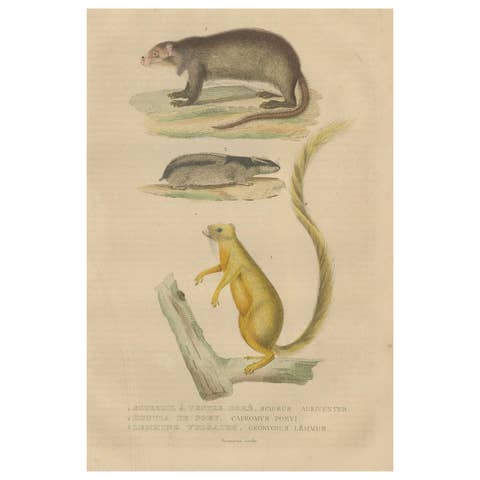
The print is an 1845 handcolored engraving that features a selection of six different bat species, each carefully illustrated to highlight their distinctive anatomical features. These bats represent a range of species, as indicated by their French scientific names:
The central image is the most prominent, depicting a bat with wings fully extended, showcasing the intricate webbing and musculature. The others are shown in various aspects: full-body views, head portraits, and side profiles, giving a comprehensive look at the physical diversity within the order Chiroptera.
The engraving shows great attention to detail, not just in the form of each bat, but also in their textures—from the fur's softness to the translucent look of the wing membranes. The handcoloring is subtle yet effective, providing a naturalistic portrayal of each species, while still allowing the viewer to discern individual details.
The paper itself has an aged cream color, with some slight discoloration that suggests a history of careful preservation. The condition of the print is quite good for its age, with the colors remaining vibrant and the lines clear. There are no apparent tears or significant damage to the images themselves, though the paper edges show signs of wear, which is common for a piece of this vintage.
This engraving would have been valuable for educational purposes in the 19th century, offering a detailed look at bat species which would have been less known to the public. It also stands as a testament to the skill of the illustrators and colorists of the period, blending scientific accuracy with artistic craftsmanship.
This engraving would have been both educational, serving as a tool for entomologists and naturalists of the era to study these species, and decorative, displaying the beauty and diversity of insects in an era when such details were often unknown to the general public. It is a fine example of the intersection of art and science during the 19th century.
This print not only serves as a scientific record but also as a work of art, reflecting the dual interests of the Victorian era in both natural history and illustration. It is a remarkable piece that would be a significant addition to any collection of natural history art or an elegant decorative piece for those with a taste for the historic and the natural world.
The style of the illustration is reminiscent of 19th-century scientific prints, which were often used in natural history books to document various species.
More info on the book in which it was published:
The 'Dictionnaire Classique des Sciences Naturelles' by Pierre Auguste Joseph Drapiez stands as a remarkable testament to 19th-century natural sciences. Published in Brussels in 1845, this work represents an expansive collation of knowledge, building upon the pioneering works of Buffon, Daubenton, Lacepede, Cuvier, de Jussieu, and other influential naturalists.
The prints within this compendium likely showcase a rich amalgamation of artistic precision and scientific accuracy. Drapiez, himself a Belgian naturalist, would have aimed for detailed representations of flora, fauna, and scientific phenomena, mirroring the illustrative styles prevalent during his time. Given the era's emphasis on illustration, these prints were likely engraved meticulously, possibly portraying intricate anatomical details or lifelike depictions of the natural world.
With Drapiez's background in natural history, the prints might bear testament to his commitment to scientific authenticity, aiming to educate and inspire scholars and enthusiasts alike. These engravings would have complemented the text, offering visual aids that elucidate the concepts and specimens discussed in the volume.
Overall, the prints of 'Dictionnaire Classique des Sciences Naturelles' likely serve as both artistic representations and invaluable scientific resources, encapsulating the essence of 19th-century natural history exploration and documentation.