Antique Allegorical Print – Dutch Victory over France, Hand-Colored, ca.1750
€ 680
Original antique · The actual sheet photographed · Certificate of authenticity on request · Sold unframed · Worldwide shipping from € 15 (rates)
Date
1750
Mapmaker / artist
J. Müller after Joseph Waldman, c.1750
Technique
Hand-colored engraving
Sheet size
37.8 × 25.7 cm (14.9 × 10.1 in)
Reference
PCT-61836
What the condition grades mean
Excellent
Bright and clean, with no faults worth mentioning.
Very good
Only light signs of age, such as faint toning.
Good
Normal signs of age for a sheet of this period: toning, some foxing, small marks or neat old repairs.
Fair
Clear faults such as staining, tears or repairs, priced to match.
Every fault we see is written in the condition note, and the whole sheet is shown uncropped in the photos.
Condition
Very good, an almost excellent impression with vibrant hand-coloring. Some light age-toning and minor spotting consistent with age. Wide margins well preserved, plate mark visible. Strong paper.
About this sheet
Batavian Victory Allegory – Antique Hand-Colored Engraving by J. Müller, c.1750
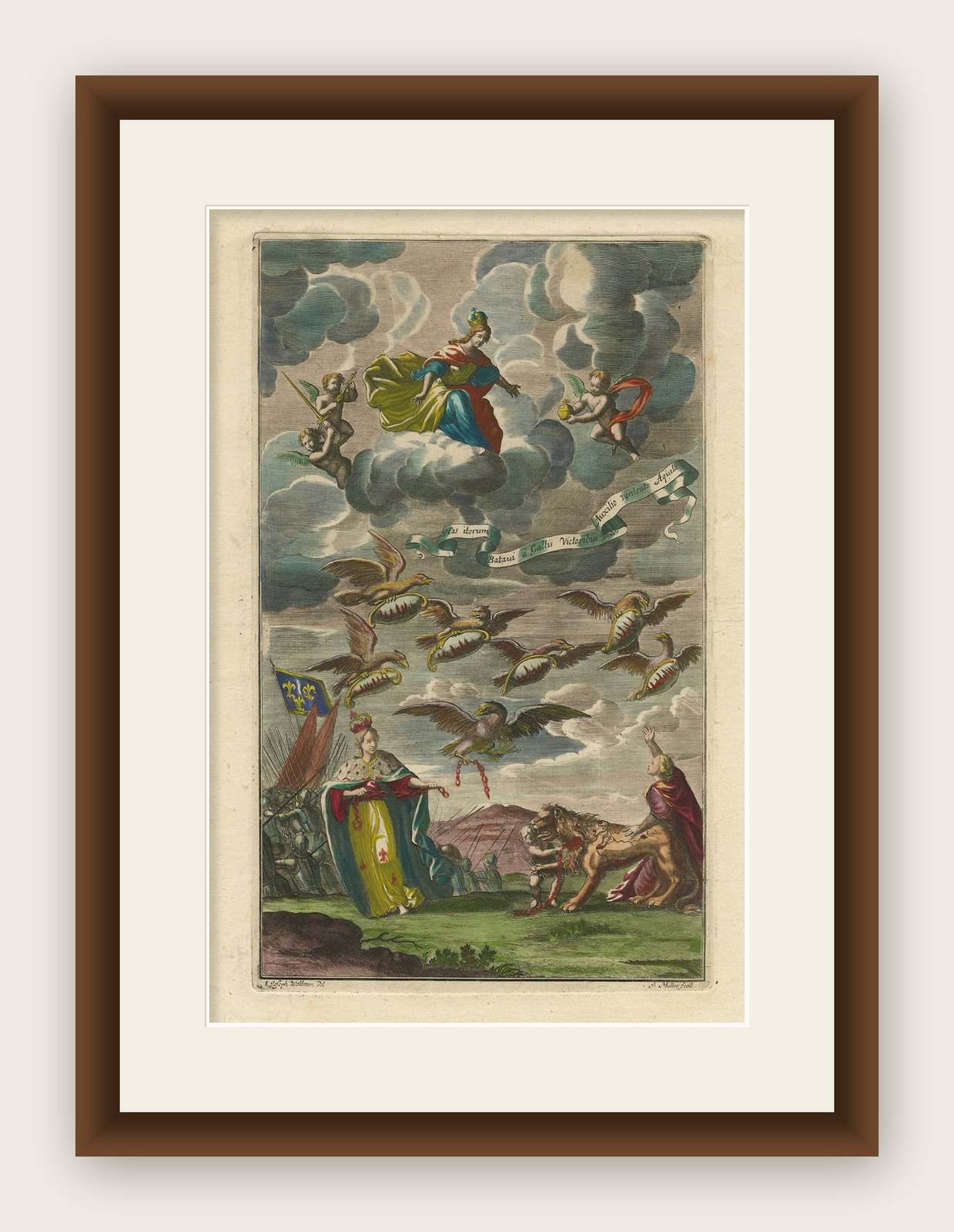
This richly symbolic 18th-century hand-colored engraving, titled Has Iterum Batavi a Gallis Victoribus..., presents an elaborate allegory of triumph and national identity. At the center, a crowned female figure, likely representing the Dutch Republic or a sovereign, stands with regal bearing, draped in ermine-lined robes. To her side is a chained lion, a long-standing emblem of the Netherlands, symbolizing strength and vigilance. Another female figure kneels in supplication or thanksgiving, hands raised to the heavens.
Above, in the celestial sphere, a queenly figure seated among clouds directs the scene, attended by cherubs bearing swords and globes of sovereignty. From the skies descend great birds, each carrying chains and emblems of victory, evoking the phoenix, a symbol of rebirth and endurance. Military banners and armed soldiers at the left underscore the martial context, while the Fleur-de-lis flag references France, suggesting a Batavian (Dutch) victory over the French.
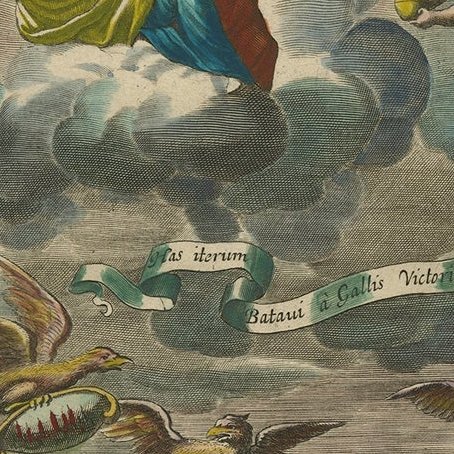
The Latin inscription across the ribbon, Has Iterum Batavi a Gallis Victoribus..., translates to “Thus again the Batavi (Dutch) victorious over the Gauls (French),” reinforcing the patriotic message. Such allegorical prints celebrated political events and military triumphs while encoding moral lessons and national pride within their imagery.
This print was engraved by J. Müller after a design by Joseph Waldman, active in the mid-18th century. Waldman’s compositions often combined classical allegory with contemporary political symbolism, creating works that appealed to both collectors and patriots of the period.
Framing tips: A gilt frame emphasizes the rich coloring and allegorical grandeur of the scene. For a more scholarly presentation, a dark wood frame with a cream or lightly toned mat will highlight the historic symbolism.