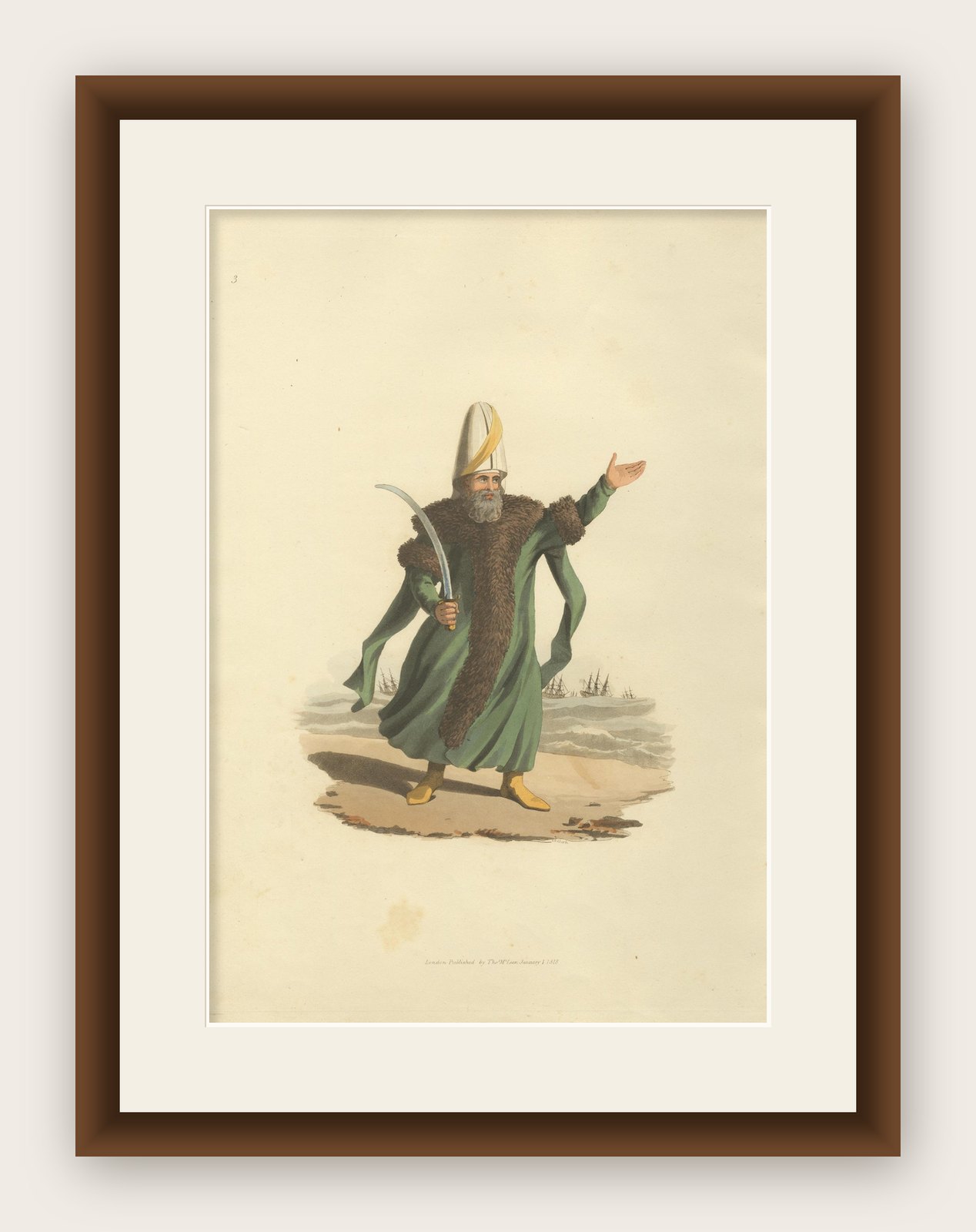
Antique Print of Capitan Pacha, Hand-Colored Aquatint, 1818
€ 370
Original antique · The actual sheet photographed · Certificate of authenticity on request · Sold unframed · Worldwide shipping from € 15 (rates)
Date
1818
Sheet size
38 × 27 cm (15.0 × 10.6 in)
Condition
Good
Reference
BG-13087-3
What the condition grades mean
Excellent
Bright and clean, with no faults worth mentioning.
Very good
Only light signs of age, such as faint toning.
Good
Normal signs of age for a sheet of this period: toning, some foxing, small marks or neat old repairs.
Fair
Clear faults such as staining, tears or repairs, priced to match.
Every fault we see is written in the condition note, and the whole sheet is shown uncropped in the photos.
Condition
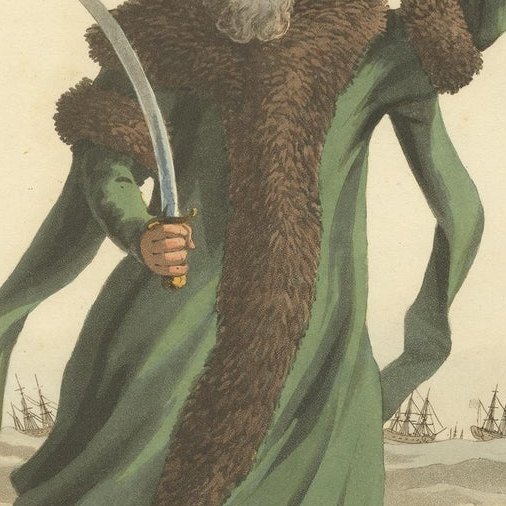
Original/contemporary hand coloring. General age-related toning, some foxing. Minor wear and soiling, blank verso. Please review the images for further condition details.
About this sheet
This print is from 'The Military Costume of Turkey. Illustrated by A Series of Engravings. From Drawings made on the Spot. Dedicated by Permission to His Excellency the Minister of the Ottoman Porte to his Britannic Majesty.'
London, Published by Thomas M'Lean, Haymarket, (1818). Folio. One of 29 fine handcolored aquatint plates . Very light offsetting from plate. The original accompanying text of this print is as follows:
'THE Capitan Pacha has the supreme command of the Turkish Navy, in which he has the appointment of all the principal officers. His power also extends over the islands of the Archipelago, where he sails every Spring for the purpose of receiving the capitation tax. The Turkish navy is chiefly navigated by Greek sailors, whilst Turkish soldiers are embarked for the purposes of attack and defense. The thirtyfirst ortah, or regiment, of Janizaries, whose symbol is an anchor, are chiefly employed for this last purpose, which therefore bears some analogy to our marine corps. The great height between the decks of the Turkish men of war makes them unable to carry a sufficient quantity of sail without rendering them liable to overset. As the Turks wear high turbans, it has been said that a sacrifice of utility to convenience in this respect is the cause of this capital defect in the construction of their ships. An intercourse with British naval officers of late years has certainly somewhat improved the state of the Turkish marine. They are still, however, miserably deficient in tactical knowledge, as well as in the practice of working their ships. A Turkish fifty gun ship, and a frigate her consort, were both taken by the Sea-horse English frigate in 1808. The passive courage manifested in this instance by the Turks was most extraordinary. After the large frigate was disabled so much as to be like a log on the water, the English frigate cannonaded her for hours, till nearly four hundred of her crew, out of a complement of five hundred, were killed or wounded; and then it was only by force that the captain (who during the whole of the action had sat on the stern smoking his pipe) was prevented from blowing her up, whilst the officers caused her colors to be struck. Such courage, aided by the dexterity wherewith the Turks handle the scimitar, would make them to be found no despicable enemies in boarding, could they manage their ships sufficiently well to lay them alongside; nor is there hardly any country which, from the advantages of its situation, as well as the number of its harbors, is better qualified than Turkey to become a maritime power of the first rank. The flag of the Capitan Pacha, having been a present from Mecca to the Grand Seignior, is honored with superstitious reverence by the Turks. —It has the names of the disciples of the prophet in the four corners, a sabre with two blades for the escutcheon, and some passages from the Koran round the border, worked in silver upon a crimson stuff. The annexed subject represents the Capitan Pacha in his ordinary dress.'