About this sheet
Antique China Punishment of the Bastinado Print – Thomas Allom, 1843
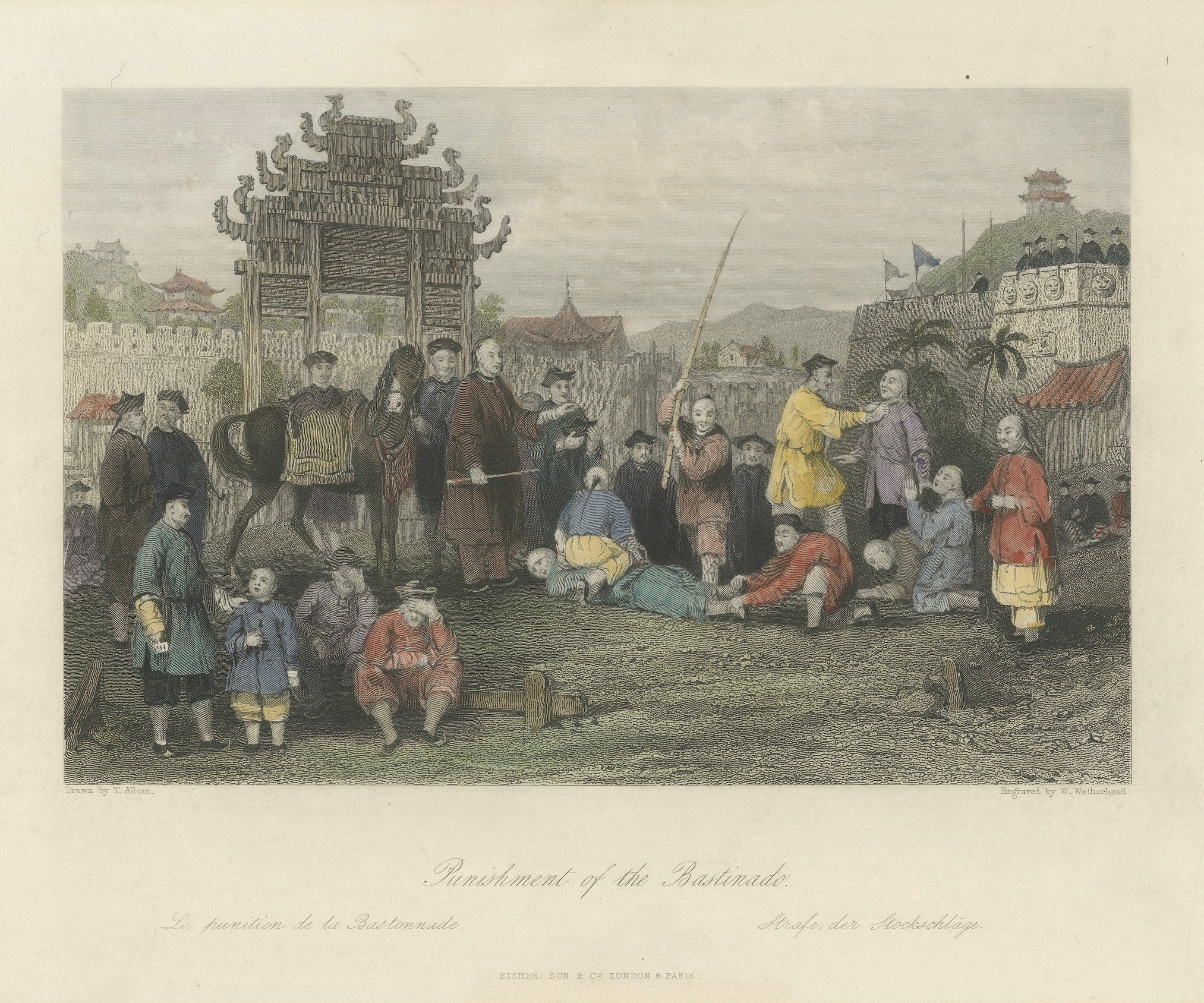
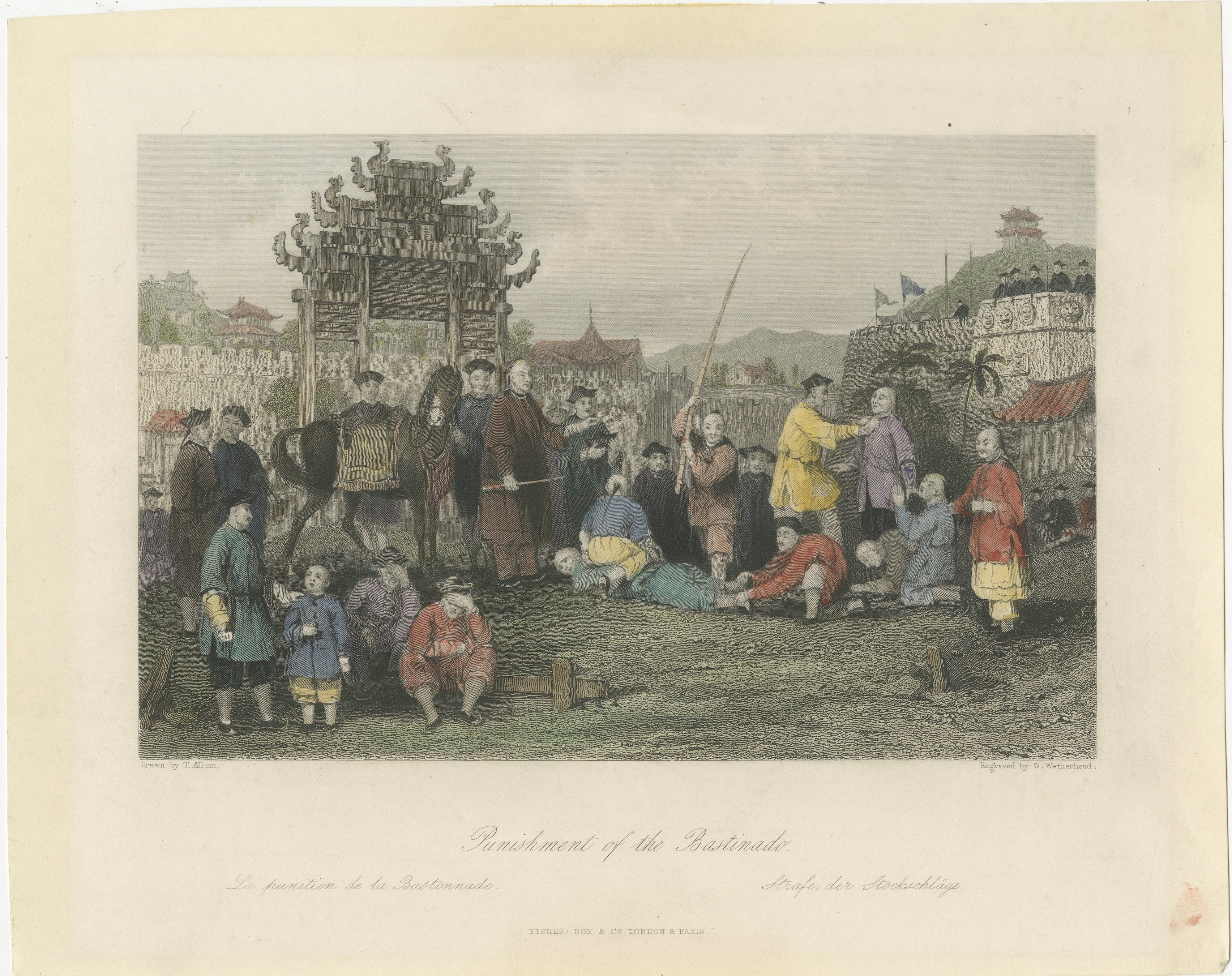
This striking antique print titled Punishment of the Bastinado was drawn by the English artist Thomas Allom and engraved by William Wetherhead. The engraving was published by Fisher, Son & Co. in the celebrated illustrated travel work China, in a Series of Views, Displaying the Scenery, Architecture, and Social Habits, of that Ancient Empire issued between 1843 and 1845.
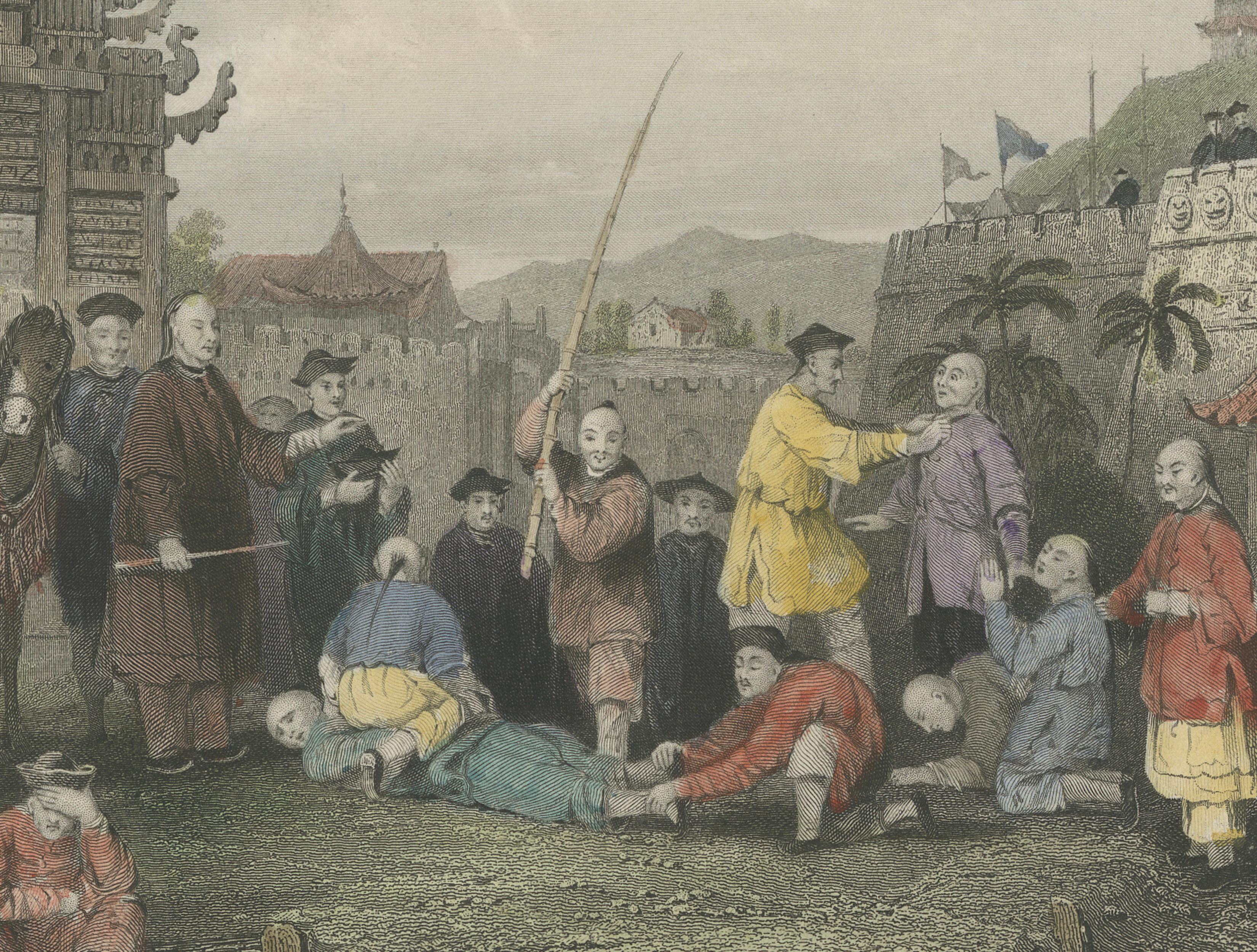
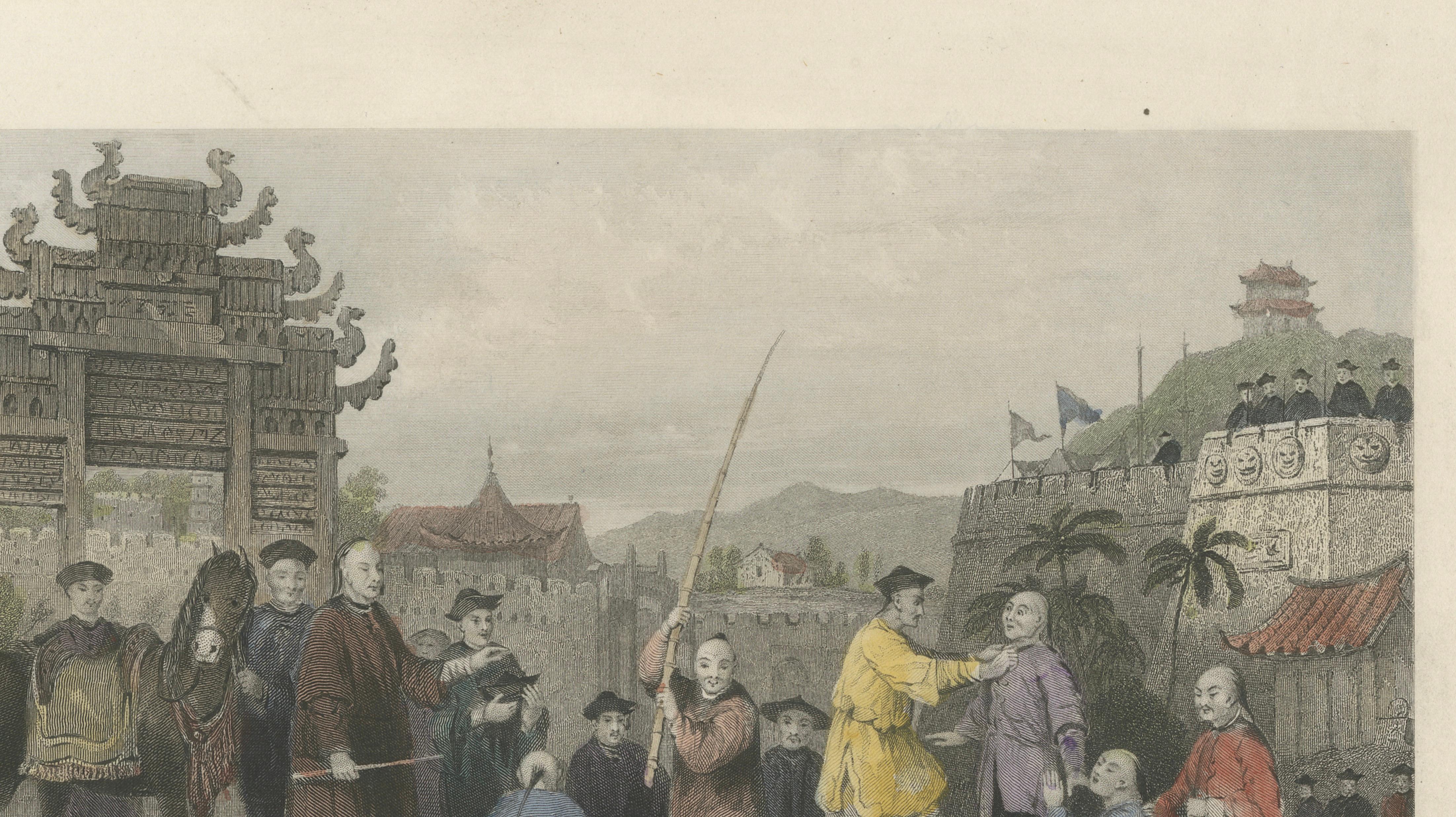
The scene depicts the punishment known as the bastinado, a form of corporal punishment historically used in various parts of Asia and the Middle East. In this method, the condemned person is restrained while the soles of the feet are struck with rods or bamboo sticks. The practice was used in Qing-era China for certain judicial penalties and disciplinary actions. Allom’s composition presents the event as a public spectacle: the victim lies restrained on the ground while an official administers the blows, surrounded by soldiers, attendants, and curious onlookers.
The composition is rich in architectural and cultural detail. A monumental Chinese ceremonial gateway rises in the background, while defensive walls, pavilions, and pagoda-like structures extend across the landscape. Figures in traditional Qing-period dress populate the foreground—officials, guards, and townspeople—creating a narrative tableau typical of mid-19th-century European travel illustration. A mounted official observes the punishment, reinforcing the authority and hierarchy represented in the scene.
Thomas Allom was one of the most prolific architectural illustrators of the Victorian era. Although he never traveled extensively in China himself, his views were based on sketches, travel accounts, and earlier visual sources. The resulting engravings were intended to present Western audiences with vivid impressions of Chinese life, customs, and landscapes at a time when the region remained largely unfamiliar to European readers.
The print is executed as a finely detailed hand-colored steel engraving, a technique that allowed for extremely delicate line work and durable printing plates. The subtle hand coloring enhances the clothing, architecture, and landscape while preserving the precision of the engraved lines.
Today, prints from Allom’s Chinese series are highly regarded both for their historical interest and their aesthetic appeal. They provide insight into 19th-century Western perceptions of China while also standing as elegant examples of Victorian book illustration.
Condition:
Very good condition for its age. Light age toning and minor handling wear visible mainly in the margins. The plate impression remains visible. Small areas of discoloration in the lower margin consistent with age.
Framing tips:
This print frames beautifully in a dark walnut or ebonized wood frame with a generous ivory or warm cream mat. Because the image contains subtle hand coloring and fine linework, museum glass is recommended to enhance clarity and protect the paper. A wide mat gives the print a refined gallery presence suitable for both classic and contemporary interiors.
Technique: hand-colored steel engraving
Maker: Thomas Allom, England, 1843