Western Gate of Antinoë, Egypt – Antique French Architectural Engraving, c.1790
€ 210
Original antique · The actual sheet photographed · Certificate of authenticity on request · Sold unframed · Worldwide shipping from € 15 (rates)
Date
1790
Mapmaker / artist
Portier, France, c.1790
Technique
Engraving
Sheet size
15.5 × 19 cm (6.1 × 7.5 in)
Condition
Good
Reference
BG-14078-13
What the condition grades mean
Excellent
Bright and clean, with no faults worth mentioning.
Very good
Only light signs of age, such as faint toning.
Good
Normal signs of age for a sheet of this period: toning, some foxing, small marks or neat old repairs.
Fair
Clear faults such as staining, tears or repairs, priced to match.
Every fault we see is written in the condition note, and the whole sheet is shown uncropped in the photos.
Condition
Condition report: Very good condition with a strong plate mark and clean impression. Minor horizontal fold through the center, light toning at the edges, and a few small foxing spots in the margin. Paper remains strong and well-preserved.
About this sheet
Western Gate of Antinoë, Egypt – Antique French Architectural Engraving, c.1790
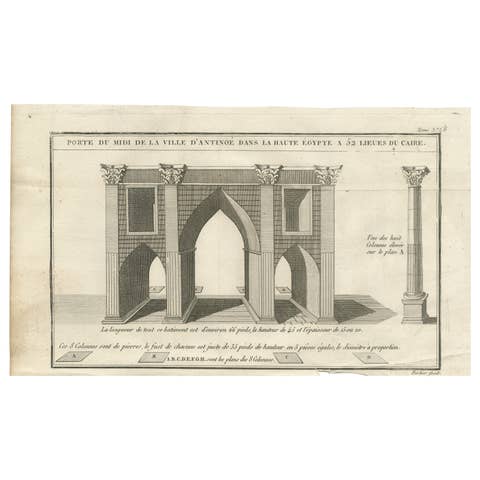
This antique French engraving depicts the “Porte du Couchant” (Western Gate) of the ancient city of Antinoë, located 52 leagues from Cairo, Egypt. Engraved by Portier around 1790, the illustration offers a precise architectural elevation of the structure, emphasizing its proportion, masonry, and functional elements.
The inscription provides measurements: approximately 50 feet in width, 35 feet in height, and 24 feet in thickness, with two staircases incorporated into the wall’s corners to access the three windows or platforms above. The façade is constructed of evenly coursed stone blocks, with a large central archway flanked by two smaller arched entrances, each surmounted by rectangular windows. Above the main arch, a broad rectangular opening dominates the upper section.
Antinoë, founded by the Roman Emperor Hadrian in the 2nd century AD in memory of his companion Antinous, became a significant Greco-Roman city in Middle Egypt. By the time of this depiction, much of its monumental architecture remained a subject of interest to European travelers, antiquarians, and scholars. Such engravings formed part of the Enlightenment-era fascination with recording ancient sites in exact detail, bridging archaeology and artistic representation.
Portier’s engraving is notable for its clean linework and emphasis on architectural precision, reflecting contemporary standards for measured drawings in illustrated travel accounts and architectural studies.
Condition report: Very good condition with a strong plate mark and clean impression. Minor horizontal fold through the center, light toning at the edges, and a few small foxing spots in the margin. Paper remains strong and well-preserved.
Framing tips: Best presented in a classic black or walnut frame with a cream or pale ivory archival mat. A thin gold fillet could add an elegant highlight to the detailed stonework.