Ancient Temple Plans at Amara and Tentyra – Egyptian Architecture c.1710
€ 190
One of a kind: this is the sheet in the photographs. Ships from Langweer, the Netherlands.
Date
1710
Sheet size
24.5 × 44 cm (9.6 × 17.3 in)
Condition
Good
Reference
BG-14102-70
Condition
Good condition. Central fold as issued. Slight browning near edges and a few minor foxing spots, mainly in blank margins. Paper strong and clean, with good plate impression.
About this sheet
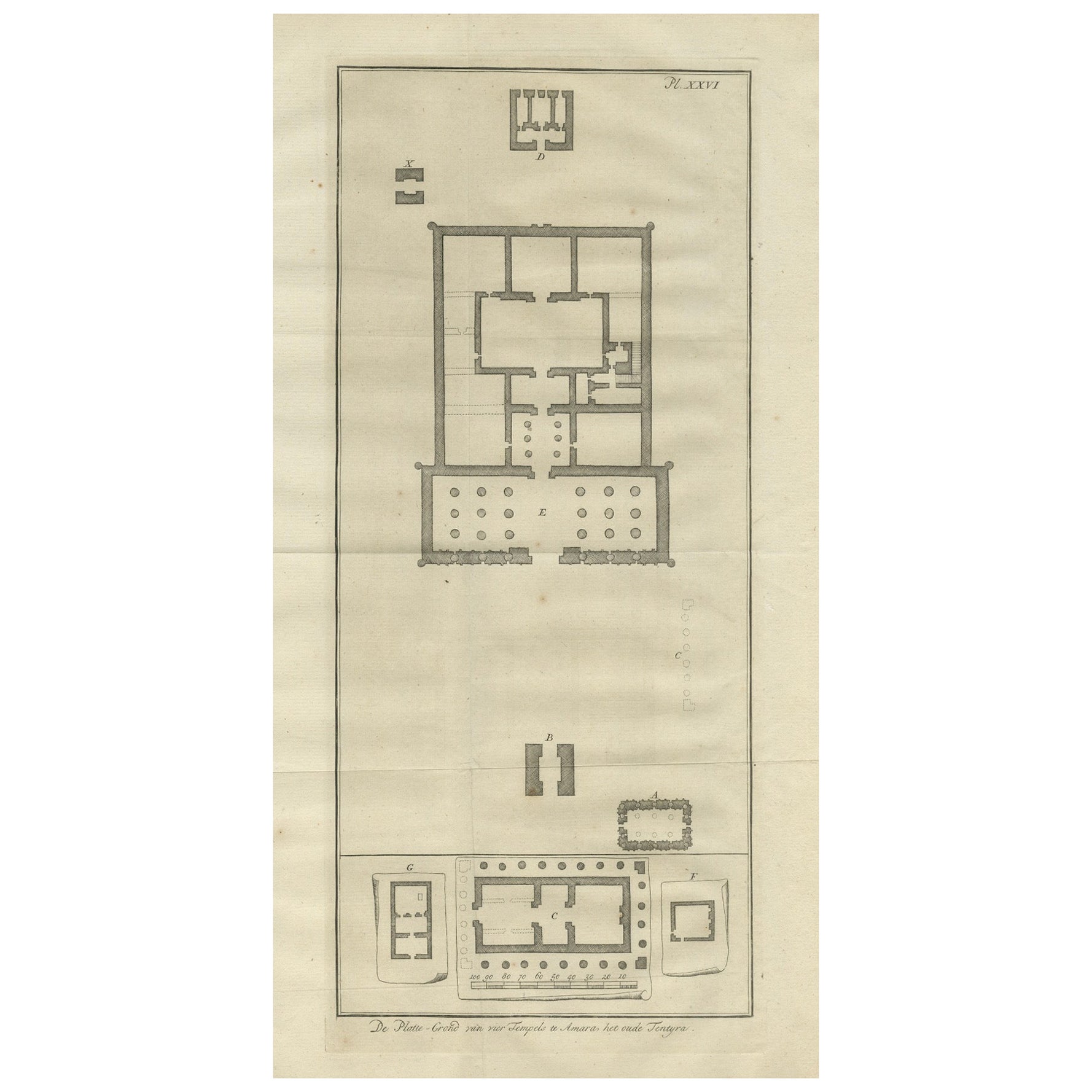
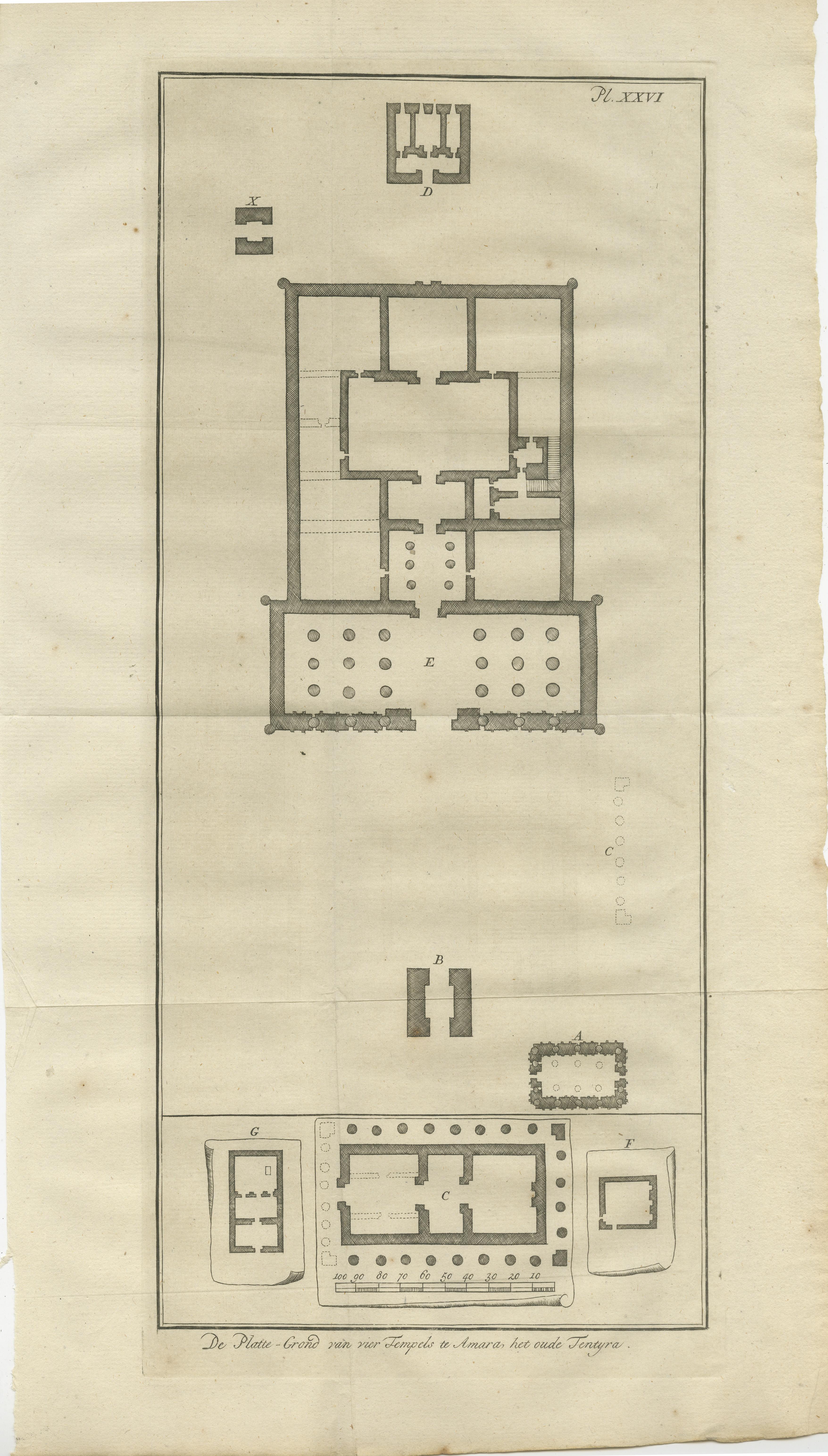
Ancient Temple Plans at Amara and Tentyra – Egyptian Architecture c.1710 This early 18th-century architectural engraving, titled "De Platte-Grond van vier Tempels te Amara, het oude Tentyræ," presents detailed floor plans of four ancient Egyptian temples located at Amara (near Nubia) and Tentyra (modern Dendera). This print was published in the Dutch edition of Cornelis de Bruijn’s famous travel accounts, likely around 1710.
The composition shows a series of floor plans labeled A to F, including both full temple layouts and partial architectural components. The central and largest plan shows a well-preserved layout of a temple including an inner sanctuary, vestibules, side chambers, and two large columned halls labeled “E.” These spatial divisions reflect the standard tripartite structure of Egyptian temples, symbolizing the transition from the outer, public world into the sacred interior.
Smaller plans around the perimeter of the sheet highlight temple variants or satellite shrines. Some are enclosed within protective perimeter walls, while others feature peristyles (surrounding columns), suggesting different phases of construction or varying religious significance. The scale is clearly marked in “ellen” (cubits), allowing for proportional interpretation.
Cornelis de Bruijn (1652–1726/27), a Dutch artist and traveler, meticulously recorded the architectural and archaeological legacy of Egypt and the Levant. His engravings, based on firsthand observation, predate the better-known Napoleonic expedition and serve as invaluable documentation of many structures that have since deteriorated or vanished.
Condition: Good condition. Central fold as issued. Slight browning near edges and a few minor foxing spots, mainly in blank margins. Paper strong and clean, with good plate impression.
Framing tips: This precise architectural engraving works well in a clean-lined black or walnut frame with a light cream mat to emphasize the clarity of the lines. Ideal for interior spaces focused on history, design, or classical architecture.
Technique: Copperplate engraving Maker: After Cornelis de Bruijn, The Netherlands, circa 1710