Maps & PrintsBartele Gallery · Langweer
Home / Antique Prints / Architecture & Design

Architecture & Design · 18th century

Circus Flaminius in Ancient Rome – Rare Architectural Engraving, 1704

€ 240

Original antique · The actual sheet photographed · Certificate of authenticity on request · Sold unframed · Worldwide shipping from € 15 (rates)

Date
1704
Mapmaker / artist
Anonymous engraver after Jan Goeree, published by François Halma, Utrecht, 1704
Technique
Engraved
Sheet size
36 × 23.4 cm (14.2 × 9.2 in)
Reference
PCT-61839
What the condition grades mean
Excellent
Bright and clean, with no faults worth mentioning.
Very good
Only light signs of age, such as faint toning.
Good
Normal signs of age for a sheet of this period: toning, some foxing, small marks or neat old repairs.
Fair
Clear faults such as staining, tears or repairs, priced to match.

Every fault we see is written in the condition note, and the whole sheet is shown uncropped in the photos.

Condition

Very good impression with wide margins. Light toning and a few faint spots consistent with age. Overall clean and well-preserved.

About this sheet

Circus Flaminius, Rome – Antique Engraving after Jan Goeree, 1704

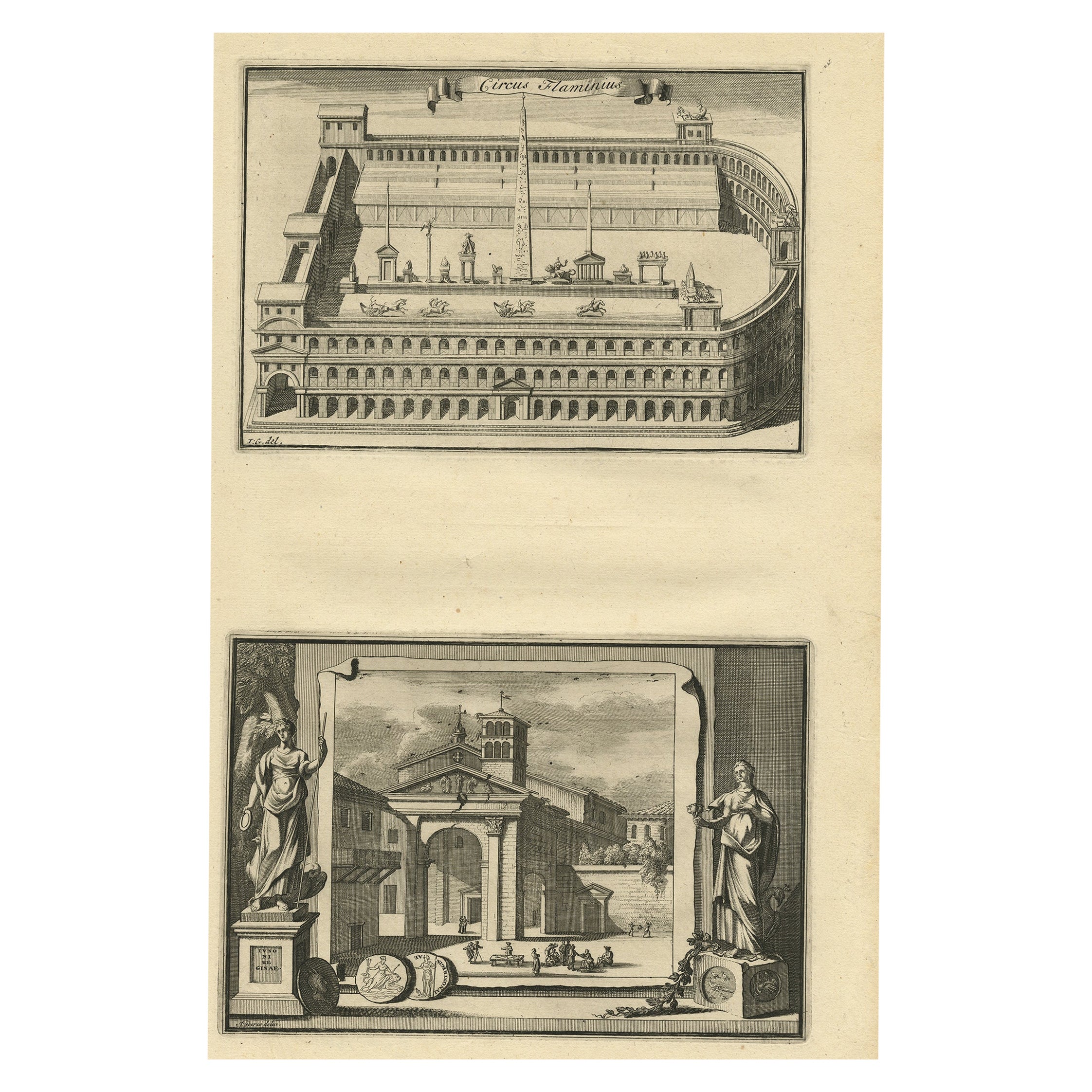
This detailed early 18th-century engraving presents a reconstruction of the Circus Flaminius, one of the great public spaces of ancient Rome. Located at the southern end of the Campus Martius near the Tiber River, the Circus Flaminius was originally built in 221 BC by Gaius Flaminius Nepos. It served as a venue for assemblies, markets, triumphal processions, and public games, often associated with military victories.

The upper image shows an imaginative reconstruction of the Circus in its grandeur, with its multi-tiered arcades, monumental obelisks, statues, and racing chariots within the arena. The precision and architectural detail convey both the scale and the ceremonial purpose of this lost Roman structure.

The lower image offers a view of Rome with the church of Santa Maria in Campitelli, framed by two statues and classical motifs, a reminder of how Christian Rome was layered upon its pagan past. The composition integrates ancient ruins, living traditions, and allegorical figures, emphasizing the continuity between antiquity and early modern Rome.

This print originates from Beschryving van Oud en Nieuw Rome (Description of Old and New Rome), published by François Halma in Utrecht, 1704. The work was translated from the French text by François Desseine (first published in 1690). It combined historical narrative with finely engraved plates documenting the city’s monuments, ruins, and churches. The quality of the engravings was regarded as comparable to later works by Piranesi, making copies of the volume often incomplete due to collectors removing the plates.

The engraving is based on designs by Jan Goeree (1670–1731), a Dutch artist, poet, and engraver, known for his book illustrations and historical depictions.

Framing tips: A classic dark walnut or ebony frame with a cream mount highlights the architectural details, while a gilt frame emphasizes the grandeur of the subject, ideal for a collector of Roman antiquities.

More from Architecture & Design

Ask about this sheet

Circus Flaminius in Ancient Rome – Rare Architectural Engraving, 1704
1704 · Ref. PCT-61839 · € 240
We reply by email, usually within one working day.

Your favorites

Saved in this browser. Email the list to yourself to keep it on any device.

We use your email to send this list and, only if you tick the box and confirm, for occasional new arrivals. Every email has an unsubscribe link. Bartele Gallery, the Netherlands.