About this sheet
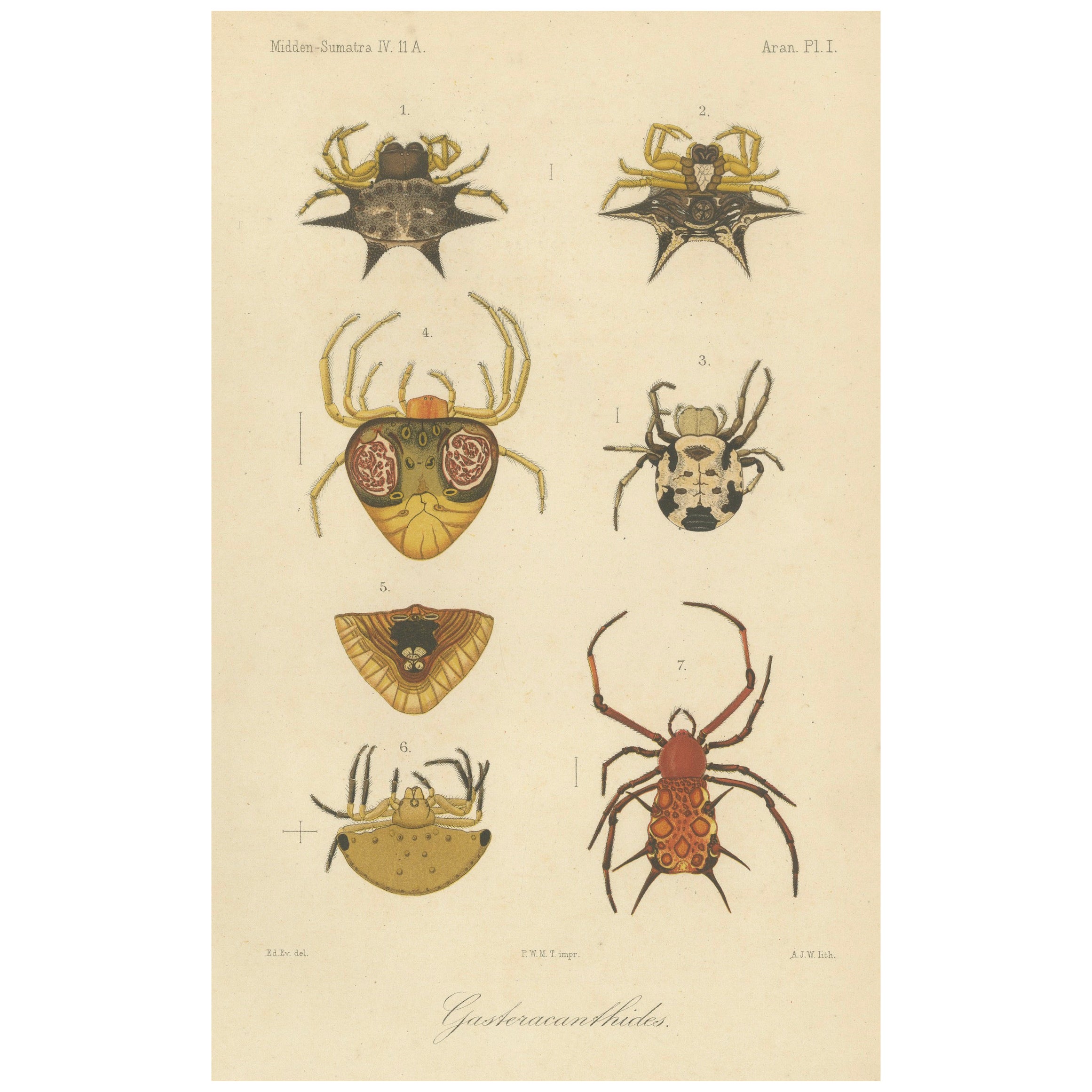
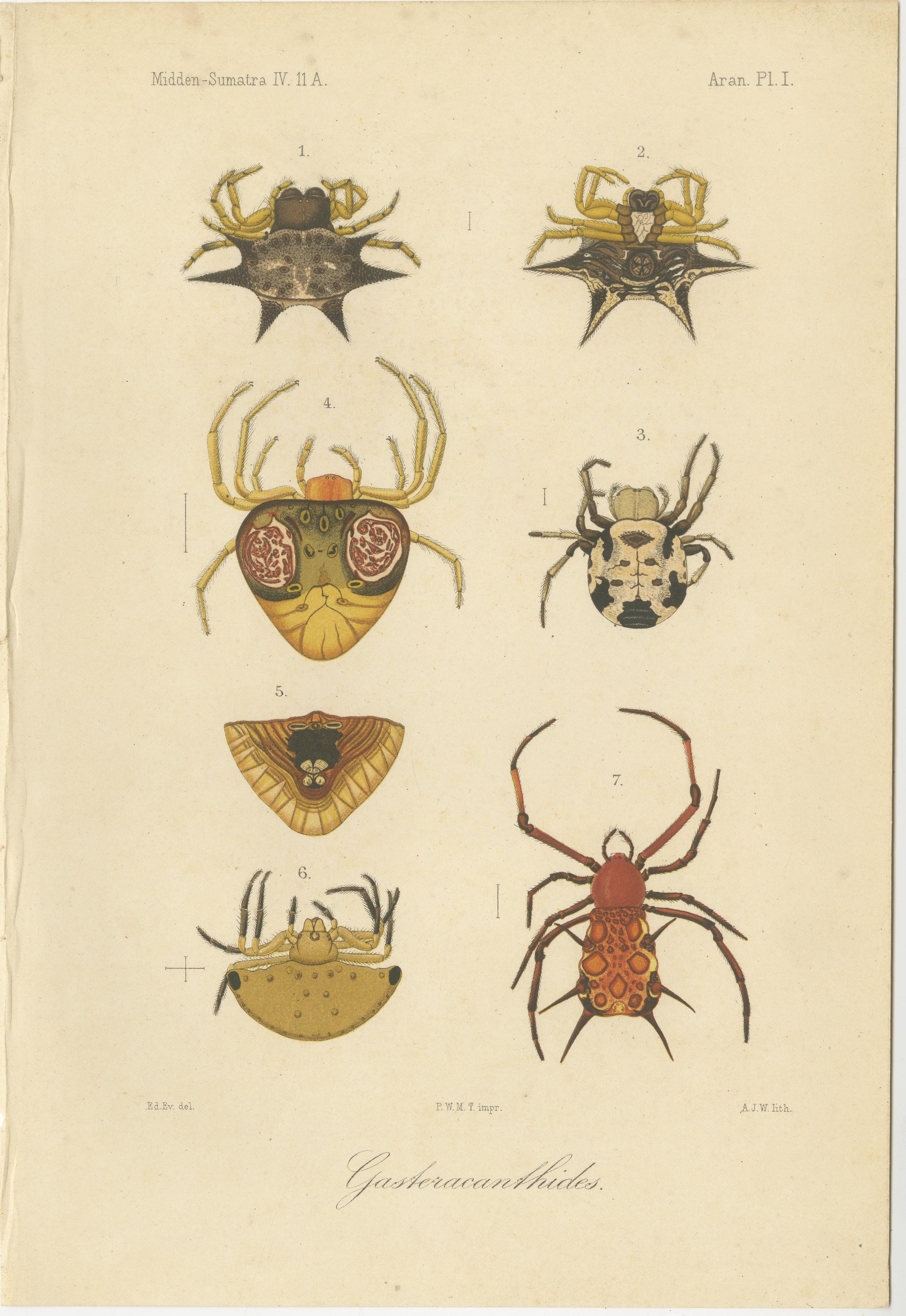
Antique Print of Gasteracantha Spiders – Sumatra c.1887
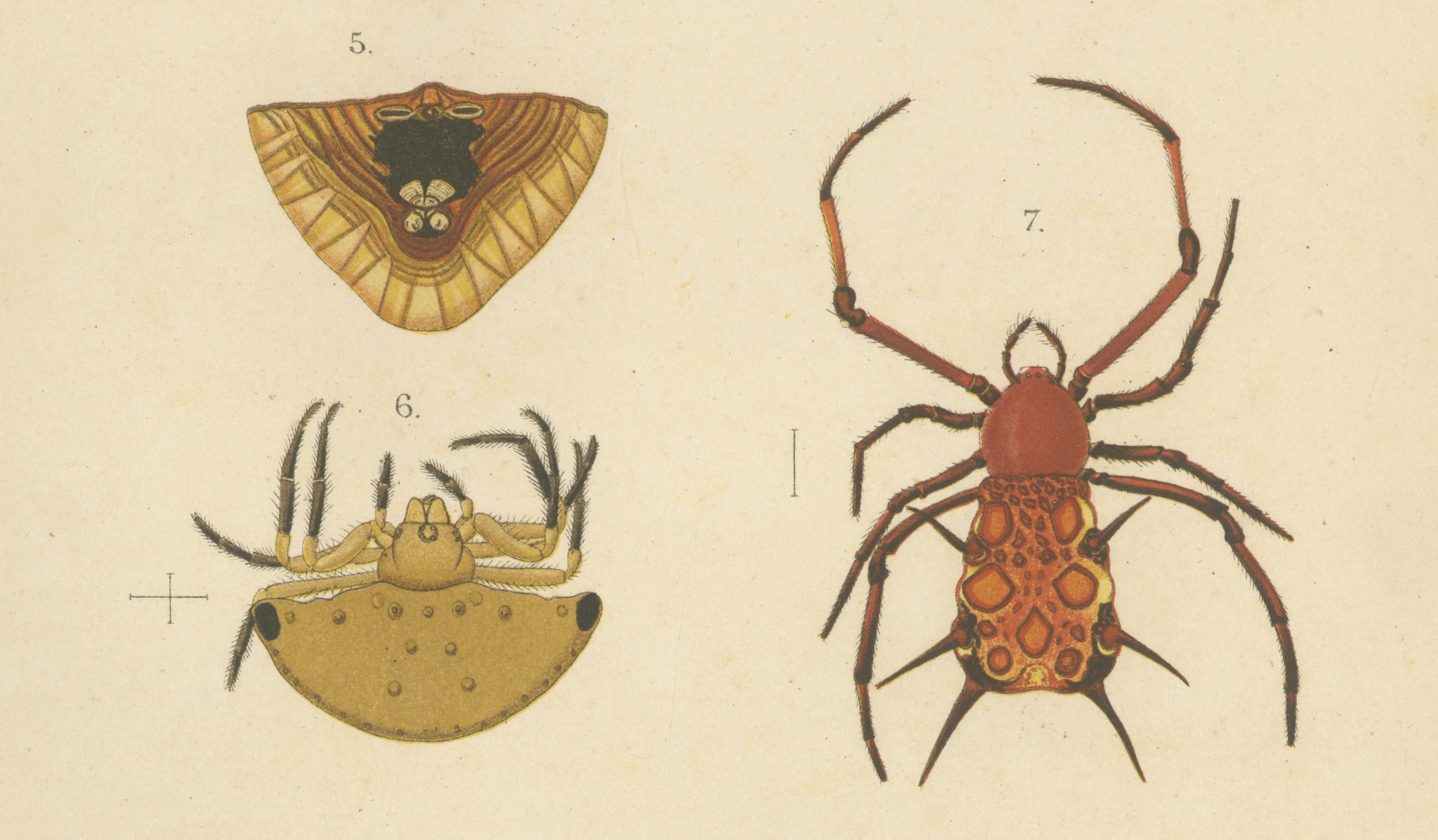
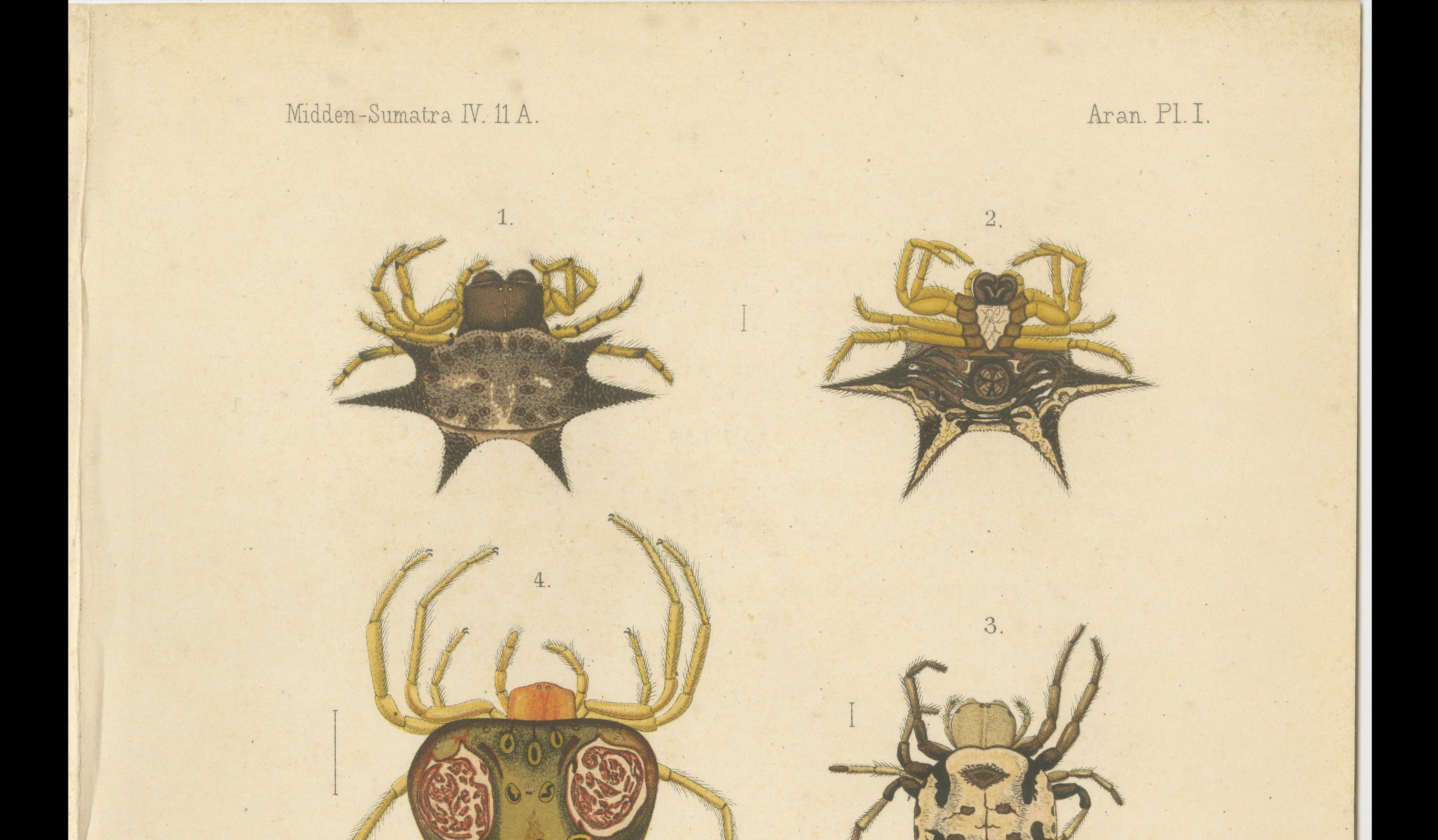
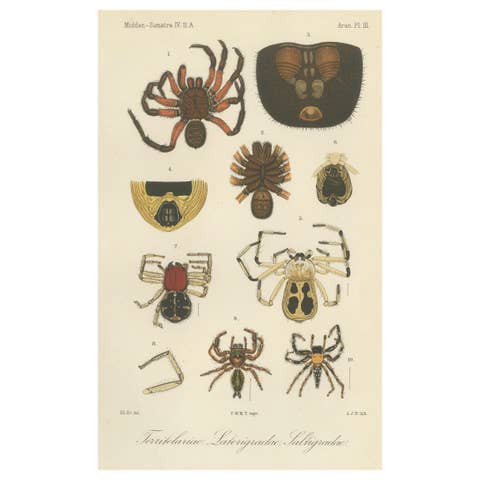
This detailed antique lithograph depicts various Gasteracantha species (spiny orb-weaver spiders) from the Dutch natural history exploration of Midden-Sumatra (Central Sumatra) in the late 19th century. The plate is titled *Midden-Sumatra IV.11 A Aran. Pl. I* and features seven vividly illustrated specimens, drawn by R.d.V., lithographed by A.J.W., and printed by P.W\.M. Trap.
These spiders, known for their distinctive hardened, spiny abdomens and striking coloration, belong to the family Araneidae. The illustration includes species with black, yellow, red, and white markings, showcasing their morphological diversity. Each figure is accompanied by scale bars to indicate their size and scientific details, characteristic of the rigorous documentation style of Dutch expeditions during the colonial period.
Such prints are valued for their historical importance in arachnology and natural history, offering both scientific accuracy and aesthetic appeal. They remain highly collectible for entomologists, arachnologists, natural history illustrators, and decorators aiming for authentic Victorian academic decor.
For more details of the spiders, scroll down.
Condition report:
The print is in very good condition with strong impressions and vivid original hand-coloring. Minimal age toning and a faint edge crease on the left margin typical of age are present but do not affect the image. Paper remains stable with no tears or repairs.
Framing tips:
This print will display beautifully in a slim black, dark wood, or gold frame with a cream or pale sand-colored mat to emphasise the intricate spider illustrations, ideal for natural history collections, libraries, offices, or educational spaces.
ADDITIONAL INFO ABOUT THE SPIDERS:
This plate depicts spiders from the genus Gasteracantha, commonly known as spiny orb-weavers. Below are their probable English and Latin names with general characteristics:
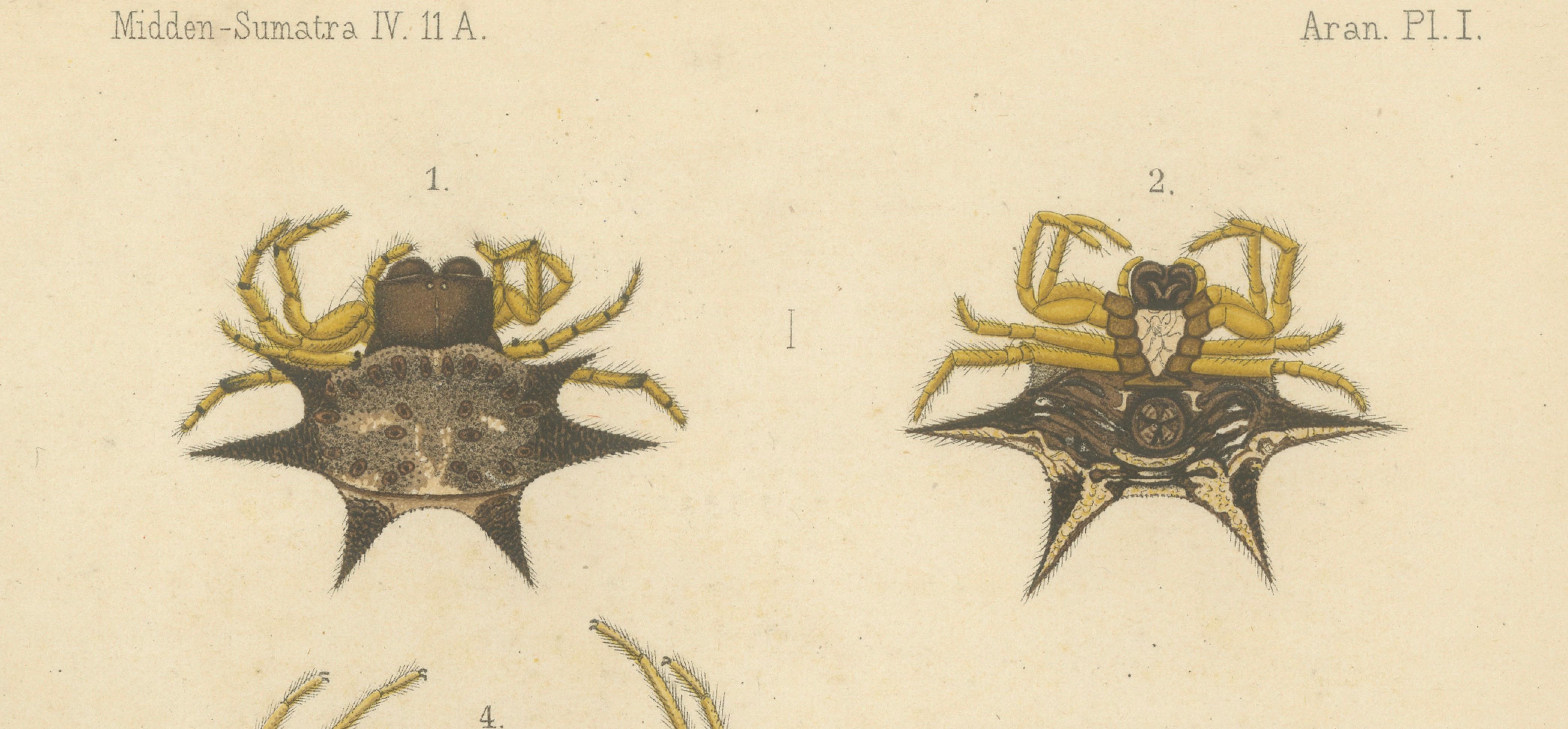
1. Gasteracantha kuhli (Kuhl's spiny orb-weaver)
Appearance: Flattened body, black with lateral spines projecting outwards like a crab.
Distribution: Southeast Asia including Indonesia.
Characteristics: Builds classic orb webs, females have distinctive spiny abdomens for predator deterrence.
2. Gasteracantha cancriformis (Spinybacked orb-weaver) – although this name is mainly used for American species, similar species occur in Asia under different names.
Appearance: Bright yellow or white abdomen with black or red spines, often with black spots.
Distribution: Related Asian species are found throughout the Indonesian archipelago.
Characteristics: Non-dangerous, noted for their striking coloration which serves as a warning (aposematism).
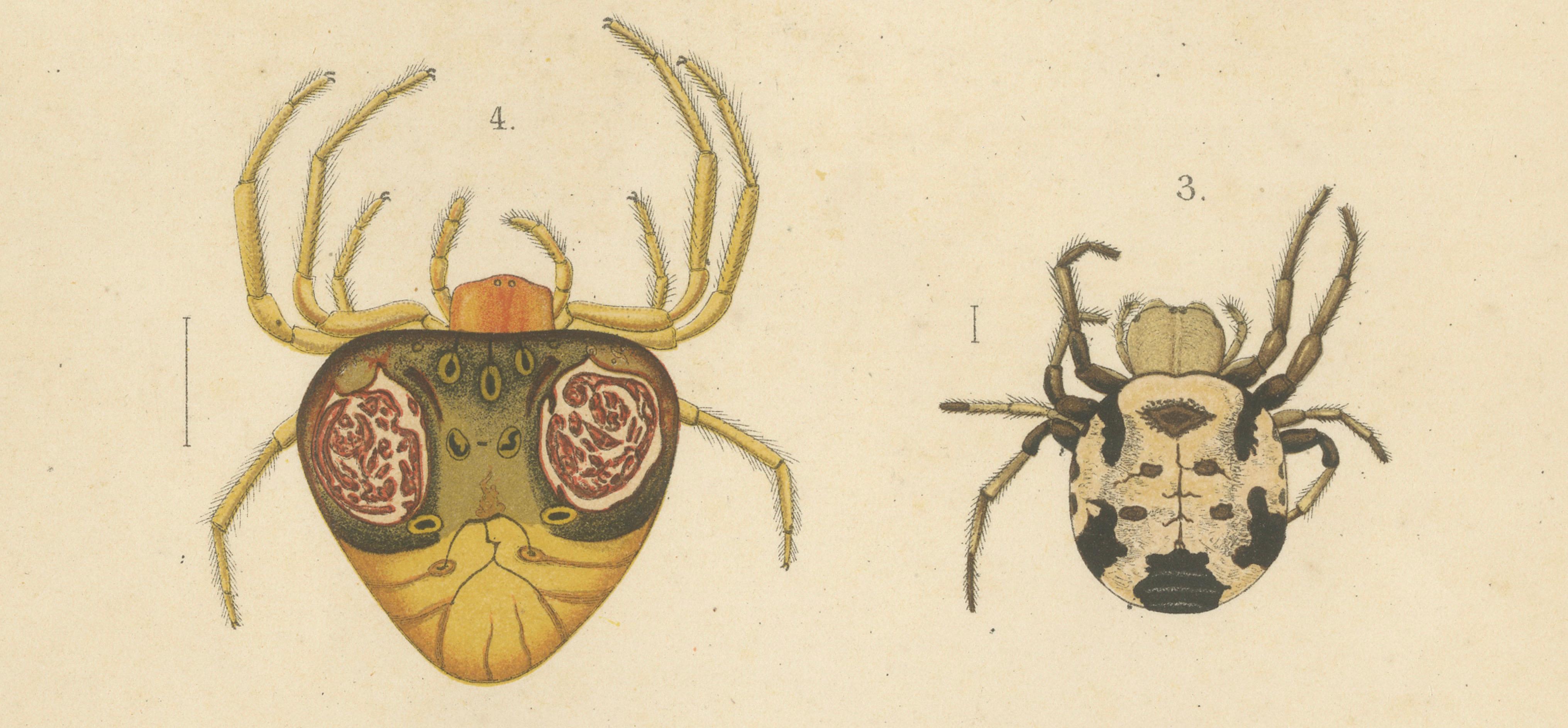
3. Macracantha arcuata (Long-horned orb-weaver)
Appearance: White or black spotted body with exceptionally long curved spines laterally.
Distribution: South and Southeast Asia.
Characteristics: Among the largest spiny orb-weavers; the long spines may discourage bird predation.
4. Gasteracantha hasselti (Hasselt’s spiny orb-weaver)
Appearance: Bright red or orange with black markings and six spines.
Distribution: Indonesia, Malaysia, Thailand.
Characteristics: Females are brightly colored and spin horizontal orb webs in gardens and forests.
5. Gasteracantha diardi
Appearance: Yellowish with black markings, broad triangular shape.
Distribution: Widespread in Southeast Asia.
Characteristics: Builds webs in open spaces, prefers disturbed habitats or forest edges.
6. Gasteracantha clavatrix
Appearance: Smaller with two long backward-pointing spines.
Distribution: Indonesia and Malaysia.
Characteristics: Less conspicuous coloration compared to other Gasteracantha species.
7. Possibly Gasteracantha mammosa (common names vary regionally)
Appearance: Orange-red abdomen with yellow markings and spines.
Distribution: Tropical Asia.
Characteristics: Similar biology to others; webs built in mid-level vegetation.
General characteristics of Gasteracantha (spiny orb-weavers):
Family: Araneidae (orb-weaver spiders).
Web: Classic orb webs with radiating spokes, often built between shrubs or trees.
Behavior: Females are larger and more colorful; males are small and inconspicuous.
Defense: The rigid spines deter predation by birds and lizards.
Venom: Mild, harmless to humans.
Ecological role: Important insect predators maintaining ecosystem balance.