About this sheet
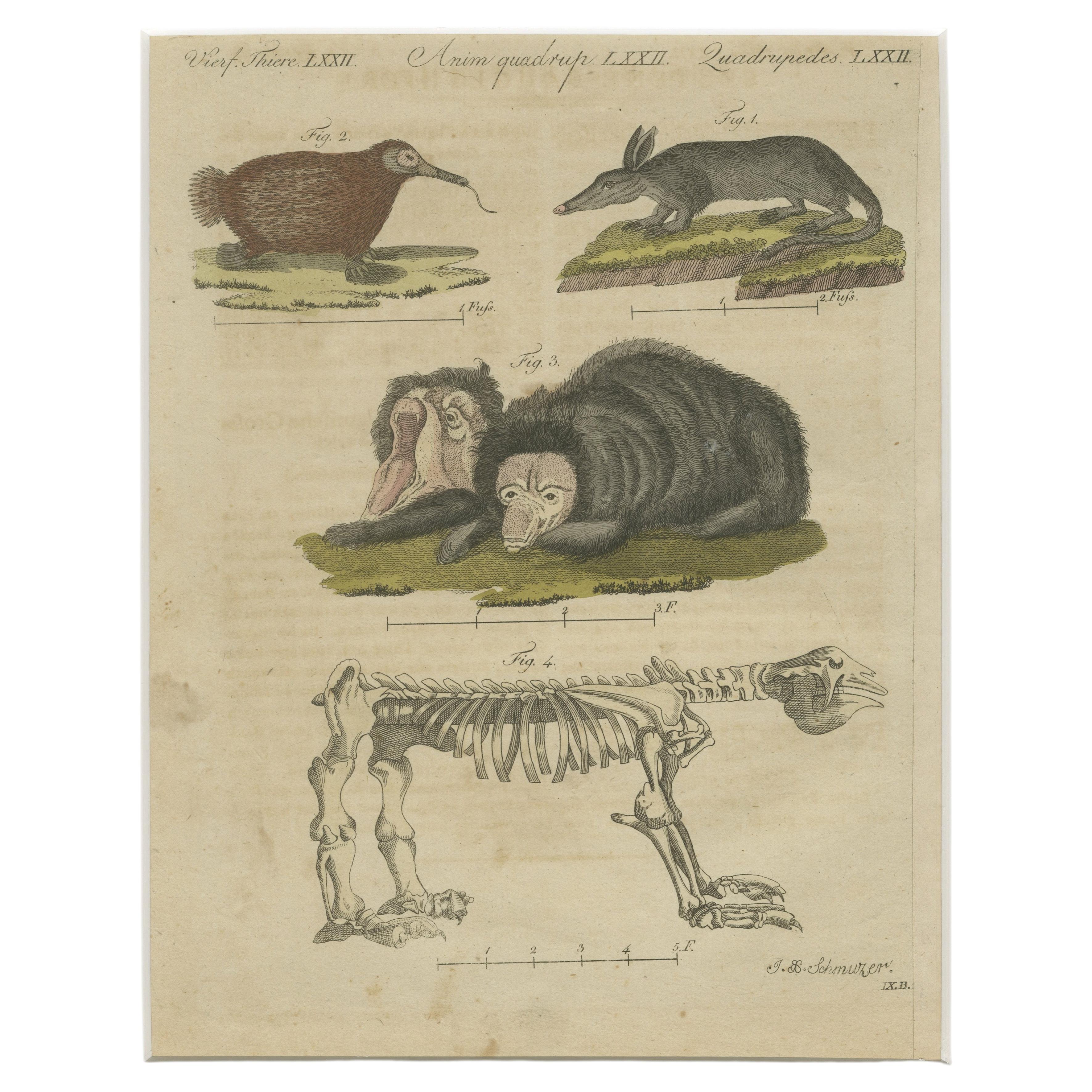
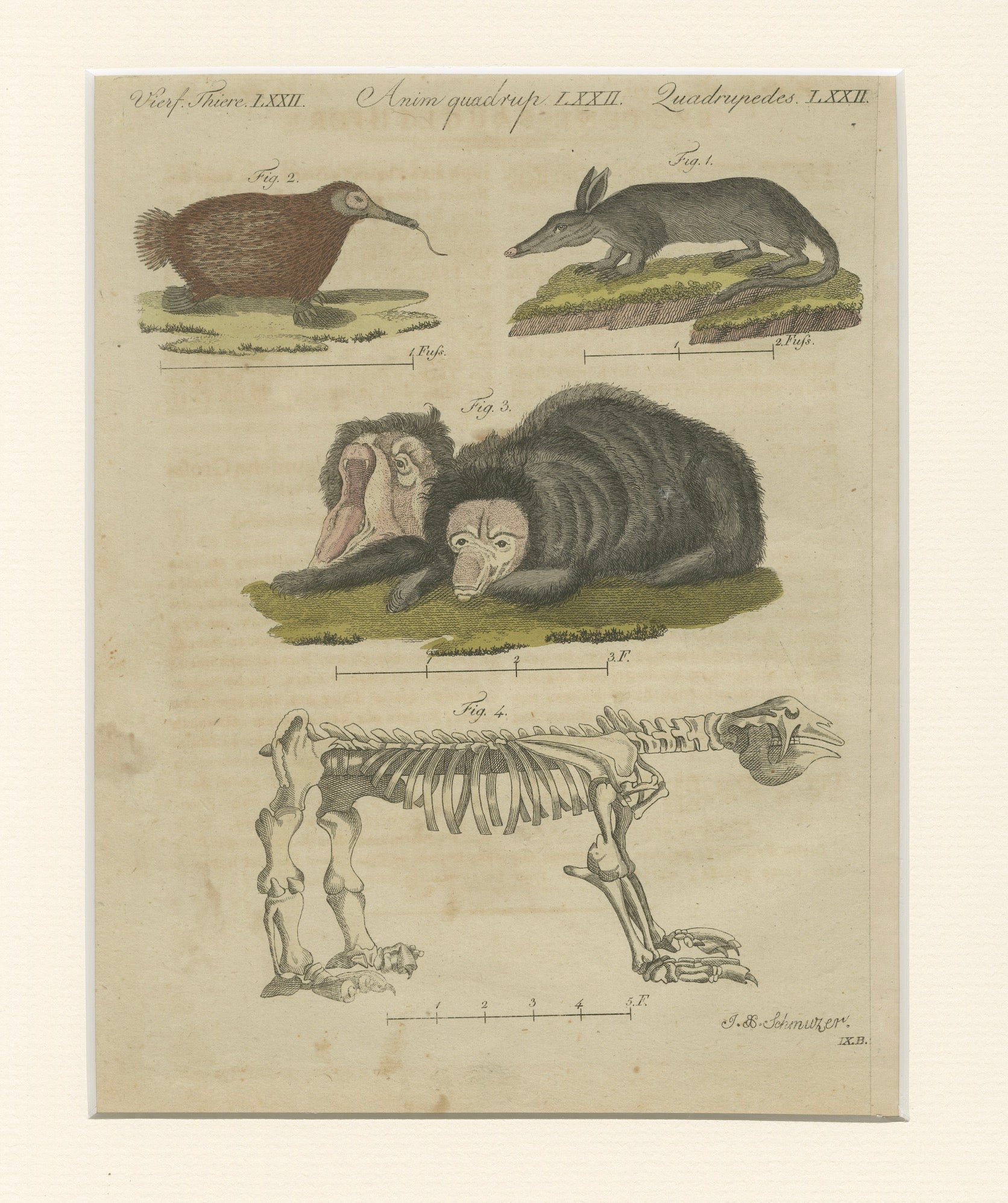
Original antique hand-colored copper engraving depicting several remarkable mammals, including an aardvark, echidna and baboons, together with a large comparative anatomical skeleton, published in Friedrich Justin Bertuch’s celebrated “Bilderbuch für Kinder” around the beginning of the 19th century.
The plate is headed “Vierfüßige Thiere LXXII / Anim. quadrup. LXXII / Quadrupèdes LXXII” and presents four fascinating zoological subjects.
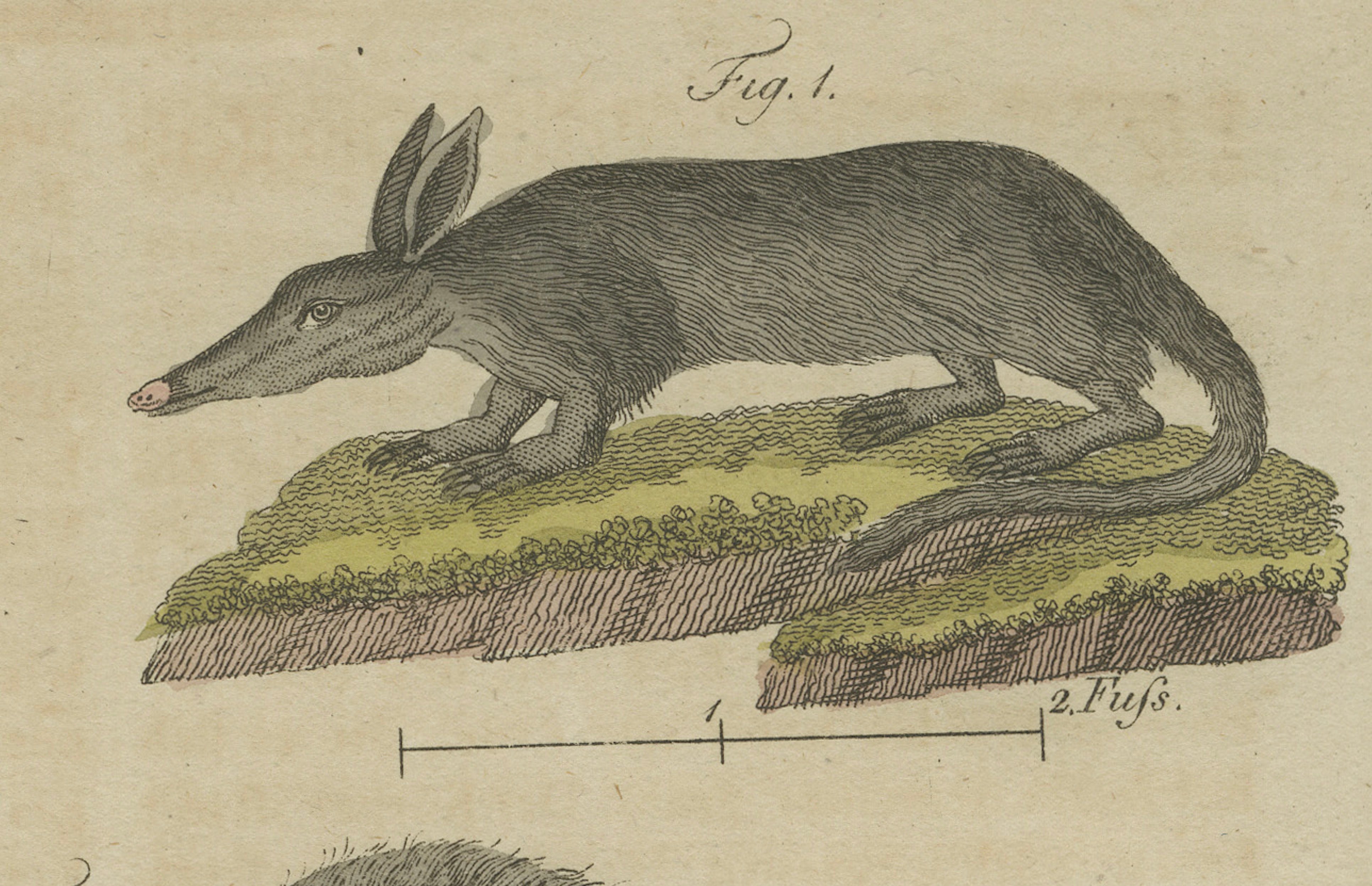
Fig. 1 – Aardvark / African Ant Bear (Orycteropus afer)
The animal at upper right is an Aardvark, one of Africa’s most distinctive mammals.
Its long snout, large upright ears, powerful digging claws and thick tapering tail are clearly represented. The name “aardvark” comes from Afrikaans/Dutch and literally means “earth pig,” referring to its burrowing habits and pig-like snout.
The Aardvark is primarily nocturnal and feeds mainly on ants and termites, which it collects using its remarkably long tongue.
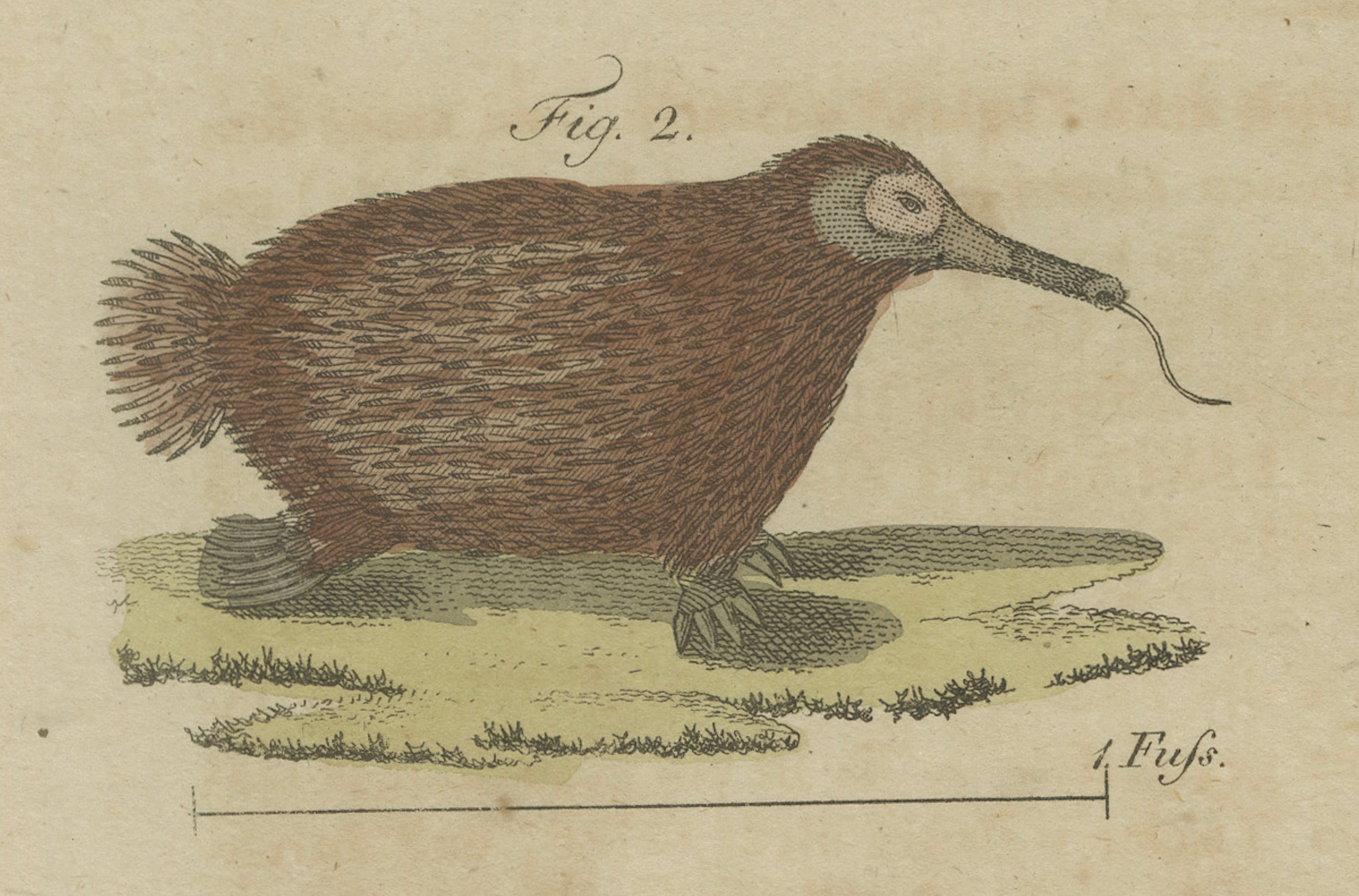
Fig. 2 – Echidna / Spiny Anteater
The extraordinary animal at upper left is an Echidna, traditionally also called a Spiny Anteater.
The engraving shows its rounded body covered with spines, elongated snout and remarkably long tongue extended from the mouth.
Echidnas are native to Australia and New Guinea and belong to the monotremes – the extraordinary group of mammals that reproduce by laying eggs rather than giving birth to live young.
Together with the platypus, echidnas are among the only surviving egg-laying mammals in the world.
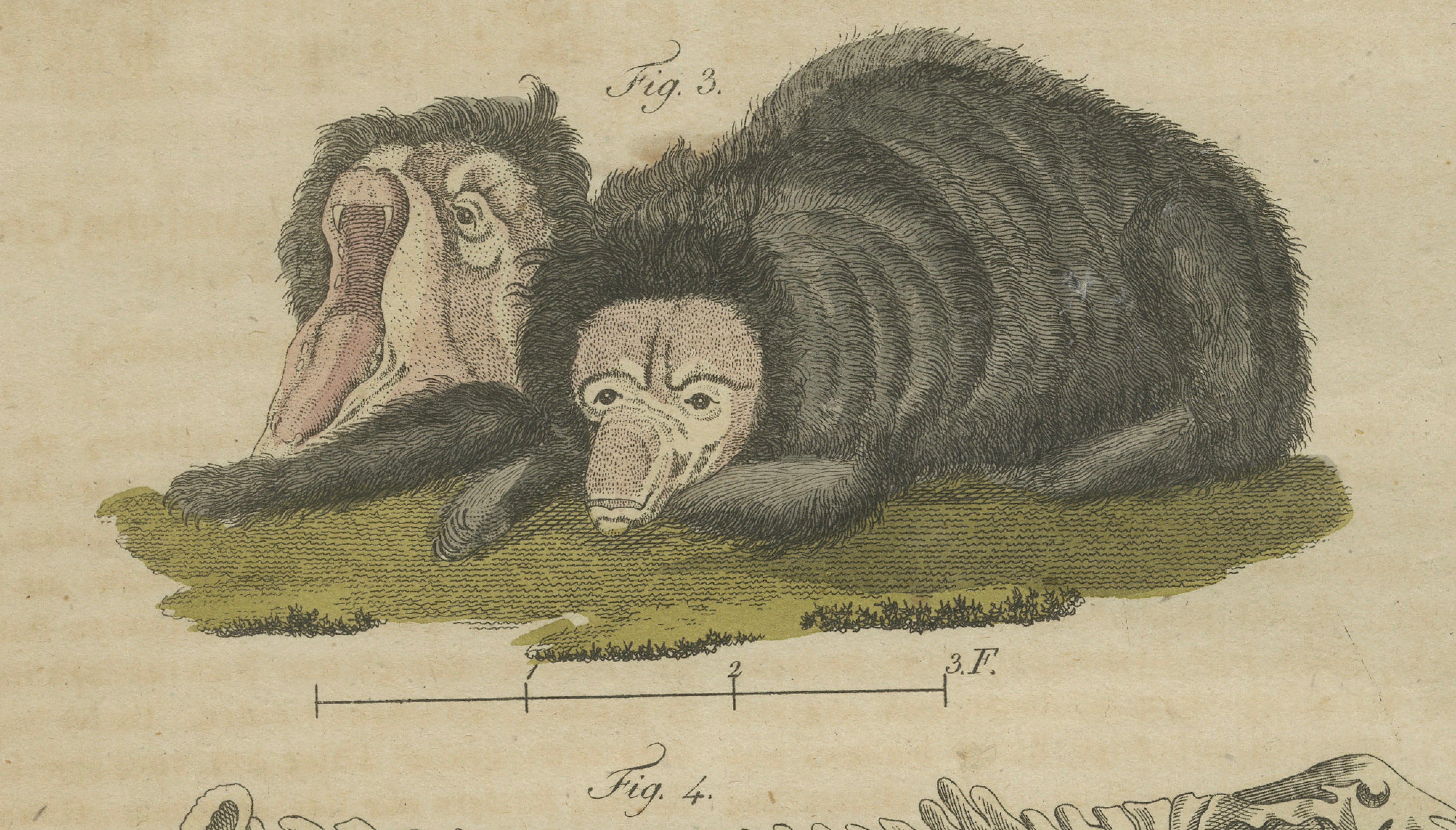
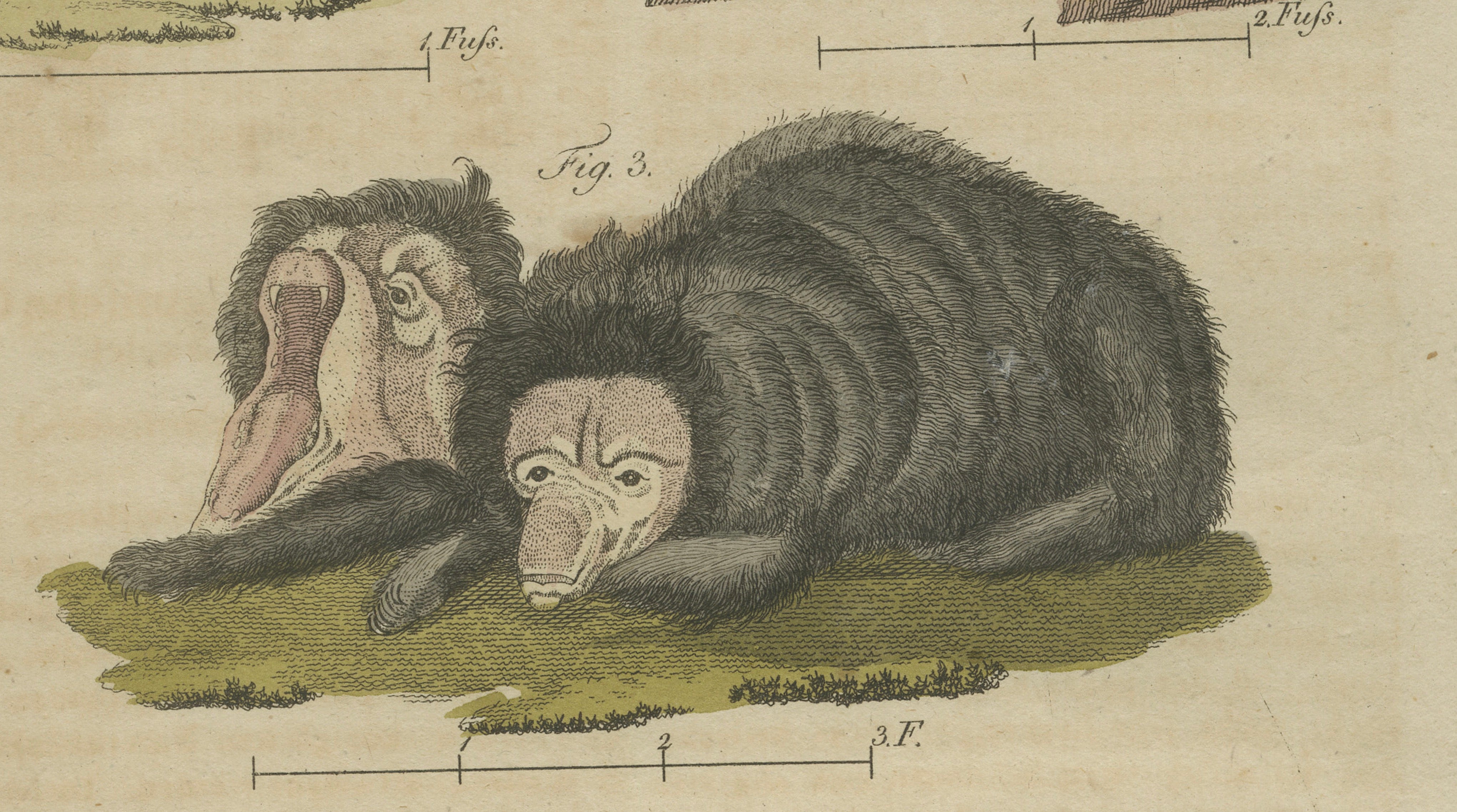
Fig. 3 – Baboons
The central illustration depicts two baboons, an adult and a smaller companion, resting together.
The exaggerated elongated muzzle and powerful build are characteristic of baboons, members of the genus Papio. Their almost human expressions and social behaviour made monkeys and baboons particularly fascinating subjects for European natural-history publications during the 18th and early 19th centuries.
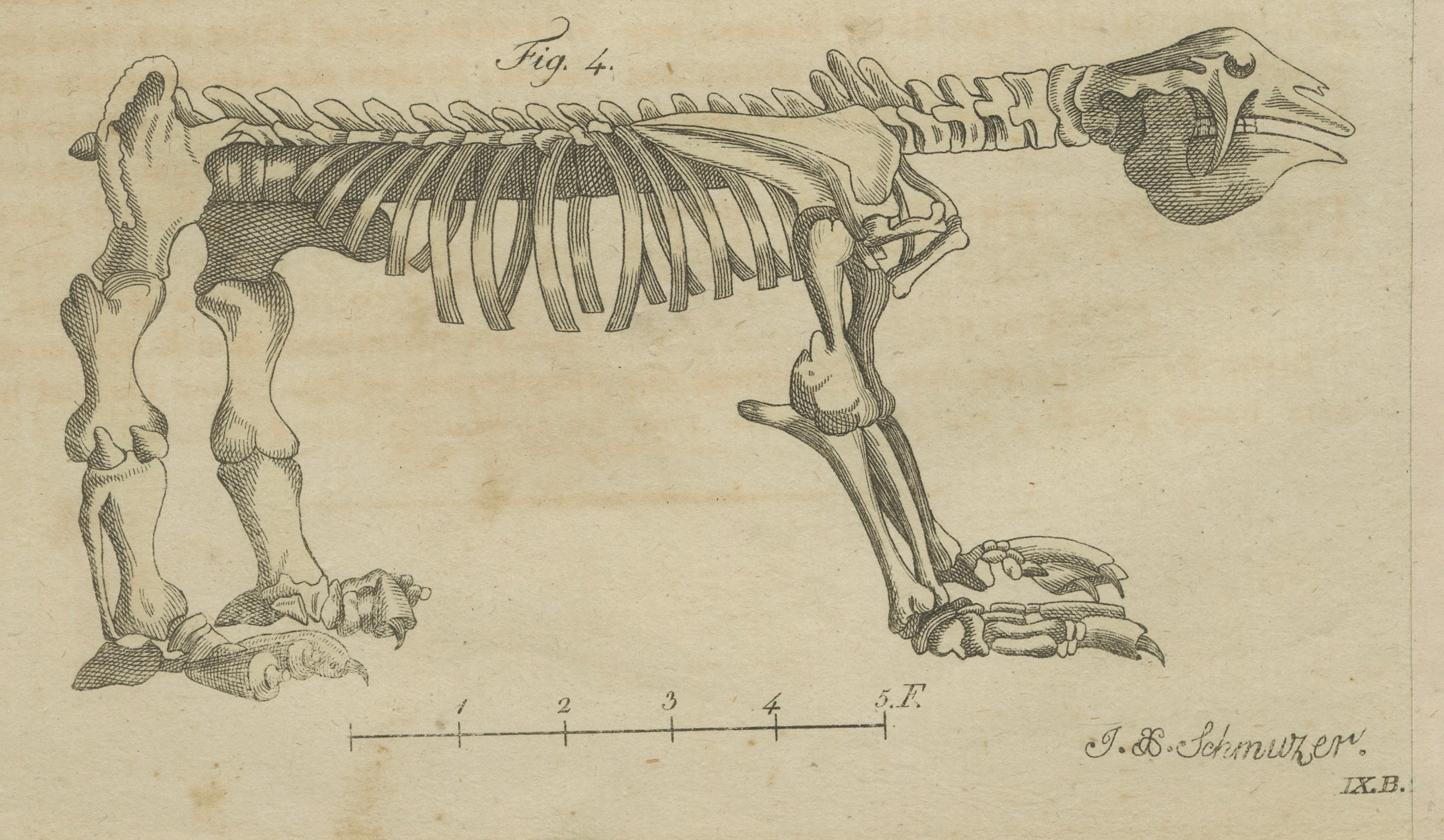
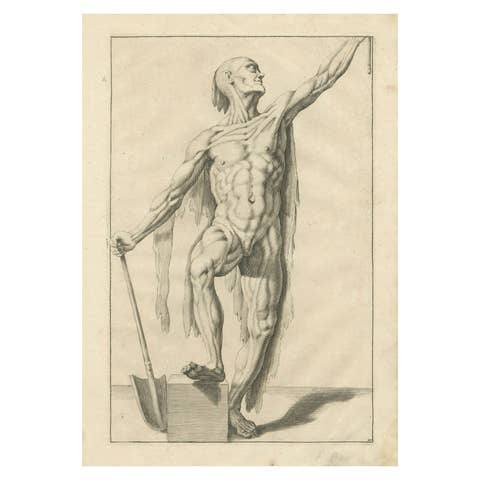
Fig. 4 – Comparative Mammalian Skeleton
The lower half of the plate is occupied by a large anatomical skeleton of a quadruped.
The inclusion of the skeleton demonstrates the increasingly scientific approach of natural-history illustration during Bertuch’s period. Rather than showing animals solely for their exotic appearance, publications increasingly included anatomical details that allowed readers to compare skeletal structures and understand relationships between different mammals.
Scale bars beneath several of the figures provide an additional indication of Bertuch’s educational and scientific purpose.
The engraving is signed in the plate “J. B. Schmuzer.”
Friedrich Justin Bertuch (1747–1822) was a German publisher, writer and patron of the arts. His monumental “Bilderbuch für Kinder” (Picture Book for Children), first published in Weimar in 1790, became one of the great illustrated educational encyclopedias of the late 18th and early 19th centuries.
Its hundreds of engraved and hand-colored plates introduced readers to animals, plants, geography, science, technology, antiquity and cultures from around the world.
This is an especially intriguing Bertuch plate because it combines exotic zoology with comparative anatomy. The Aardvark and Echidna represent two remarkable insect-eating mammals from Africa and Australasia, while the expressive pair of baboons and the large skeletal study give the composition an almost cabinet-of-curiosities character.
Technique: Original hand-colored copper engraving
Publisher: Friedrich Justin Bertuch / Industrie-Comptoir
Publication: Bilderbuch für Kinder
Place: Weimar, Germany
Date: circa 1800–1810
Plate: Vierfüßige Thiere LXXII / Anim. quadrup. LXXII / Quadrupèdes LXXII
Engraver: J. B. Schmuzer
Subjects:
Fig. 1 – Aardvark / African Ant Bear
Fig. 2 – Echidna / Spiny Anteater
Fig. 3 – Baboons
Fig. 4 – Comparative mammalian skeleton
Modern scientific names:
Aardvark – Orycteropus afer
Echidna – family Tachyglossidae
Baboons – Papio species
Condition:
Good antique condition with overall age-related toning, scattered foxing and spotting and some visible show-through or offsetting from text. There are several small brown marks and stains, particularly toward the lower portion of the sheet. Minor handling and age-related imperfections are present. The original hand coloring remains attractive. Please study the photographs carefully as they form part of the condition description.
The engraving is loosely inserted in an acid-free matting board.
Please note: This is an original antique hand-colored copper engraving from the early 19th century, not a modern reproduction. The print is sold unframed. Framed images or interior views, if shown, are for presentation and inspiration only.
Other companion animal and natural-history plates from Bertuch’s “Bilderbuch für Kinder” are also available separately.
Keywords: Friedrich Justin Bertuch, Bilderbuch für Kinder, aardvark, African ant bear, Orycteropus...