About this sheet
Bernard Picart was the maker of this specific engraving. Bernard Picart (1673–1733) was a renowned engraver known for his detailed and highly skilled work, particularly in illustrating travel books, religious rituals, and ancient civilizations.
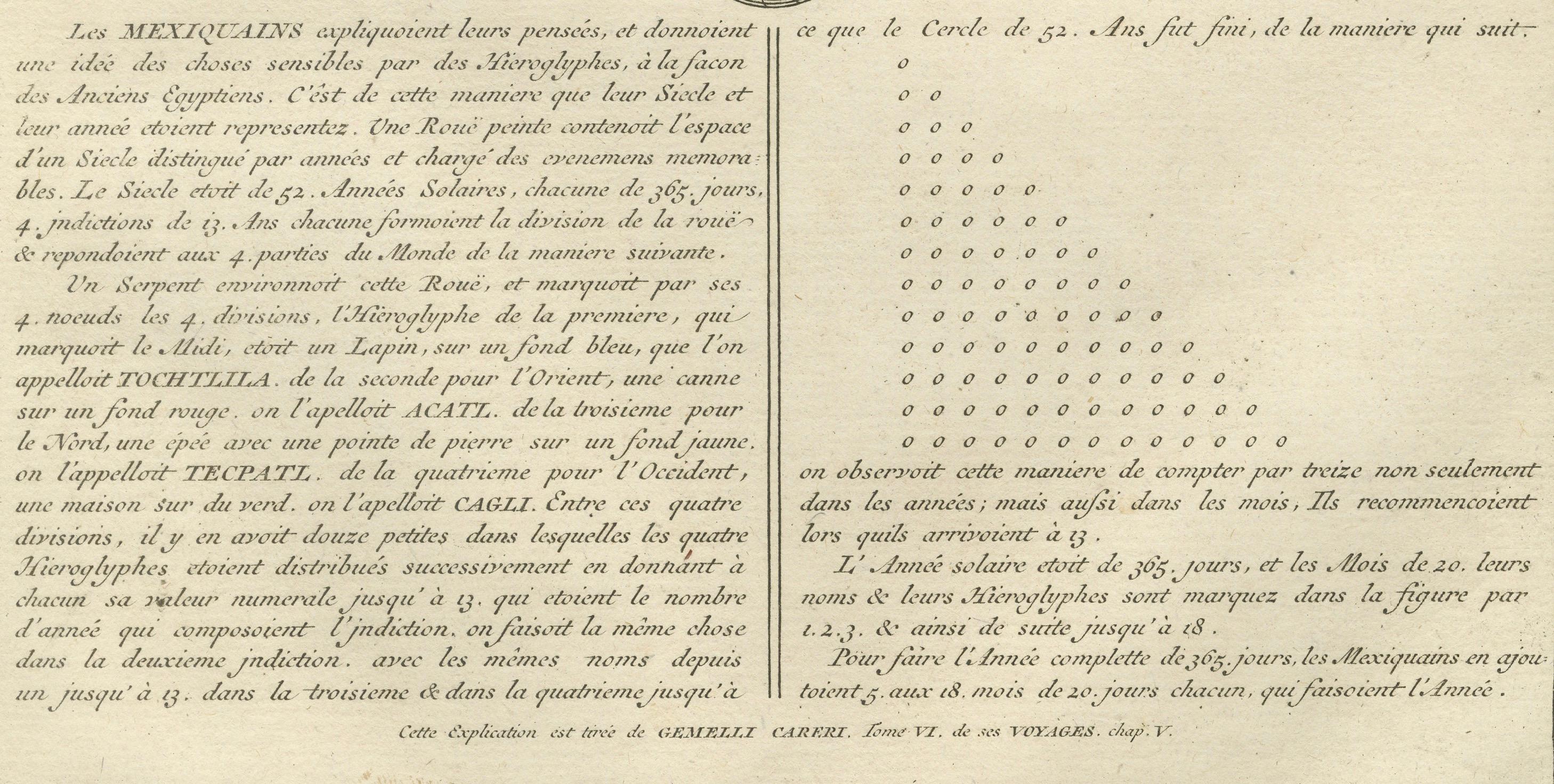
Picart collaborated on several major publications in the early 18th century, and one of his best-known works was "Cérémonies et coutumes religieuses de tous les peuples du monde" (Religious Ceremonies and Customs of All the Peoples of the World), published between 1723 and 1743. This work included illustrations of Mexican (Aztec) artifacts and ceremonies,.
Given Picart’s known involvement in illustrating cultural and religious scenes, and his distinctive engraving style, it's plausible that this engraving could have been produced by him. The French text below the image, as well as the detailed and fine craftsmanship, align well with Picart’s typical works. Additionally, many prints related to Aztec cosmology, such as the calendar system, were reprinted and circulated in Europe during the 18th century, making it possible that Picart’s engravings were part of such collections.
While Gemelli Careri might have provided the descriptions and source material, Bernard Picart was the engraver who brought these descriptions to life in visual form.
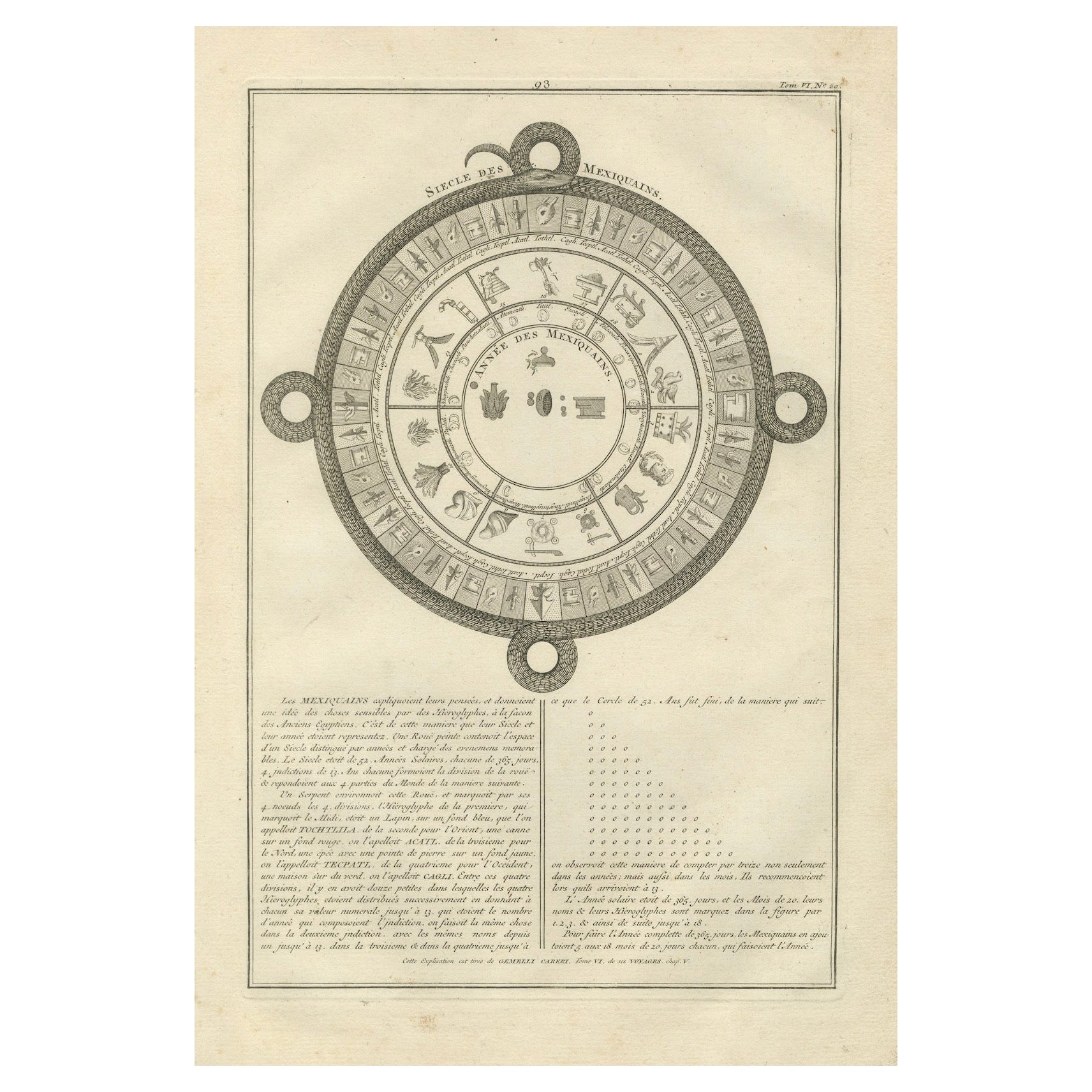
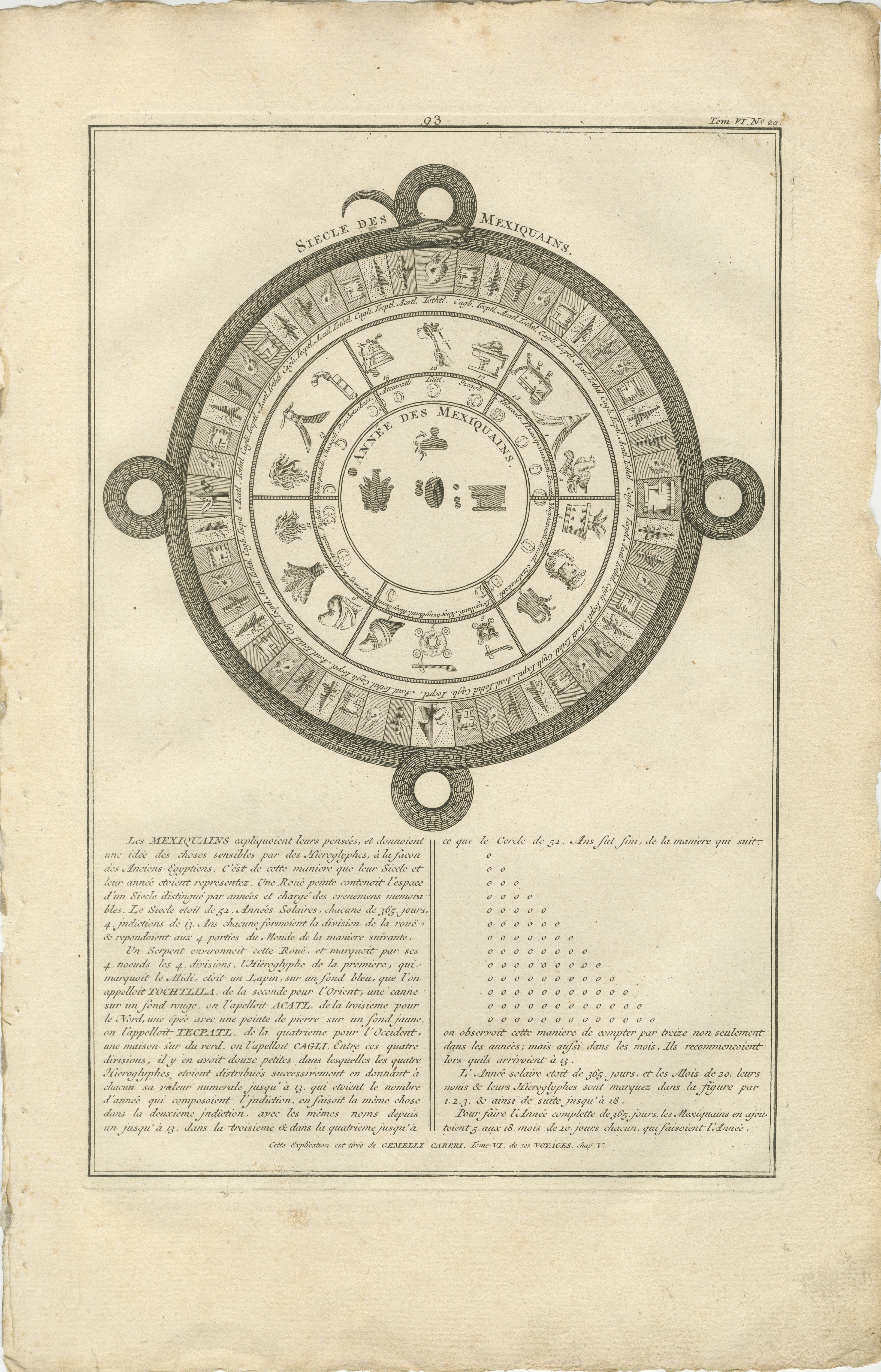
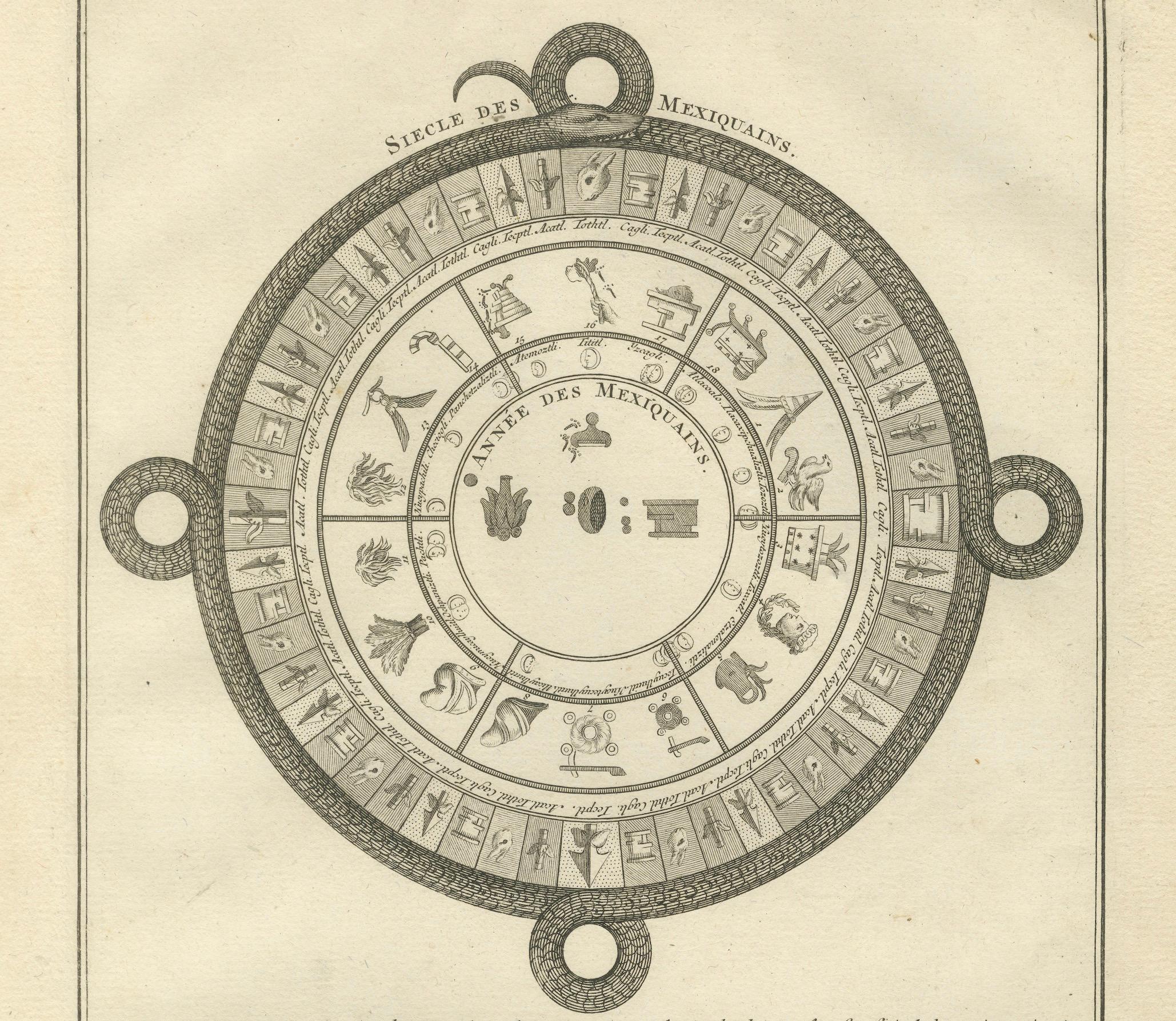
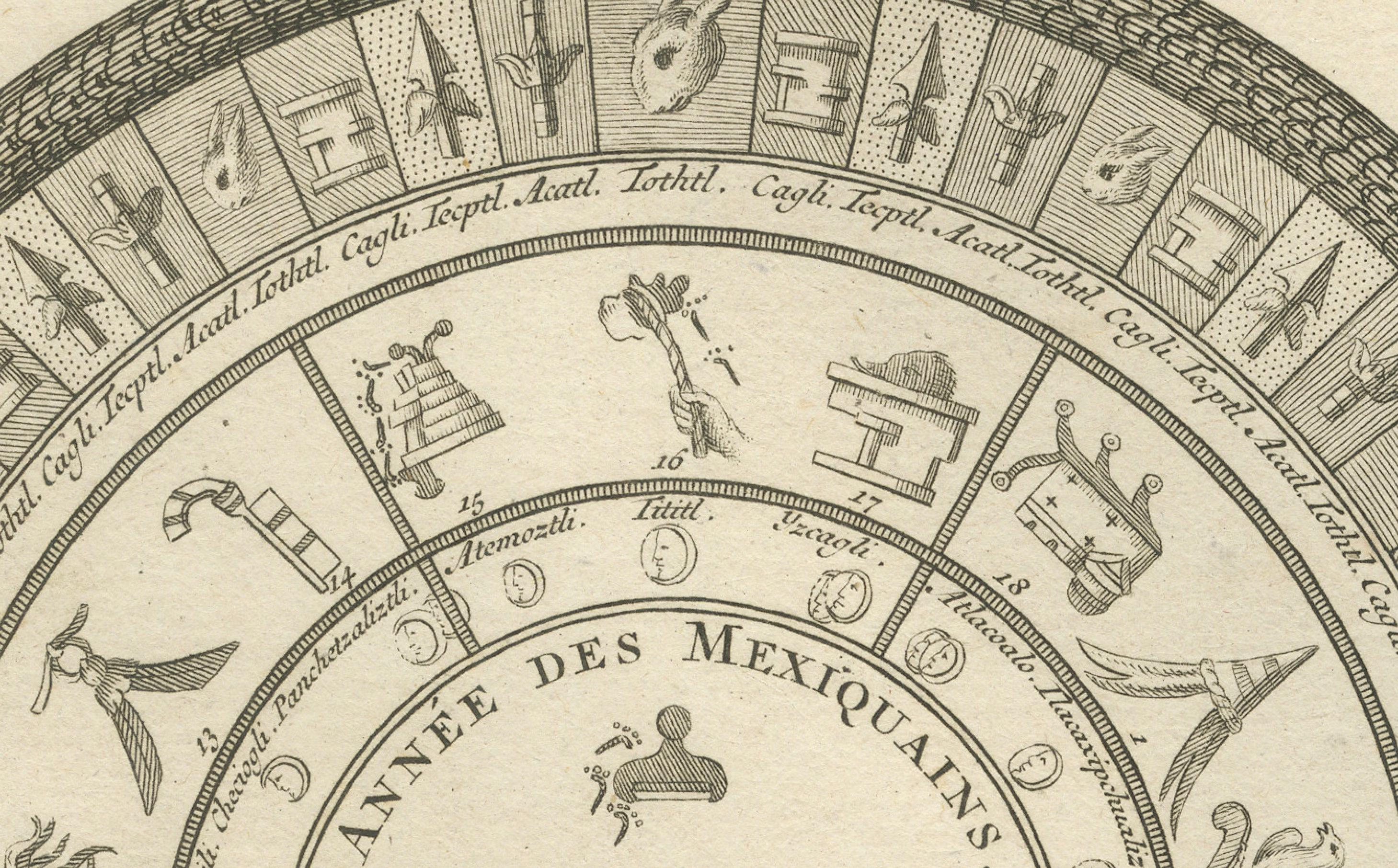
This print appears to depict an ancient Mexican (Mesoamerican) calendar, showcasing the Mexica (Aztec) system of timekeeping and cosmology. The circular design features symbols, likely representing the days, months, and possibly years used in their calendar system. The outer ring contains a sequence of glyphs, each symbolizing a specific day or concept, and they are arranged within larger geometric patterns that guide the viewer's attention toward the inner circle, which may represent *a year or solar cycle.
At the top, we see the text "Siècle des Mexiquains" (Century of the Mexicans), suggesting the focus is on an important timeframe in their cyclical view of time. The inner part of the design labeled "Année des Mexiquains" (Year of the Mexicans) likely refers to how the Mexica calculated and recorded their years, in close relationship with the days and solar cycles. The central symbols, which are surrounded by other smaller rings, may represent the gods, natural forces, or specific religious or ceremonial items tied to their cosmology.
Below the circular depiction, a block of text provides an explanation in French, describing how the Mexicans (Aztecs) explained their ideas, likely through hieroglyphs or pictograms. It discusses how they divided time into centuries and years, with particular attention to symbolic elements used to depict and measure the passage of time. The reference to ancient Egyptian hieroglyphs indicates a European attempt to relate the unfamiliar Aztec system to something more commonly known in Western scholarship at the time.
The style of the engraving and its French caption suggest that it was likely created by European scholars or explorers fascinated by the Aztec (Mexica) civilization, possibly in the late 18th or early 19th century when European interest in Mesoamerican cultures was growing due to colonial encounters and rediscoveries of indigenous knowledge systems.
Here is the translation of the French text from the image:
---
The Mexicans explained their thoughts, and gave an idea of sensible things through hieroglyphs, similar to the manner of the Ancient Egyptians. This is how their Century and their year were represented. A Wheel contained the span of a Century, distinguished by years and filled with memorable events. The Century was of 52 Solar Years, each of 365 days, 4 indications of 13. Each division of the wheel corresponded to the 4 parts of the World in the following manner.
A Serpent surrounded this Wheel, marked by its 4 nodes and 4 divisions. The hieroglyph of the first one, which marked the South, was a Rabbit, on a blue background, called Tochtli. For the East, the second was marked by a reed on a red background, called Acatl. For the North, the third was a knife with a stone point on a yellow background, called Tecpatl. The fourth one, for the West, was a house on a green background, called Calli, Between these four divisions, there were twelve smaller ones, in which the four hieroglyphs were successively distributed, giving each a numerical value up to 13.
Each one represented the number of years composing an indication, and the same thing was observed in the second indication, with the same names from 1 to 13 in the third and fourth.
The Solar Year was 365 days, and the Months of 20. Their names and their hieroglyphs are marked in the figure by 1, 2, 3, and so on up to 18. To complete the 365-day Year, the Mexicans added 5 days to the 18 months of 20 days each, which made up the Year.
---
This text explains the Mexican (Aztec) calendar system and how they represented their centuries and years using hieroglyphs, as well as the symbolic animals and objects tied to...