Architectural Ornament of the Louvre – Cornices and Balustrade by Baltard, 1799
€ 350
Original antique · The actual sheet photographed · Certificate of authenticity on request · Sold unframed · Worldwide shipping from € 15 (rates)
Date
1799
Mapmaker / artist
Louis-Pierre Baltard, Paris, late 18th century
Technique
Copperplate engraving
Sheet size
58 × 43 cm (22.8 × 16.9 in)
Condition
Fair
Reference
BG-06533
What the condition grades mean
Excellent
Bright and clean, with no faults worth mentioning.
Very good
Only light signs of age, such as faint toning.
Good
Normal signs of age for a sheet of this period: toning, some foxing, small marks or neat old repairs.
Fair
Clear faults such as staining, tears or repairs, priced to match.
Every fault we see is written in the condition note, and the whole sheet is shown uncropped in the photos.
Condition
Strong impression with crisp lines and deep platemark. Minor foxing and toning mainly in the margins. Wide original sheet with deckled edges, well preserved for its age.
About this sheet
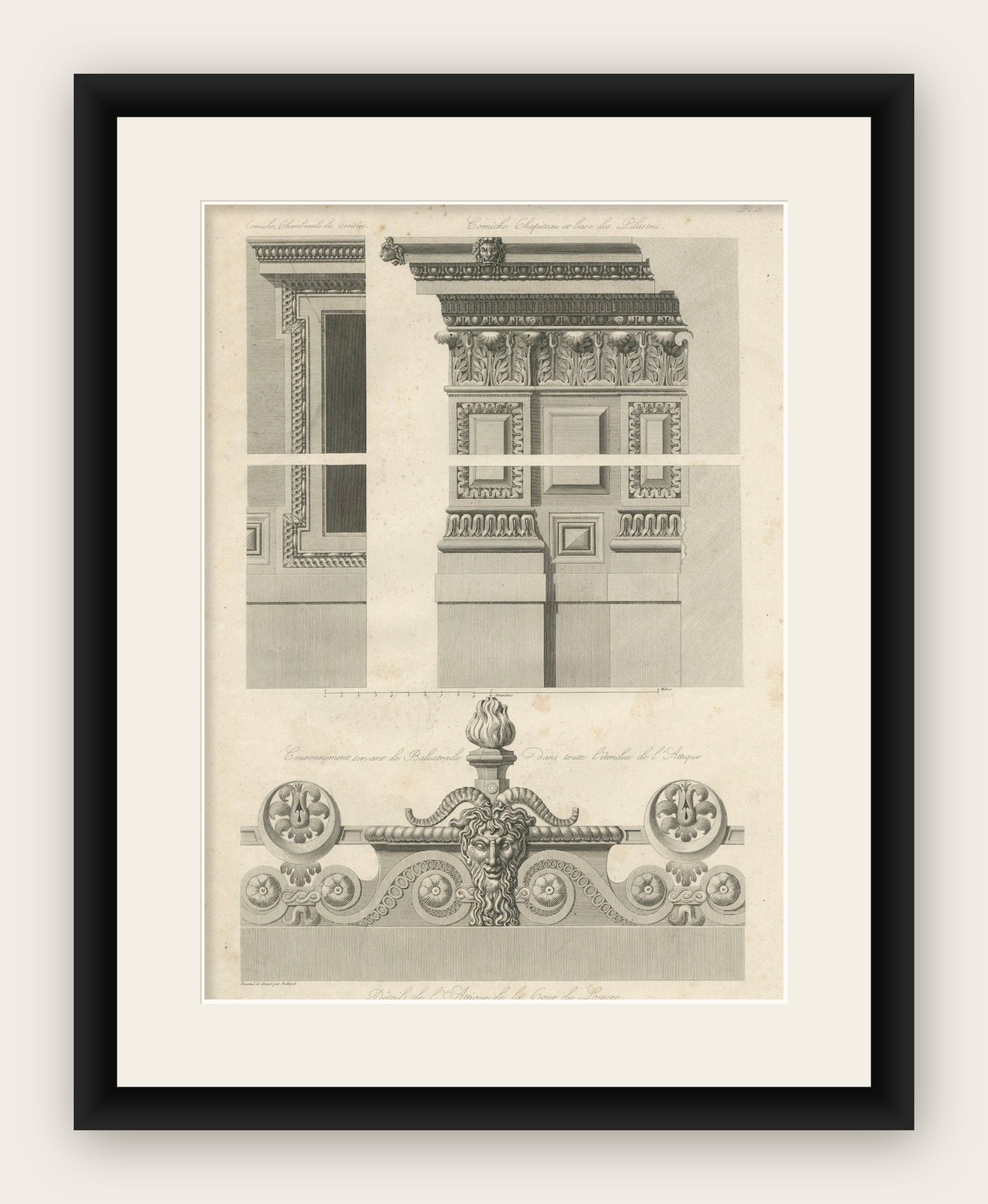
Architectural Ornament of the Louvre – Cornices and Balustrade by Louis-Pierre Baltard An exquisite architectural engraving by Louis-Pierre Baltard (1764–1846) depicting detailed cornices, pilaster bases, and balustrade ornaments from the Louvre Palace in Paris. This work, executed with Baltard’s characteristic precision and balance, showcases the ornamental mastery of French classical architecture during the reigns of François I and Louis XIV.
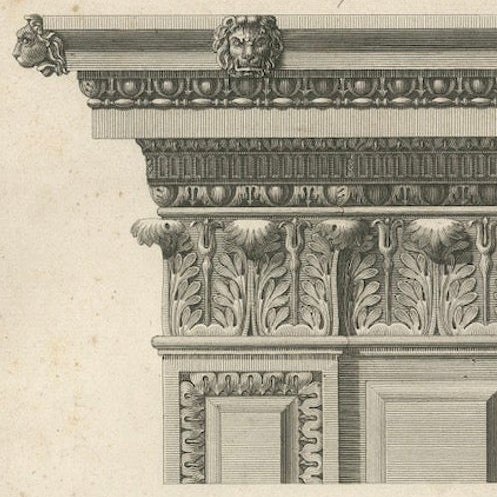
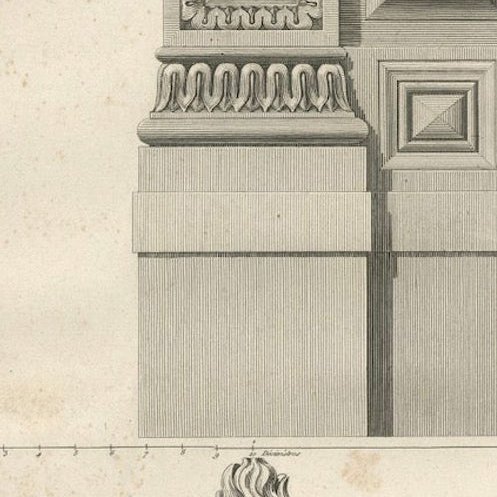
The plate, titled Détails de l’Attique de la Cour du Louvre, presents a highly refined study of decorative elements found in the Louvre’s courtyards. The upper section illustrates the architectural structure of cornices, capitals, and window framings — each rendered with intricate attention to the interplay of light and shadow, emphasizing their sculptural depth. Below, a balustrade frieze features an elaborate mascaron with curling ram’s horns and a flaming urn, surrounded by symmetrical scrollwork, rosettes, and acanthus foliage.
Baltard’s engravings were not merely decorative studies but educational resources for architects and artists. They reflect the disciplined precision and grandeur of the French academic style, transmitting the ideals of proportion, ornament, and harmony to future generations. As an architect and professor at the École des Beaux-Arts, Baltard’s work bridged the study of antiquity with the evolving neoclassical and imperial aesthetics of his time.
Condition report: Strong impression with crisp lines and deep platemark. Minor foxing and toning mainly in the margins. Wide original sheet with deckled edges, well preserved for its age.
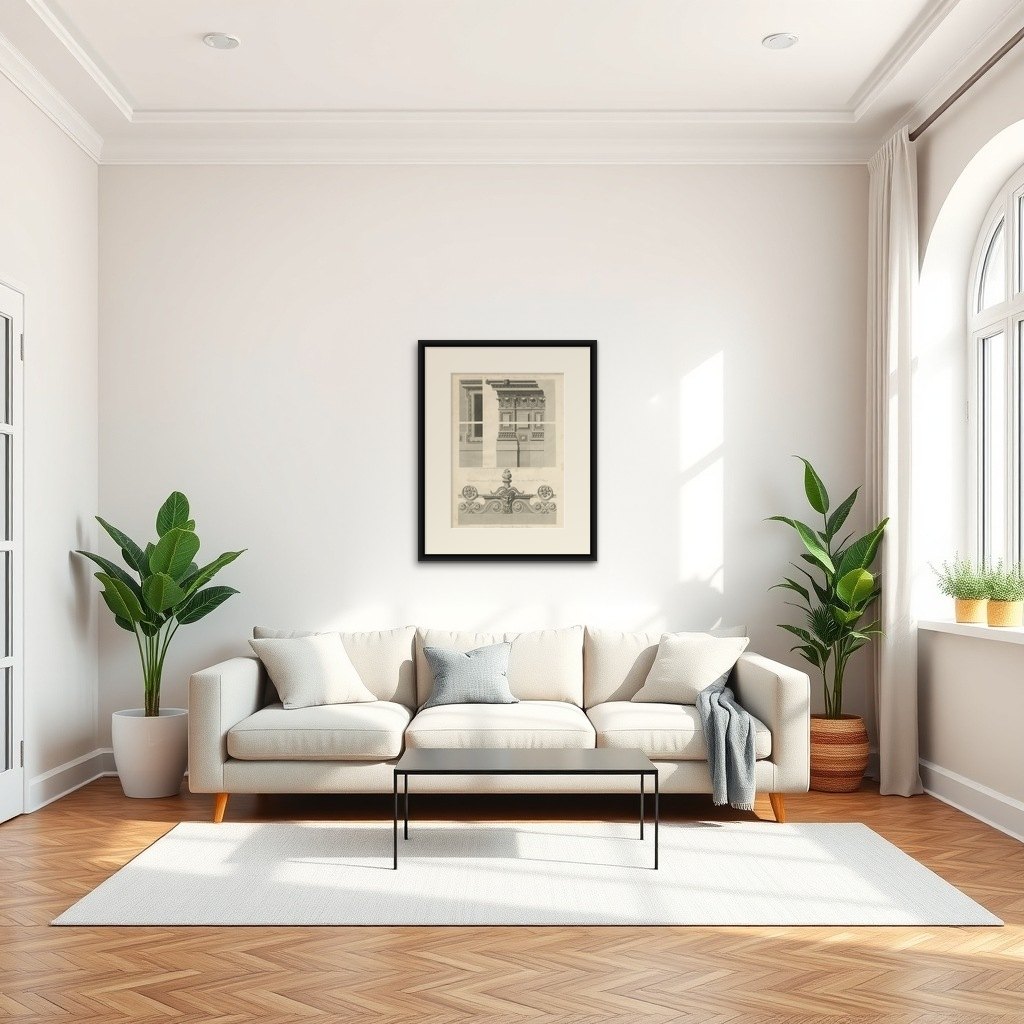
Framing tips: Ideal for display in a classic or architectural interior. Use a light cream mount and a simple gold or black frame to accentuate the engraving’s symmetry and fine linear detail.