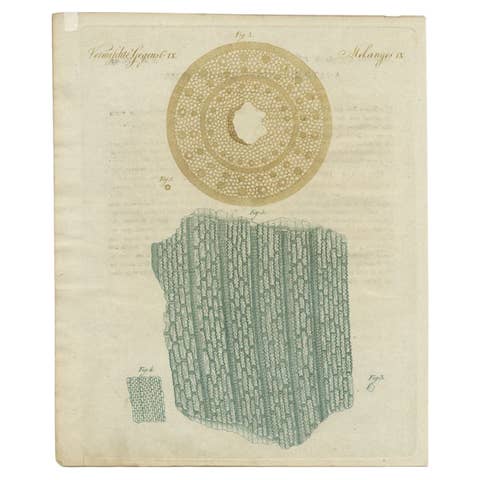
Antique Engraving of Phellinus Igniarius & Laricifomes Officinalis Fungi, 1795
€ 230
Original antique · The actual sheet photographed · Certificate of authenticity on request · Sold unframed · Worldwide shipping from € 15 (rates)
Date
1795
Sheet size
24 × 19.3 cm (9.4 × 7.6 in)
Condition
Fair
Reference
BG-12902-31
What the condition grades mean
Excellent
Bright and clean, with no faults worth mentioning.
Very good
Only light signs of age, such as faint toning.
Good
Normal signs of age for a sheet of this period: toning, some foxing, small marks or neat old repairs.
Fair
Clear faults such as staining, tears or repairs, priced to match.
Every fault we see is written in the condition note, and the whole sheet is shown uncropped in the photos.
Condition
Wear consistent with age and use. General age-related toning, shows wear and soiling. Few tiny holes, most in margins. Blank verso. Please review the images for further condition details.
About this sheet
Original antique print of Phellinus igniarius and Laricifomes officinalis. Phellinus igniarius (syn. Phellinus trivialis) is a fungus of the family Hymenochaetaceae. Like other members of the genus of Phellinus it lives by saprotrophic nutrition, in which the lignin and cellulose of a host tree is degraded and is a cause of white rot. Common names are willow bracket and fire sponge. Laricifomes officinalis, also known as agarikon, eburiko, or the quinine conk, is a wood-decay fungus that causes brown heart rot on conifers native to Europe, Asia, and North America, as well as Morocco.
Originates from Bertuch's 'Bilderbuch für Kinder'. In 1790 Friedrich Justin Bertuch started his biggest book-project ever. Issued in 12 volumes it containes short articles written at a child's level of understanding to 'spread the knowledge of the epochs out before children'. Bertuch assembled the books according to his educational philosophy: the emphasis should be on illustrations that were 'beautifully and correctly drawn', 'selected and engraved from the best originals', in order to give children accurate information, while the text should be kept concise. He also felt that it is possible to use even strange and rare phenomena to capture the child's attention and imagination. Therefore, the encyclopedia was illustrated throughout with vivid and detailed copperplate engravings, that were scientifically accurate and sophisticated in their composition and execution. It was originally published in German and French, the 'Bilderbuch zum Nutzen und Vergnügen der Jugend' besides in Latin and Hungarian. Friedrichs son Carl Bertuch (* 1777) supported his fathers work and published in co-operation with him some fragments of the 'Picture Book for Children'. The whole project secluded in 12 volumes with 1185 pages showing over 6000 illustrations and it became the first encyclopedic book about nature and earth worldwide.