Imperial Menagerie: The Stuffed Museum - Magnan, Walewski, and Billault, 1870
€ 140
Original antique · The actual sheet photographed · Certificate of authenticity on request · Sold unframed · Worldwide shipping from € 15 (rates)
Date
1870
Sheet size
24.1 × 30.5 cm (9.5 × 12.0 in)
Reference
BG-13805-29
What the condition grades mean
Excellent
Bright and clean, with no faults worth mentioning.
Very good
Only light signs of age, such as faint toning.
Good
Normal signs of age for a sheet of this period: toning, some foxing, small marks or neat old repairs.
Fair
Clear faults such as staining, tears or repairs, priced to match.
Every fault we see is written in the condition note, and the whole sheet is shown uncropped in the photos.
Condition
Good, given age. General age-related toning and/or occasional minor defects from handling. Please study scan carefully.
About this sheet
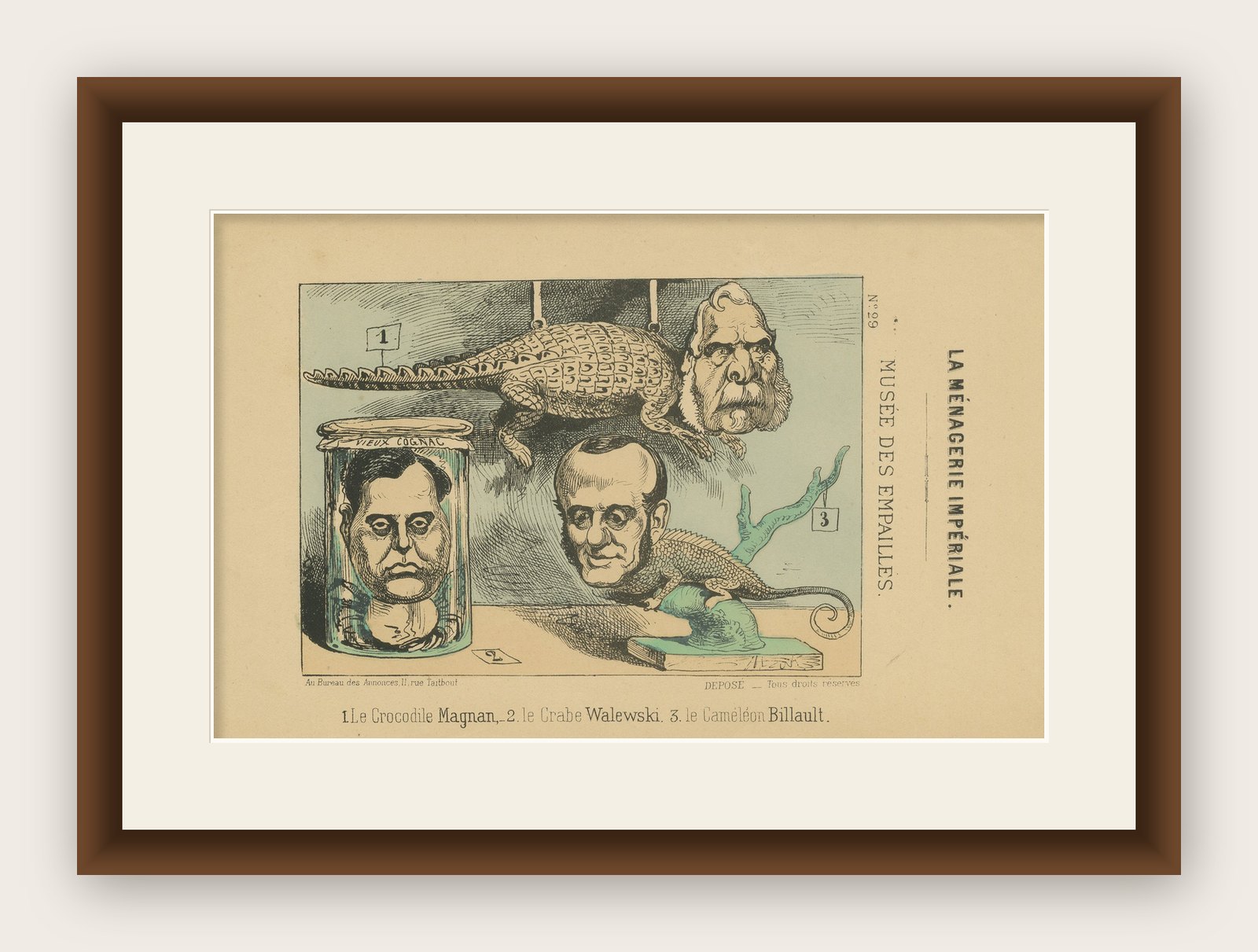
The print titled "La Ménagerie Impériale - Musée des Empaillés" is a satirical caricature featuring three figures, each depicted as a different animal. It is part of a series composed of 31 hand-colored lithograph plates by the artist Hadol, published in Paris by Au Bureau des Annonces around 1870. The album, "LA MENAGERIE IMPÉRIALE," portrays various figures as animals, metaphorically representing those who have "devoured" France over the past 20 years, including during the Franco-Prussian War (1870-1871).
In this specific print, three individuals are illustrated:
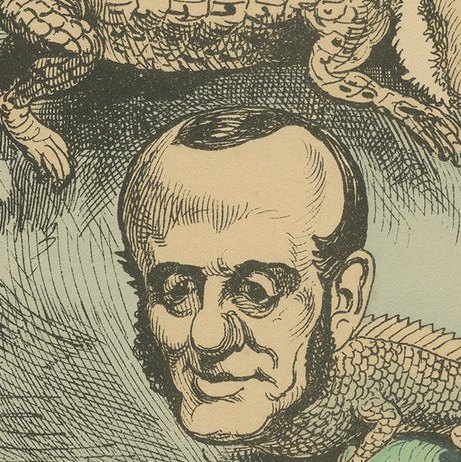
1. "Le Crocodile Magnan" (The Crocodile Magnan) – A figure with a human head attached to a crocodile's body. 2. "Le Crabe Walewski" (The Crab Walewski) – A figure's head preserved in a jar labeled "Vieux Cognac." 3. "Le Caméléon Billault" (The Chameleon Billault) – A figure with a human head and a chameleon's body perched on a branch.
The print uses humor and exaggeration to depict these figures in a derisive manner, critiquing their roles and actions during a turbulent period in France’s history. The text at the top reads "LA MENAGERIE IMPERIALE" and "MUSÉE DES EMPAILLÉS" (Museum of the Stuffed Animals), with each figure labeled accordingly. The format is small quarto (Sm. 4to), and the edges are slightly worn and browned, typical for works of this age.