Original antique · The actual sheet photographed · Certificate of authenticity on request · Sold unframed · Worldwide shipping from € 15 (rates)
Date
1800
Mapmaker / artist
C. van Baak, Amsterdam, circa 1800
Technique
Copper engraving
Sheet size
29 × 22 cm (11.4 × 8.7 in)
Condition
Good
Reference
BG-11645-1-1
What the condition grades mean
Excellent
Bright and clean, with no faults worth mentioning.
Very good
Only light signs of age, such as faint toning.
Good
Normal signs of age for a sheet of this period: toning, some foxing, small marks or neat old repairs.
Fair
Clear faults such as staining, tears or repairs, priced to match.
Every fault we see is written in the condition note, and the whole sheet is shown uncropped in the photos.
Condition
Overall with crisp impression. Light age-toning and faint fold lines from original binding or storage. No tears or repairs. Margins intact. Strong contrast on clean laid paper.
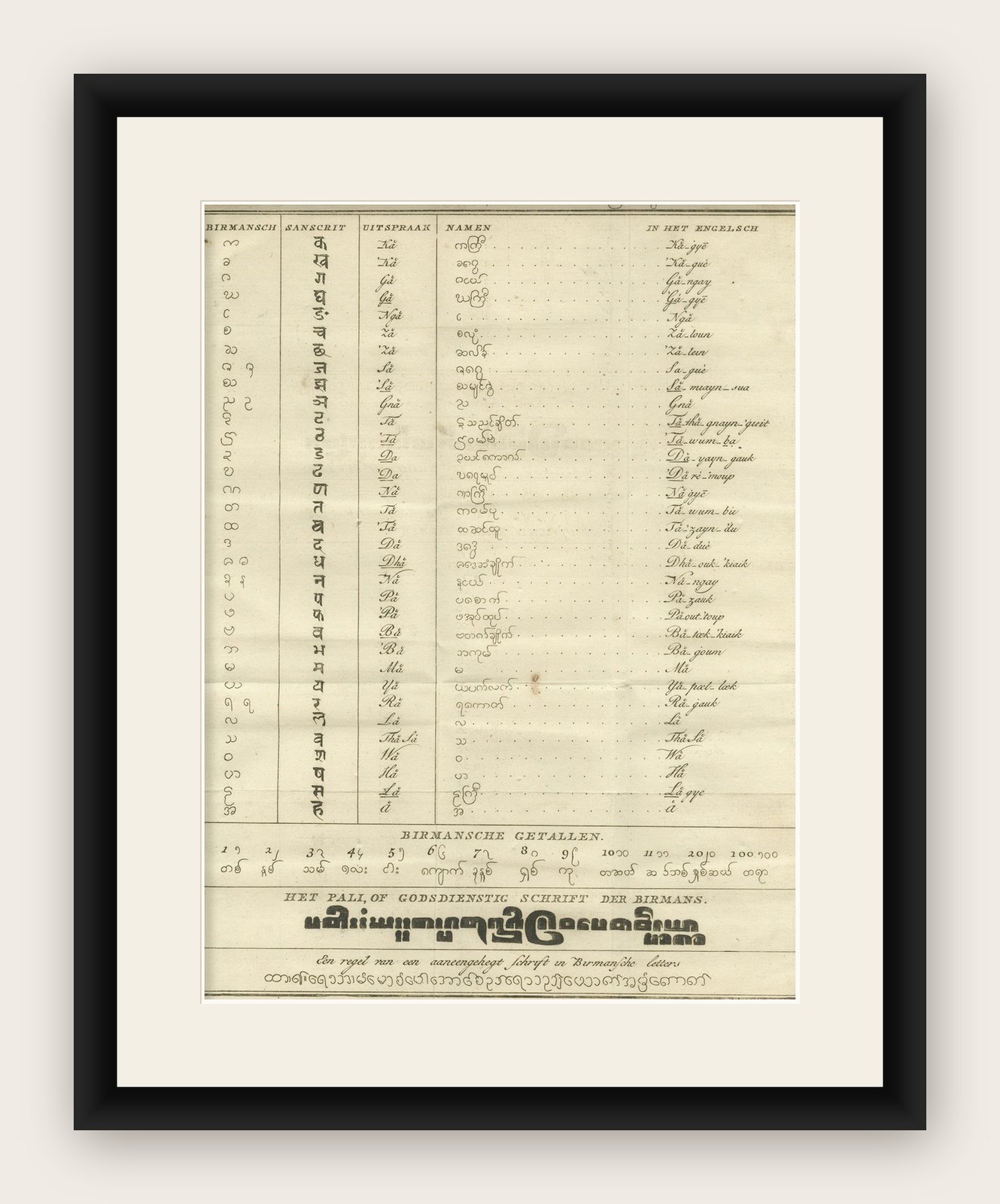
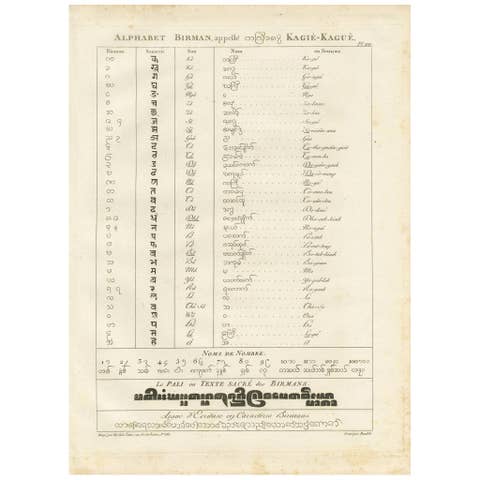
This elegant and rare antique linguistic chart presents the Burmese alphabet under the title 'Het Birmansche Alphabet, genaamd Kagye-Kagué', printed in Dutch around 1800. Closely related to the French version published in the account of Michael Symes’ 1795 embassy to the Burmese Empire, this edition serves as a fascinating example of early European efforts to transcribe and interpret Southeast Asian languages during the colonial and missionary era.
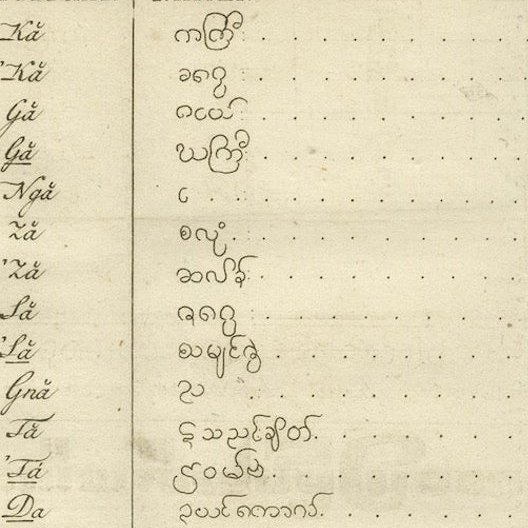
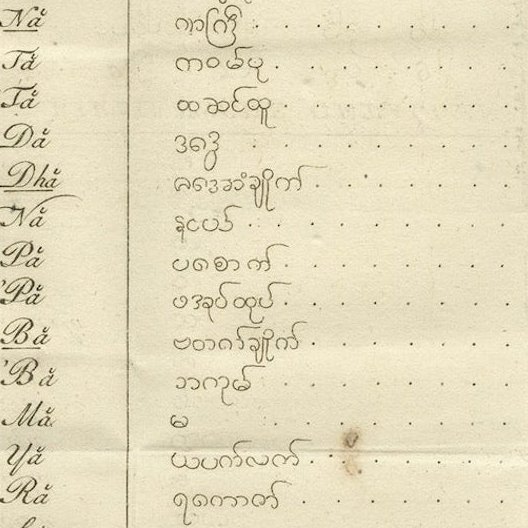
The chart offers a meticulous comparative study of the Burmese script (also used for liturgical Pali), cross-referenced with Sanskrit equivalents and organized for Dutch readers. It includes:
– Birmansch (Burmese characters) – Sanscrit (Sanskrit/Devanagari letters) – Uitspraak (Pronunciation) in Romanized Dutch – Namen (Names) in Burmese script – In het Engelsch (In English) providing phonetic English approximations
The bottom section, 'Birmansche Getallen', displays Burmese numerals from 1 to 100,000 in script and Romanized form, offering a practical reference for early linguists, merchants, or missionaries. Below that appears a phrase in 'Het Pali, of Godsdienst Schrift der Birmans' (The Pali or Religious Script of the Burmese), printed in an ornamental Burmese line of text, likely from a canonical or sacred source. A Dutch caption notes: “Een regel van een aaneengehegt schrift in Birmansche letter,” translating roughly to: “A line from a connected script in Burmese letters.”
This chart not only reveals the structure and elegance of the Burmese writing system but also reflects the Enlightenment-era European ambition to classify and understand non-Western languages and cultures systematically. It holds strong appeal for collectors of Southeast Asian history, missionary linguistics, typographic history, and early Orientalist studies.
Framing tips: This rare chart would be beautifully displayed in a slim black or gold-leaf frame, with an off-white or ivory mount. Floating the print to show its full margin and plate line enhances its antique character and scholarly appeal.