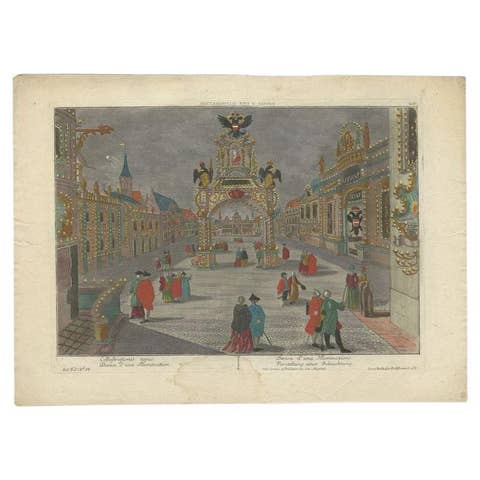
View of Delft Canal to The Hague – Hand-Colored Optical Print, Paris, c.1760
€ 320
Original antique · The actual sheet photographed · Certificate of authenticity on request · Sold unframed · Worldwide shipping from € 15 (rates)
Date
1760
Mapmaker / artist
Published by Basset, Paris, c.1760
Technique
Copperplate engraving with original hand-coloring
Sheet size
31 × 48 cm (12.2 × 18.9 in)
Condition
Fair
Reference
BG-13614-6
What the condition grades mean
Excellent
Bright and clean, with no faults worth mentioning.
Very good
Only light signs of age, such as faint toning.
Good
Normal signs of age for a sheet of this period: toning, some foxing, small marks or neat old repairs.
Fair
Clear faults such as staining, tears or repairs, priced to match.
Every fault we see is written in the condition note, and the whole sheet is shown uncropped in the photos.
Condition
To good condition considering age. General toning, a few soft creases and small edge tears, mostly in margins. Color is bright and original. Some wear consistent with handling, especially around the edges. Plate mark present.
About this sheet
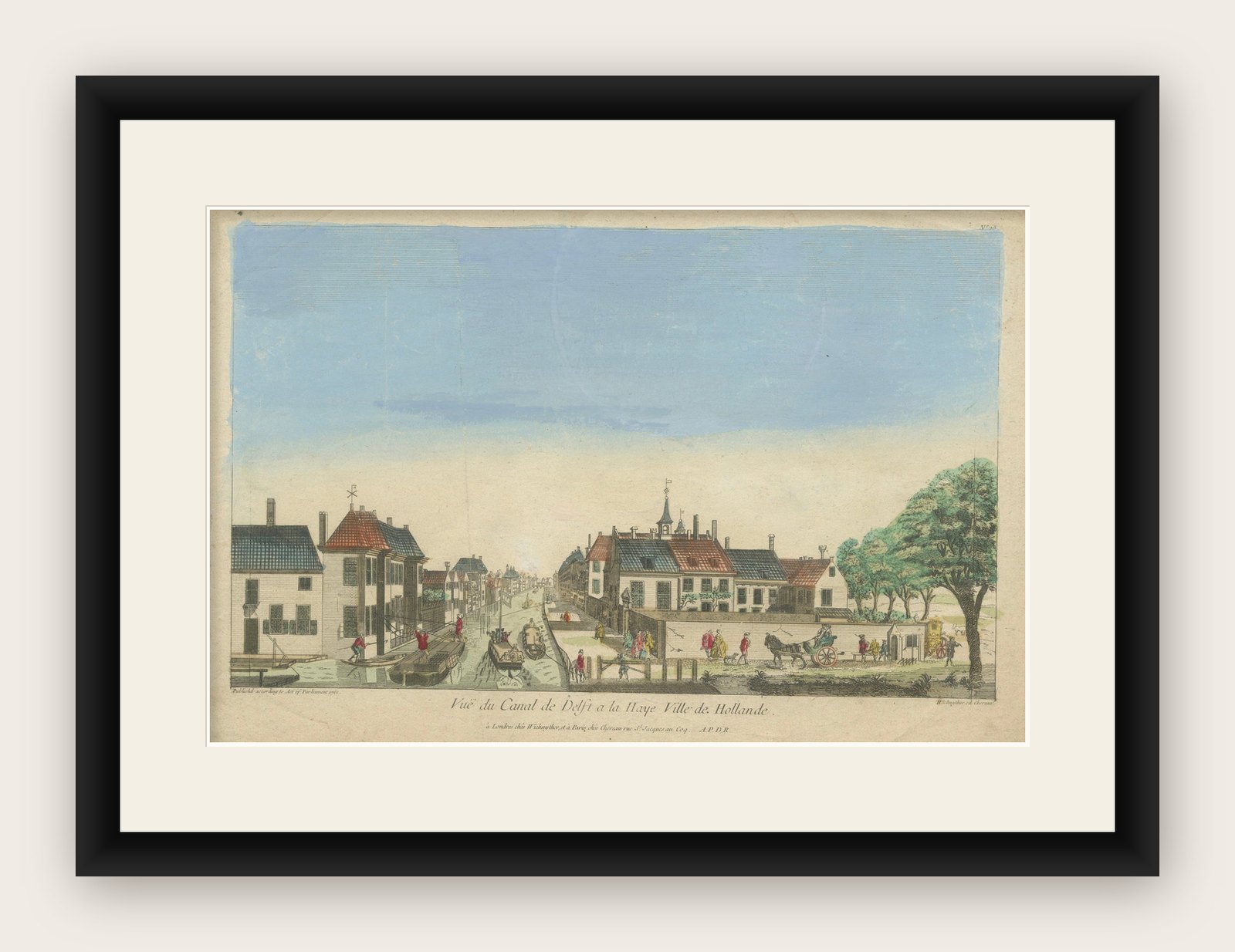
View of Delft Canal to The Hague – Hand-Colored Optical Print, Paris, c.1760
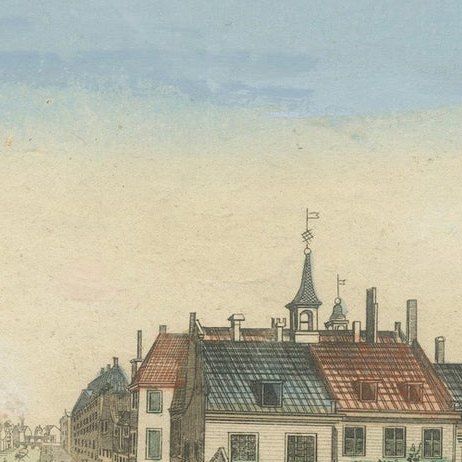
This charming hand-colored optical print titled “Vue du Canal de Delft à la Haye Ville de Hollande” depicts a lively 18th-century Dutch canal scene connecting Delft and The Hague. The view is full of daily activity: canal boats gliding through the water, figures walking along the quay, horse-drawn carts, and groups of pedestrians in period dress animating the streets and bridges. To the right, trees line the road, adding a pastoral contrast to the urban architecture, while to the left, classic Dutch gabled houses are reflected in the calm canal water.
The print was made as a vue d’optique, a perspective view designed for use in an optical viewing device called a zograscope. These prints were popular in the mid-18th century for their dramatic perspective and immersive effect when viewed through a lens. The exaggerated vanishing point down the center of the canal enhances the three-dimensional feel, drawing the eye deep into the scene.
Published in Paris by the firm of Basset, a well-known producer of vues d’optique, this print features the typical reverse title at the top (now cut or trimmed away), and a French caption below. The inscription notes that it was available from Basset’s shop on Rue St. Jacques in Paris.
These optical prints served both as educational tools and as decorative art, offering armchair travelers across Europe visual access to famous cities and landmarks.
Framing tips: This piece pairs well with a thin black or dark walnut frame, and a soft cream or sky-blue mat that complements the wash of color in the sky and canal.